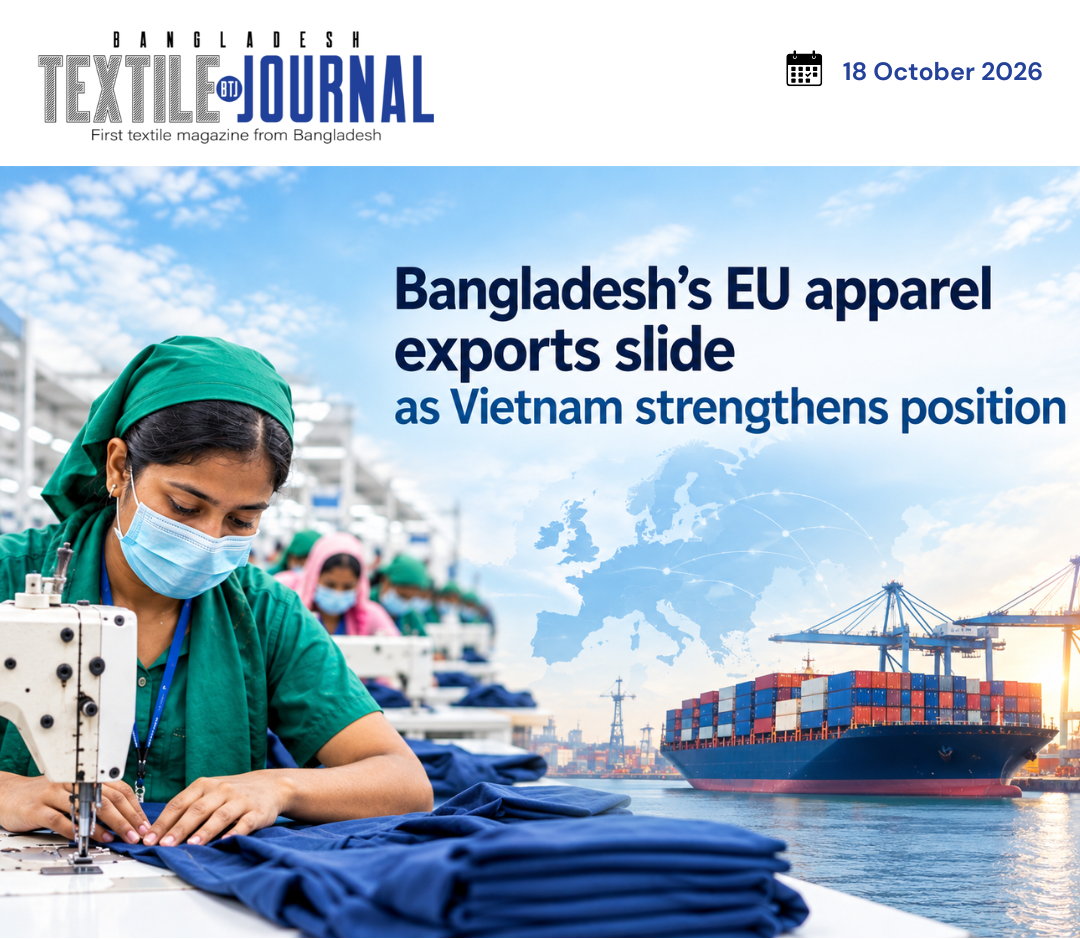
Bangladesh’s EU apparel exports slide 11.7% as Vietnam strengthens position
Bangladesh’s readymade garment exports to the European Union (EU) declined sharply in the first eight months of 2026, falling faster than the bloc’s overall apparel imports as Vietnam expanded its market share and China retained its position as the leading supplier.
Bangladesh shipped apparel worth €11.92 billion to the EU during January–August 2026, down 11.7% from the same period a year earlier, according to Eurostat data released on October 16.
The decline exceeded the 3.83% contraction in the EU’s total apparel imports, which fell to €60.28 billion from €62.69 billion in the corresponding period of 2025.
Industry insiders attributed the slowdown to geopolitical uncertainty, the Middle East crisis and weaker consumer spending in Europe. They also cited Bangladesh’s logistical disadvantages, domestic constraints and limited capacity to respond quickly to orders for manmade fibre (MMF)-based garments.
Vietnam gains ground as Bangladesh loses momentum
Vietnam strengthened its position in the European market, with apparel exports rising 4.46% year on year to €2.99 billion in January–August 2026, up from €2.87 billion.
China remained the EU’s largest apparel supplier, although its shipments declined 2.38% to €19.25 billion from €19.71 billion a year earlier.
Inamul Haq Khan, senior vice-president of the Bangladesh Garment Manufacturers and Exporters Association (BGMEA), said China and India had encountered difficulties in the US market due to tariffs in recent months and were aggressively offering lower prices to expand their presence in Europe.
The resulting price competition has added pressure on Bangladesh’s apparel exporters as European demand remains subdued.
Weak consumer demand weighs on European market
Mijanur Rahman, managing director of Fabrica Knit Composite Ltd, said demand across the EU had weakened amid the Middle East crisis, with consumers reducing spending and prioritising essential purchases.
The decline in overall market demand has made competition among apparel-producing countries more intense, particularly for suppliers seeking to maintain orders and market share.
However, Bangladesh’s steeper export contraction compared with the overall EU market indicates that factors beyond weaker consumer demand may also be affecting its competitiveness.
MMF apparel and faster delivery give Vietnam an edge
Fazlee Shamim Ehsan, executive president of the Bangladesh Knitwear Manufacturers and Exporters Association (BKMEA), said Vietnam had a competitive advantage in MMF-based apparel because of its polyester industry and access to raw materials from China.
He explained that orders for manmade fibre garments often involve smaller quantities and require faster delivery, making supply-chain flexibility particularly important.
Bangladesh cannot accommodate all such orders because it relies on imported raw materials, including supplies from China, he said.
Vietnam also enjoys a logistical advantage of around 15 to 20 days over Bangladesh, according to Ehsan. The shorter lead time allows Vietnamese manufacturers to respond more quickly to buyers’ requirements.
The gap highlights the importance of developing Bangladesh’s MMF supply chain, improving access to raw materials and strengthening production flexibility to meet changing international sourcing demands.
EU-Vietnam trade deal intensifies competition
The EU-Vietnam Free Trade Agreement (EVFTA) is another factor shaping competition in the European apparel market.
Under the agreement, tariffs on Vietnamese exports to the EU are being progressively reduced, with full elimination scheduled for 2027.
The preferential trade arrangement is expected to strengthen Vietnam’s competitive position as European buyers evaluate sourcing costs, delivery times and supply-chain reliability.
For Bangladesh, maintaining its position in the EU market will require greater product diversification, stronger MMF capabilities and improvements in logistics and delivery performance.
Major apparel suppliers also record declines
Several other major apparel-exporting countries recorded lower shipments to the EU during January–August 2026, according to Eurostat.
- Turkey: Exports fell 11.0% to €5.10 billion.
- India: Shipments declined 10.8% to €3.07 billion.
- Cambodia: Exports dropped 4.51% to €2.81 billion.
- Pakistan: Shipments decreased 9.63% to €2.29 billion.
- Indonesia: Exports fell 11.0% to €608.88 million.
Despite the broader downturn among several suppliers, Vietnam’s export growth sets it apart from competitors facing weaker European demand.
Bangladesh’s immediate challenge is to regain momentum in its largest apparel export markets by improving cost competitiveness, expanding manmade fibre production, reducing lead times and responding more effectively to buyers’ changing requirements. The latest figures underline the need for strategic investment and supply-chain upgrades as competition for European apparel orders intensifies.