


Are you ready to future-proof your business? Discover how you can easily get started with the Digital Product Passport (DPP) and soon not only comply with legislation but enjoy the benefits of sustainable business.
What is a Digital Product Passport?
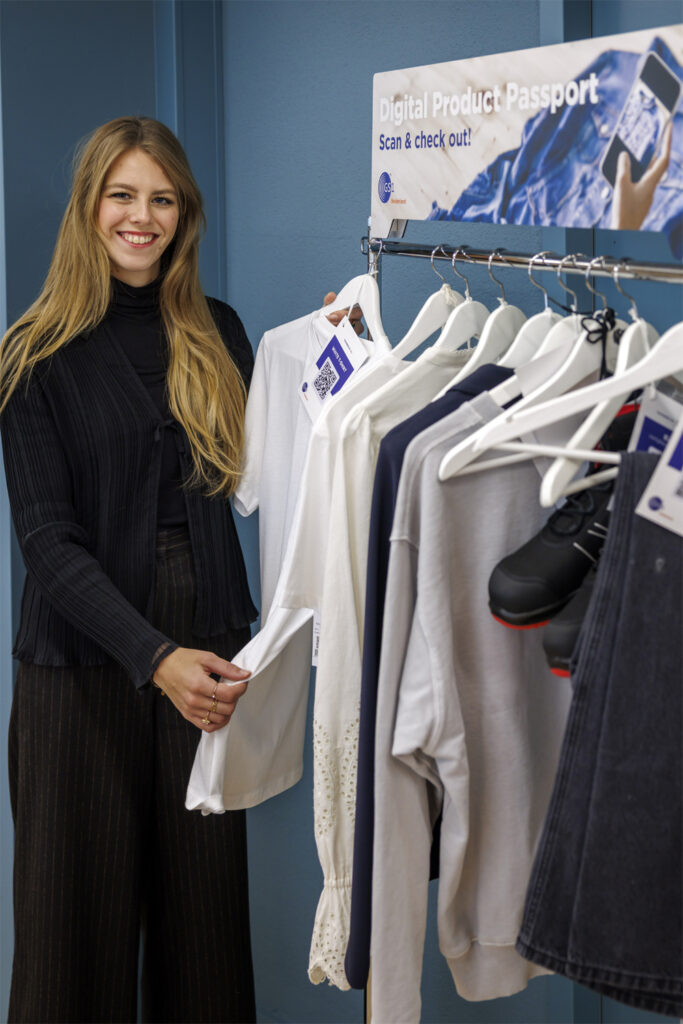
The DPP is an important building block of the Green Deal, the European Union’s plan to achieve a circular economy by 2050. A Digital Product Passport (DPP) provides detailed information on the sustainability of products, such as material composition, origin and recycling options. It helps users make more sustainable choices and contributes to the transition to a circular economy. Eventually, all products entering the European market must have a DPP, but textiles will be one of the first product categories to do so in 2027.
Legislation is not yet set in stone, but you can already start collecting data and creating DPPs to strengthen your market position. By starting now, you can prepare your business for future regulations and reap the benefits of sustainable operations.
The 5-step plan
Step 1: What do you want to achieve?
A DPP offers an opportunity to become future proof as a company and create value for both consumers and other stakeholders. It is a capstone for new (circular) business models. By promoting transparency and sustainability, you can stand out in the market and attract consumers who value eco-friendly products.
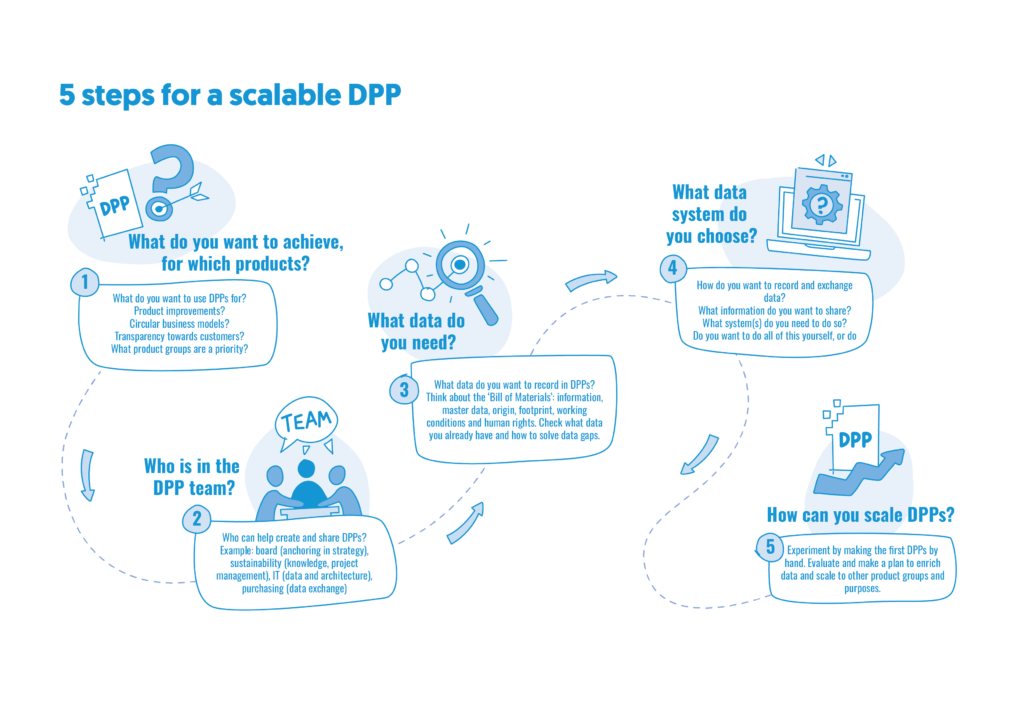
Step 2: Assemble abbbbbbbbbbbbbbbbbbb DPP team
The DPP will play an important role for companies, supply chain partners, consumers and recyclers. It is a tool that helps all actors to be able to make more sustainable (and therefore conscious) choices. Therefore, in addition to the sustainability and ICT manager, involve procurement and management. A well-assembled team can streamline the implementation of the DPP and ensure that all relevant data can be collected.
Step 3: Determine what data you need
Identify where you have the necessary data in your systems and where you may still need to get it from.
You can roughly divide the data that DPPs are expected to contain into four groups:
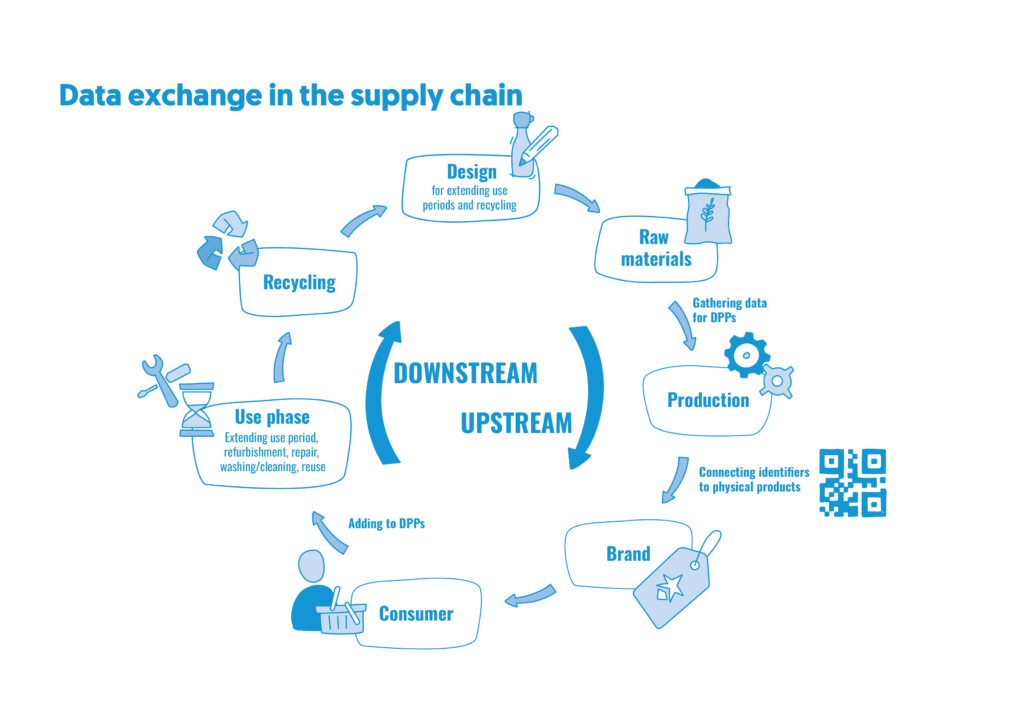
1. Information for optimising the use and life of the product. How to maintain, repair, refurbish, wash and clean a product.
2. Information on recycling the product. What do you do when the product is no longer usable? The DPP contains information on where the product can be deposited, how a product can possibly be assembled and eventually recycled (or upcycled).
3. Information about the materials in a product. The so-called Bill of Materials (BoM) of products goes beyond “plastics” or “metals”, for example. The specification of this BoM varies from company to company and from product to product. But for all products, it at least includes the origin of the product, composition percentages, whether materials have been recycled and the possible presence of harmful substances.
4. Social information and impact figures. It is not directly mandatory, but to help consumers make sustainable choices, you can also include social and environmental aspects in the production chain. Think about certifications, audits, impact figures, CO2 emissions and water and energy consumption.
Step 4: Choose a data system
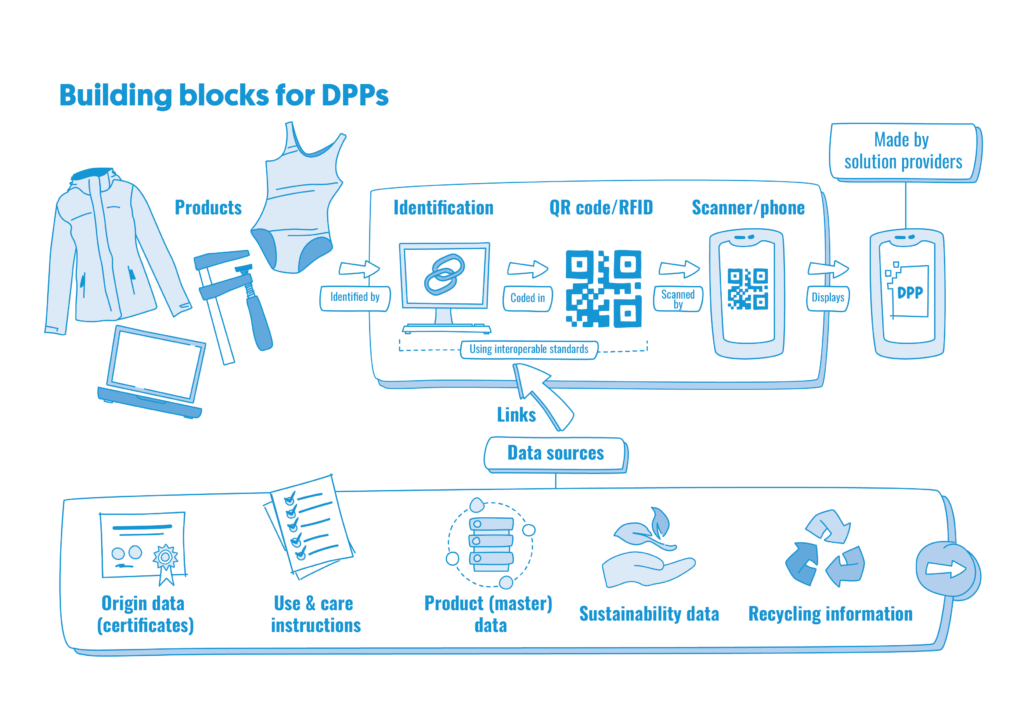
Make sure that all systems involved can easily capture and exchange information. And don’t reinvent the wheel. Use existing building blocks and the data infrastructure you already use, such as PIM, ERP and DPP systems and standardised product identification tools such as GS1 article codes (GTINs) and QR Codes powered by GS1 with Digital Link. These systems help collect and share product information efficiently.
Step 5: Use and scale up the DPP
Start small with a product, evaluate and learn and scale up. Use real-life examples to see what DPP implementation can look like in practice. By scaling up the DPP, you can maximise its benefits and position your company as a leader in sustainability.
How did the 5-step plan come about?
The five-step plan was developed by ShoppingTomorrow’s DPP expert group in the Netherlands, led by PwC and with the participation of 35 manufacturers, retailers and other experts. GS1 Netherlands was a sponsor of the expert group and contributed content to the roadmap. The plan is based on the latest insights and practical examples to help companies implement the DPP.
After reading how to get started with the DPP, let’s look at the role of GS1:
Who is GS1?
GS1 creates the global standards behind the barcodes we see on nearly every product today, also known as the Global Trade Item Number (GTIN). These standards ensure that products are uniquely and consistently identified across the globe. With one scan you have access to reliable data of any product, in this way GS1 contributes to the positive changes our world needs nowadays.
GS1 is a global, not-for-profit organization that develops and maintains supply chain standards, most notably the barcode. Founded in 1973, GS1’s mission is to improve efficiency, trusted data, and transparency across a wide range of industries—including retail, healthcare, logistics, and fashion. In the fashion sector, GS1 standards support efficiency in the supply chain, better inventory management, product authentication, data standards and traceability. GS1 is best known for creating the Global Trade Item Number (GTIN), which powers the barcodes scanned billions of times daily worldwide.
With operations in over 100 countries, GS1 enables businesses to uniquely identify, capture, and share information about products, locations, and assets. Fashion brands use GS1 standards to digitize product information, streamline operations, and enhance customer experiences both online and in- store. These standards also support circular fashion initiatives by enabling product traceability and reuse/refurbishment and recycling options. As the fashion industry embraces digital transformation, GS1 provides a critical framework for interoperability and global supply chain visibility. Ultimately, GS1 helps fashion businesses—and the world—speak the same data language.
GS1’s Role for Digital Product Passports
For DPPs to work, especially across complex supply chains, they need the same kind of universal system. There are three GS1 standards for a Digital Product Passport:
1. Global Trade Item Number (GTIN): identifies products with a unique number. It enables efficient tracking and management of items in supply chains and retail systems.
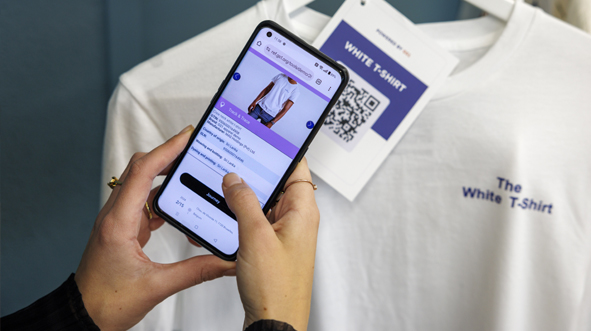
2. QR Code powered by GS1 including digital Link: links a product’s unique identifier to online information. It provides access to multiple link sources. For example, it links to the product information page, the DPP page and can even be scanned at checkout.
3. Global Location Number (GLN): streamlines supply chain operations in the textile industry by uniquely identifying companies, production facilities, and distribution centres worldwide. This standardised identifier enhances traceability and facilitates seamless communication between global trading partners.
GS1’s tools—like product identifiers (GTIN), the QR Code powered by GS1 including digital link and the GLN —make it possible to attach a digital passport to every item and ensure it can be read and used anywhere.
For manufacturers in Bangladesh, this is big. DPPs will soon be a requirement for exporting to the EU—and GS1 is helping make it possible.
Here’s how GS1 supports the DPP system:
1. Product Identification
GS1 provides unique codes (like GTINs) to identify each product globally.
2. Standardised Data Sharing
GS1 ensures DPP data (material information, care instructions, CO₂ footprint) is shared in a format that works across the entire EU supply chain. As an example, there is no need to create different formats for different buyers – one global standard works for all.
3. Traceability
Using GS1 tools like the QR Code powered by GS1 with Digital Link and event data like EPCIS, manufacturers can track each item’s journey—from factory to warehouse to consumer.
4. Easy Access to Information
With GS1 Digital Link, a simple barcode or QR code on the label lets anyone—buyers, customs, or customers—scan and access real-time product info. One link provides multiple link sources, one scan shows the DPP about where for example the T-Shirt came from and how at the end of its lifetime it can be repaired and recycled.
5. Alignment with EU Regulations
GS1 works closely with the European Commission and global brands to ensure the DPP system is built on open, trusted standards—not proprietary tech. By teaming up with policymakers, manufacturers, and retailers, GS1 is helping turn the EU’s vision of sustainable products into a digital reality.
Why it matters for Bangladesh:
The real impact of data takes place in the supply chains of manufacturing countries. Adopting GS1 standards early helps manufacturers stay competitive, meet EU-compliance, and offer transparency that global brands demand.
Want to know more?
Want to know more about how to get started with the Digital Product Passport? Check out the website of GS1 Netherlands: www.gs1.nl or contact Jeanet van der Stoel; jeanet.vanderstoel@gs1.nl




Comment here