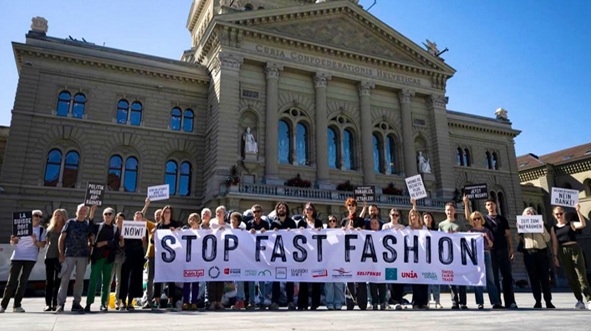
At the Première Vision trade fair in Villepinte, leading European textile and clothing federations issued a joint declaration urging immediate action against the rapidly expanding phenomenon of ultra-fast fashion, a business model driven largely by non-European e-commerce giants.
According to industry estimates, in 2024 the EU imported 4.5 billion parcels of ultra-fast fashion items, accounting for 5% of total clothing sales and nearly 20% of online fashion sales. The pace of growth shows no signs of slowing, prompting growing alarm across Europe’s textile and fashion industries.
Concerns Raised
The federations warned of the severe and multi-dimensional risks posed by ultra-fast fashion:
- Waste explosion: Billions of cheaply made garments end up as textile waste within weeks of purchase, undermining Europe’s sustainability goals.
- Unfair competition: European SMEs and manufacturers, who comply with stringent labor, environmental, and quality standards, are undercut by platforms that ignore these obligations.
- Retail decline: Local fashion retailers and high street stores face mounting pressure, accelerating the erosion of traditional city centers.
- Regulatory breaches: Cases of VAT fraud, counterfeiting, and circumvention of EU trade rules are widespread among low-cost e-commerce imports.
Key Demands from the Industry
The federations are urging the European Commission and Member States to enforce and strengthen regulatory frameworks without delay. Their main proposals include:
- Full implementation of the European Customs Code reform adopted on June 27, 2025.
- Tighter enforcement under the Digital Services Act (DSA) and Digital Markets Act (DMA) to curb illegal practices.
- Obligating e-commerce platforms to appoint legal representatives within the EU to ensure accountability.
- Introducing taxation on small parcels and abolishing the €150 customs duty exemption currently exploited by importers.
- Ensuring VAT collection on all parcels entering the EU.
- Opening structured dialogue with Chinese authorities, given that a large share of ultra-fast fashion imports originate from Chinese platforms such as Shein and Temu.
In addition to regulatory measures, the declaration appeals to European consumers to shift buying habits toward durable, high-quality products, thereby supporting local companies committed to sustainability, craftsmanship, and innovation.
An Unprecedented United Front
The initiative reflects a pan-European mobilization, bringing together more than 20 national and regional textile and fashion federations from across the continent, including:
- EURATEX – European Apparel and Textile Confederation
- UFIMH – Union française des Industries de la mode et de l’Habillement
- UIT – Union des Industries Textiles (France)
- Confindustria Moda (Italy)
- Fedustria (Belgium)
- DM&T – Danish Fashion & Textile (Denmark)
- Textil+Mode (Germany)
- SEPEE – Hellenic Fashion Industry Association (Greece)
- Modint (Netherlands)
- ATP – Associação Têxtil e Vestuário de Portugal (Portugal)
- Consejo Intertextil Español (Spain)
- Swiss Textiles (Switzerland)
- and many others representing Finland, Lithuania, Serbia, Sweden, Poland, Austria, and Belgium, along with the Alliance for European Flax-Linen & Hemp.
A Clear Call to Action
The federations concluded their declaration with a firm message:
“Ultra-fast fashion cannot become the norm. The European Union has both the means and the duty to act immediately to protect its businesses, its workers, and the environment.”
The call marks a turning point in the European fashion industry’s response, as trade bodies across multiple countries join forces to push Brussels for urgent regulatory intervention to safeguard the continent’s textile heritage, sustainable future, and economic resilience.