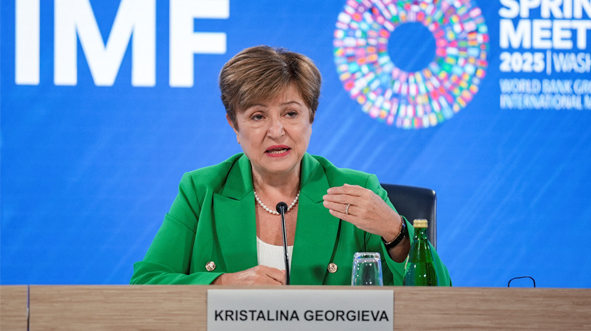
The global economy is performing better than feared but worse than needed, according to IMF Managing Director Kristalina Georgieva, ahead of the upcoming IMF–World Bank annual meetings in Washington.
Georgieva said the IMF now expects global growth to slow only slightly in 2025 and 2026, buoyed by stronger-than-expected performance in the US and several emerging economies. Despite ongoing uncertainty, she noted that the world has avoided a full-scale trade war so far, crediting improved policies, private sector adaptability, and supportive financial conditions.
She highlighted that the average US tariff rate has dropped from 23% to 17.5%, though it remains higher than the global average. However, she cautioned that the full impact of trade measures has yet to materialize and that global economic resilience is still being tested.
The IMF projects medium-term global growth around 3%, lower than the pre-pandemic average of 3.7%, with China slowing and India emerging as a key growth driver. Georgieva urged countries to boost productivity, rebuild fiscal buffers, and correct trade imbalances.
Regionally, she advised:
- Asia: Deepen internal trade, strengthen services, and expand financial access — potentially lifting output by 1.8%.
- Africa: Pursue business-friendly reforms and strengthen the Continental Free Trade Area, which could raise GDP per capita by over 10%.
- Europe: Appoint a “single market czar” to drive structural reforms, enhance competitiveness, and catch up with US private sector dynamism.
- United States: Address the federal deficit and encourage household savings.
- China: Implement fiscal reforms to spur domestic consumption and reduce reliance on industrial policy.
In summary, Georgieva emphasized that while the world economy has weathered multiple shocks, structural reforms are crucial to sustain growth and ensure long-term resilience.