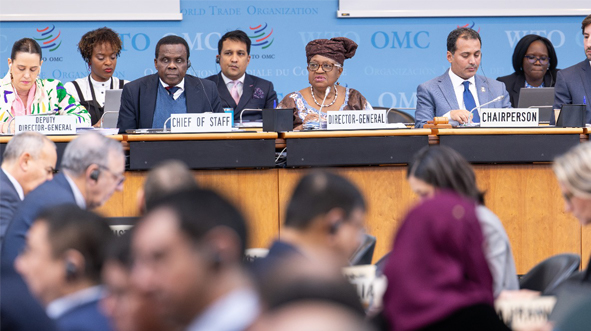
World Trade Organization (WTO) members reviewed global cotton market trends, investment priorities and prospects for a ministerial outcome on cotton as preparations gather pace for the WTO’s 14th Ministerial Conference (MC14), scheduled to be held in Yaoundé, Cameroon, in March 2026.
The discussions took place during the 44th round of consultations under the Director-General’s Consultative Framework Mechanism on Cotton (DGCFMC), alongside the WTO’s Dedicated Discussions on cotton-related trade developments. Members examined both the economic outlook for the cotton sector and the long-standing policy challenges that continue to affect cotton-producing countries, particularly in Africa.
Focus on investment and value addition
Addressing the meeting, WTO Deputy Director-General Jean-Marie Paugam congratulated the UN Food and Agriculture Organization (FAO) for hosting World Cotton Day 2025 in partnership with the International Trade Centre (ITC) and the government of Chad. He stressed that the cotton agenda has now moved beyond diagnosis and into an operational phase, requiring concrete investment to transform cotton and textile value chains.
Members received updates on the Partenariat pour le Coton (Cotton Partnership), an initiative aimed at strengthening value addition in the cotton–textile–garment (CTG) sector across the Cotton-4+ (C-4+) countries — Benin, Burkina Faso, Chad, Mali and Côte d’Ivoire — as well as other African producers. The United Nations Industrial Development Organization (UNIDO) reported progress on baseline assessments, national consultations, a steering committee meeting held in Cairo in April, and a recent regional workshop.
Calling on development partners, DDG Paugam urged financial institutions and donors to support this critical implementation phase, emphasizing the need for targeted investment capable of upgrading regional CTG value chains.
Private-sector perspectives were also shared. Otto International Scan-Thor, an international sourcing company, highlighted persistent challenges in the sector but noted that these same challenges create an opportunity for the C-4+ region to develop a competitive regional fashion industry capable of attracting multinational retailers and large-scale sourcing commitments.
Global market outlook
The International Cotton Advisory Committee (ICAC) presented its preliminary outlook for the 2025–26 season, projecting global cotton production at around 25.4 million tonnes, broadly in line with the previous year. Global consumption is expected to edge down slightly to about 25 million tonnes.
ICAC also noted continued growth in specialty cotton, which now accounts for roughly one-third of global cotton lint production. This includes long and extra-long staple cotton as well as fibre produced under sustainability and certification programmes such as Better Cotton and Cotton Made in Africa.
Push for stronger support ahead of MC14
Concluding the DGCFMC session, DDG Paugam called for stronger capacity-building efforts, coordinated investment promotion campaigns and deeper investment across the CTG value chain in the C-4+ region. He also encouraged regional expansion in response to recommendations from technical experts and development partners.
The C-4+ group requested that a high-level event on the cotton value chain be convened on the sidelines of MC14 in Yaoundé to review progress under the Cotton Partnership and mobilise further support for investment in the sector.
Reforming cotton trade policies
Separately, the WTO’s Dedicated Discussions on cotton trade developments, chaired by Ambassador Ali Sarfraz Hussain of Pakistan, focused on long-standing policy issues. Cotton has remained on the WTO agenda since 2003, when West African countries first proposed a sector-specific initiative, though progress has been slow due to broader stalemates in agricultural negotiations.
The WTO Secretariat introduced an updated background paper compiling cotton-related notifications, policy questionnaire responses, and data on tariff and non-tariff measures. The chair underscored the importance of transparency to support well-functioning markets and inform negotiations.
While several members expressed support for achieving a compromise outcome on cotton by MC14, others urged a more cautious approach, suggesting that expectations be recalibrated if progress on agriculture remains limited.
The C-4+ group reaffirmed its strong commitment to securing a meaningful outcome at MC14, particularly on domestic support. It indicated that a stand-alone decision on cotton could be pursued if broader agricultural reforms stall, and announced plans to submit a written proposal following a C-4+ ministerial meeting scheduled for 28 November in Bamako, Mali.
Members also reiterated calls to reduce cotton-specific trade-distorting domestic support. Some favoured linking any cotton outcome to a wider agricultural reform package, while others proposed voluntary measures to improve market access for least-developed country exports across the entire cotton–textile–apparel value chain, supported by targeted assistance and investment.
As MC14 approaches, cotton remains a central test case for the WTO’s ability to address development concerns, balance trade reform with investment needs, and deliver tangible outcomes for vulnerable producers.