Ahead of Textile 2026, Callum Legg Group Sales and Projects Manager at FESPA, and Textile spokesperson, explores how digital print is transforming interior décor, as technology and creativity converge…
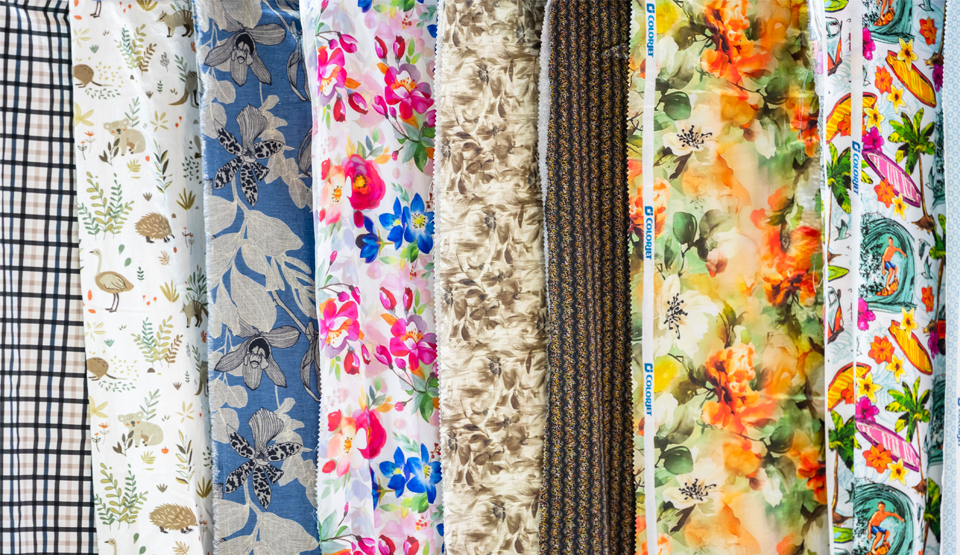
Walk through a premium hotel lobby, a luxury apartment showroom or a high-end retail fit-out today, and the surfaces around you may tell a more complex story than what first meets the eye. Walls suggesting raw stone or veined marble; splashbacks carrying photographic detail; or textiles bearing patterns generated by AI hours before production. Digital printing has moved beyond paper into the fabric of interior environments – and much of the industry is only beginning to catch up with what is now technically possible.

The drivers behind this shift encompass culture, technology and society simultaneously. Research from Canon’s ‘Exploring the Future of Print’ report identifies shifting attitudes towards identity, personalisation and sustainability as forces reshaping multiple sectors at once. In décor, their convergence is especially visible: the home has become a sanctuary, a workspace and a statement of individual identity all at once. According to Smithers, even within the broader digital textile printing market, of which interior décor forms a significant part, digital methods still account for only around 6% of total production[1], despite the market reaching €4.80 billion in 2024[2]. It is clear, then, that the scale of the remaining opportunity is considerable.
As Matthew Faulkner, EMEA Director of Marketing and Innovation at Canon Europe, has observed: “With advanced digital technologies, we now have the tools to make personalised projects accessible for all – from retail fit-outs to immersive home interiors.” The market is no longer asking whether bespoke is possible; it’s asking why it should cost more or take longer than mass-produced alternatives.
Technology Enabling Change
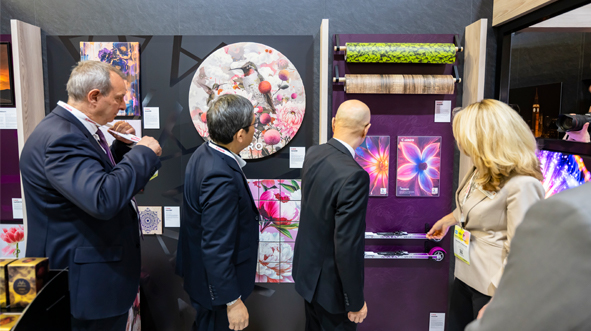
Faulkner refers to is Canon’s UVgel technology with FLXfinish+, which reproduces complex designs with tactile surface effects and realistically mimics raw silk or wood panels at a fraction of the traditional cost.
At studios like Haley Studios, collections begin on a physical drawing board and are hand-painted before being scanned and digitally finished. The Sanderson Design Group’s collaboration with Emma Shipley, which produces velvets and embroidered drapes through a combination of digital and analogue methods, reflects a market where craft and digital production increasingly work in combination rather than opposition.
Echoing these trends, there are many solutions, which support textile printing in interior decor applications, that will be displayed at Textile in May.
EFI Reggiani solutions enable high-quality digital textile printing for interior décor applications, which deliver precise colour and intricate designs across fabrics used in upholstery, curtains and wall coverings.
Kyocera’s FOREARTH inkjet digital printer allows rich, high-definition designs to be applied to fabrics for applications like upholstery, curtains and soft furnishings. Its low-water functionality supports more low-impact, on-demand production while maintaining the colour depth and quality needed for both bespoke pieces and large-scale interior schemes.
Kornit’s Presto Max printer supports on-demand digital textile printing for high-quality interior décor applications without the need for complex pre- or post-treatment. Its single-step, water-free process supports faster turnaround, reduced waste and flexible production.
Both DGI and DGEN printers producing vibrant, durable designs on fabrics used in soft furnishings. They enable cost-effective, consistent output for both customised designs and larger-scale interior projects.
The Road Ahead
David Sweetnam, Director of Textile, Production and Wide Format Lab Testing Services at Keypoint Intelligence, highilghts: “The evolution of smart decorative printing is not just about advancements in technology; it’s about empowering creatives and industries to realise their visions sustainably and efficiently.” And with Smithers forecasting digital textile print volume to reach 5.5 billion square metres this year, with a value approaching €7 billion[3], for print service providers and designers willing to engage with not only the technical specifications enabling supply but also the cultural forces shaping demand, the opportunity is substantial.
Visitors to Textile will be able to see various textile-related technologies and consumables, including: roll-to-roll machinery; direct-to-garment (DTG) and direct-to-fabric (DTF) machinery; design and workflow software; embroidery and sewing equipment; finishing equipment; material and apparels; inks and coatings; and more.
Join us at the first edition of Textile, from 19 – 22 May 2026, at the Gran Via, Fira de Barcelona! For more information and to register, visit: https://europe.fespa.com/textile
[1] Smithers – The Future of Digital Textile Printing to 2026
[2] Smithers – The Future of Digital Textile Printing to 2028
[3] Smithers – The Future of Digital Textile Printing to 2028