

 For the first time, that was in March, 2020, Covid-19, declared by WHO as the period of Pandemic Worldwide. Then the second wave and then, the third wave and it keeps going on. New viruses and variants appeared out of nothing and hit us one after another, killed millions of people around the globe and the world is experiencing these horrible time which we have never seen in our life time.
Things are changing so fast, with in these two years of time, the whole dimension shaped up differently. The place, the people, the market, the transactions and what not? Changes took places in terms of trade and businesses around the globe. We have witnessed the almost death of physical market which was taken over by online platform, all around the globe during these periods.
But life still goes on, no matter where we live and what we have to eat of wear. For Bangladesh, the export of garments to the world is so important that whatever it takes and whatever happens, we must keep that on run as we found the answer to the question on our better survival, as they give us our daily bread and butter and runs the wheel of life in this country.
In the hardest time of Covid-19 during 2020 ad 2021, in the first and the second phases, our workers showed their tremendous supports and no matter how hard it was, they just uplift the weight of the burden on their shoulders and carry on and certainly we are seeing the results for their effort, earning better volume than any others. We salute to every soldiers who had run the show in the hard time of pandemic.
During these period, we have seen the revolutionary changes on market place, trading and transaction, promotion and marketing of goods and services where the old tips and tricks are almost useless. Here comes the situation that is mostly different from the pre-pandemic era. Let us look at the situation where Bangladesh stands now with its position in the world of apparel business and then we will talk about the challenges and highlights a few important points which are to be taken care of in order to grab new orders and to continue with better market share in EU and in the rest of the world.
European Union, still the most Lucrative market for apparel manufacturers from all around the globe.
“Europe is a strong apparel market with continuous growth, and is home to some of the world’s biggest and most renowned apparel companies. Europe’s apparel import market was valued at €127.4 billion in 2020, down from 146.9 billion in 2019. A significant drop of 13.3%, which was caused by the COVID-19 pandemic and a weakening of the international trade. Before 2020, the market grew by an average annual rate of 4.7% from 2016 to 2019. A recovery of the market, back to the sales values of 2019, is expected in 2023.”
Despite a 6.6% decline in annual average growth, China solidly remained the largest apparel exporter to the EU with a 15% share, followed by Bangladesh and Turkey. Myanmar’s apparel export value to the EU has grown faster at a 39% annual average from the period 2015 to 2020. The competition is stronger among Vietnam, Cambodia and Bangladesh though Bangladesh had been capable to be the second largest exporter to the EU and surely heading to secure the top notch.
Bangladesh in EU apparel market
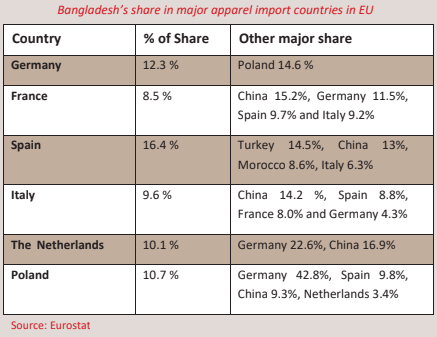
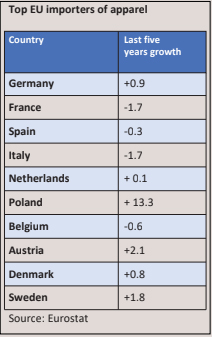 Western European apparel markets are larger in size and more developed than central and Eastern Europe which are still comparatively small though it shows high growth. In the beginning of 2020, 71.7% of import value comes from the top six EU markets: Germany, France, Spain, Italy and the Netherlands. In this top six countries in EU apparel market, Bangladesh has quite strong appearance in terms of share taken by them. In Germany, Bangladesh is the second highest exporter after Poland. In France, Bangladesh is the fourth largest exporter after China, Germany, Spain and Italy. Bangladesh is the largest exporter to Spain and second largest in Italy after China. In Italy, the Netherlands and Poland, Bangladesh secured second, third and second largest exporter position respectively.
Poland is one of the fastest growing EU markets for apparel as we can see it as the highest growth among all other EU countries. The third largest EU importer, the UK is also the third largest export market for the developing country left the EU in January 2020.
Current Scenarios:
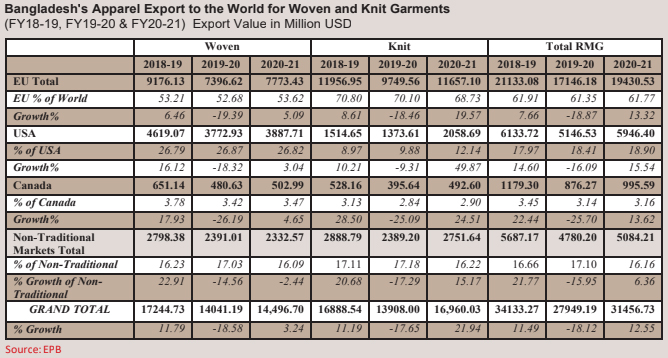
Garment export to the European Union including the UK rose 23.83% year on year to 12 billion USD in the current fiscal year’s first half and this came in spite of global pandemic’s fallout in the supply chain.
Bangladesh had witnessed an overall increase in shipment towards other countries like USA and Canada, for instance, a 45.91% and 23.78% increase of export year on year respectively, according to EPB. Even in non-traditional market during the same period, the data showed that Bangladesh is performing better in China, India and Japan. Except for the EU, USA, UK and Canada, all markets are considered non-traditional.
Big transformation during Covid-19 and EU is the fastest to change
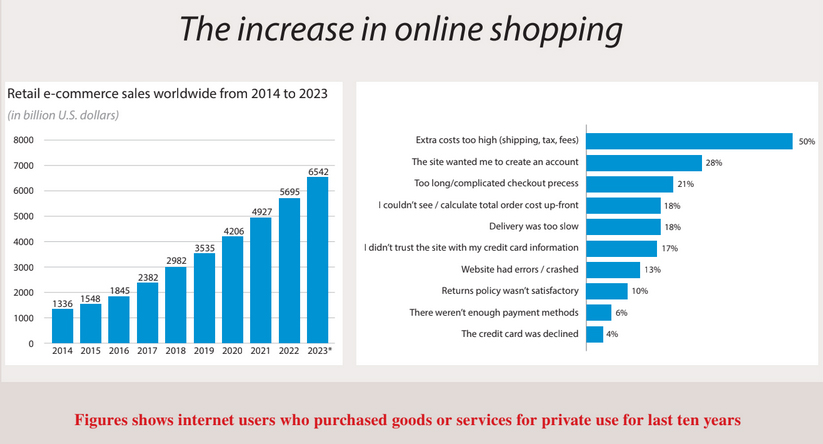
 The European apparel market faces many challenges and is changing fast. The changes is taking place much faster in EU than any other countries and due to those changes in factors, world trade is also shaping into a different dimension unlike before. Followings are the factors which has changed the market, During the Pandemic period, we observed that everything is closed, life is closed at home, closed outlets, closed borders, closed restaurants, restriction on any kind of traveling, maintain social distance and so on, the list is quite endless. As a result, so many orders were cancelled. Unsold stocks were the highest in our lifetime and the supply-demand had to face the reality and thus the era of online shopping had seen the new horizon when physical purchase was almost closed. Online market had grew with ever highest percentages and took over the physical market. These whole situation ripples through the entire supply chain and shift the whole process into a new reality.
Sustainable production
The European green deal puts more constraints on RMG trade
These are the set of EU proposals to make the European continent as the most sustainable continent in the World. CSRD says the law of due diligence regarding human rights and environmental protection will be more strict than any other time before.
Sustainable products initiatives which gives more durable, reusable, repairable, recyclable and more energy efficient products are being preferred and abide by the laws.
A new “carbon border adjustment mechanism’’ (CBAM) which imposes a tax on exporters to the EU from countries that do not imposes a carbon constraint on their industries.
”Extended producer responsibility’’ (EPR: making companies financially responsible for environmental costs of products during their life cycle).The ‘’right to repair’’ for consumers and the National Laws implemented by some of the EU countries like France and Netherlands and also the UK.
Challenges like proposal of EPR will be implemented from 2023, 50% recycled materials in textiles in 2030, child labor due diligence law (Netherlands) and In UK (Modern Slavery Act) and in France (Duty of Vigilance law), these all are new phenomenon that has to be faced by the suppliers, specially from the developing countries.
“Sustainable Consumption’’ is the current Buyer’s trends in Europe
“I am buying less than I used to buy before the pandemic, to reduce clutter and live more simply’’ said 57% of Europeans. Young European adults and women shows high interests in limiting spending for to sustainability reasons. Around 70% of senior population and parents are increasingly fixing, recycling apparel items rather than buying new apparel.52% of European ‘’will not buy from companies that are harming the environment’’.
Sustainability Requirements:
Of course, media has strong roles to play and we can see how those many famous and popular brands and retailers are behaving, standards and certifications are becoming ever more important for the exporter’s basic requirements. Besides that many brands and retailers signing on to many different transparency pledges, for example, they register their supply partners to UN fashion charter which is about limiting carbon emission. For example, statements like ‘’Fashion is killing the Amazon Rainforest’ and ‘’Chile’s Atacama Desert: where fast fashion goes to die’’.
Quality over Price:
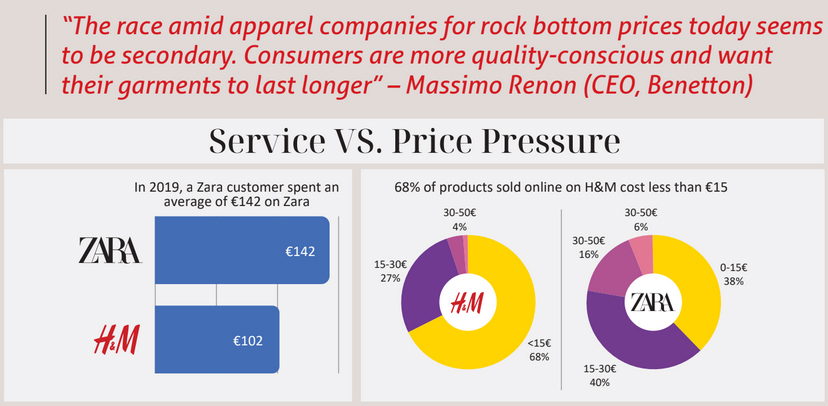
Though price is always an important factor in every apparel market but yet the consumers are back into place where they prefer more durable and reusable garment.
Pressures on Price
Suppliers are indeed in a pressure on pricing. On one hand, due to the rising of raw material price including cotton and polyester, rising labor costs in most of the developing and developed countries, the rising cost of transportations and other logistics, it is really hard for them to meet the buyer’s demanding level prices and also extended payment terms.
Digitalization: Online platform takes over the physical market
‘‘Data has a better idea”
The winner will surely be the one who knows how to smartly use of data in this new era of Digitalization. The usage of IoT will be increasing in every sectors of these businesses. Data will be the fact which will take us to the precision and perfection, in production, in quality control, in the process of shipment and where not? The only thing is, we need to be well educated to deal with data and machines. Automated manufacturing, designing, supply chain mapping, material traceability, smart logistics, and impact measurement, sales data to read the mind of the consumers or retailers are all in the form of data, thus we need to have the capability of reading them and act accordingly. Many brands and exhibitors are already using digital show room and catwalk to showcase their goods and services.
Online fashion brands and retailers will surely take over the market and they will lead as they have already took over some of the major market share which was seen from the beginning of the pandemic era. The prime reasons were lockdowns and restrictions on physical movements. According to European Commission, online sales has been caught on eyes increased from 62% in 2015 to 72% in 2020. The Netherlands is leading the digital sales within the European Union with a more than 90% share on digital sales while the UK reached a very similar share in 2020. Among the other goods, cloths, shoes and accessories were the most popular digitally purchased products in the European Union in 2020 and afterwards. Amazon, the world’s biggest retailer has also become the leading fashion retailers since the beginning of the pandemic. And due to Amazon’s ongoing success and popularity on fashion retailing, they have decided to extend their fashion roadshow to several countries in Europe, like in The UK, Germany, France, Italy and Spain, according to the head of Amazon Fashion Europe.
The followings are some measures that we can work on to adopt with digitalization:
• Getting familiarized with most common forms of digitalization.
• Learn to use EU’s growing e-commerce industry to your advantage.
• Gather data within your factories and marketing team.
• Learn to participates in all these new platform day by day.
• Learn to know the jargon.
• Let the data and their patterns drive your sales strategies.
• Maximize your knowledge and practice to use the digital tools.
Near Shoring due to increase of shipping cost:
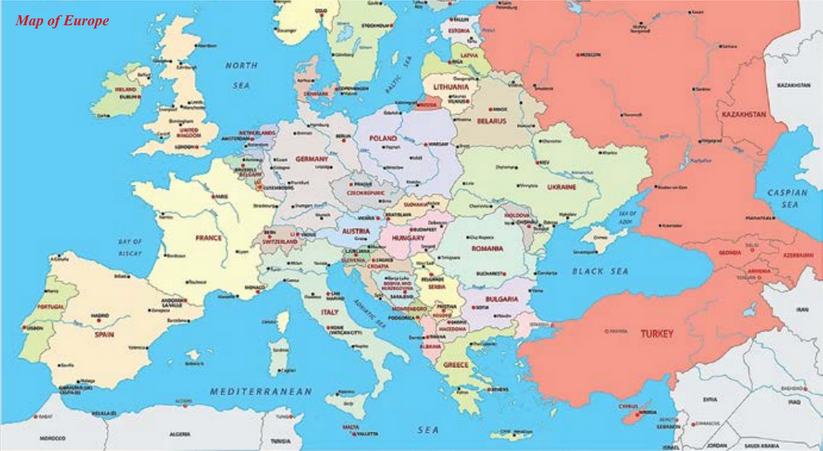
European buyer’s in this time of pandemic, increasing their supply partners from nearby countries as they have more control over production, lower transportation costs and of course shorter lead time and these are promoted by EU itself. Like turkey is fully booked now with European orders and due to over booking, they have shifted their lead time from 4 weeks to 8 weeks for any new orders. We can also see that Egypt, Jordan, Morocco, Tunisia, Moldova, Portugal, Romania and Bulgaria has more orders to supply to their neighboring countries. Even a shift in manufacturing from Italy is being observe recently. All these new challenges are to be faced for the eastern and far-eastern countries like Bangladesh, Vietnam, and Cambodia etc.
Flexibility on orders
Currently the right product at the right time for the EU market requires the following factors to be considered:
• Smaller MoQ’s (minimum order quantity)
• Flexibility in styles and design
• Shorter lead time
• Stock service
• Sample room and 3D-sampling
• Seasonal sales forecast
Manufacturer should ask buyers to share their sales data, so that the manufacturers have an idea how the buyers are behaving on their current market requirements. Additionally, the suppliers need to analyze more and more other data to learn about the facts that are currently become high factors in terms of trade with EU countries.
These changes that took places in many EU countries drastically, they will be able to continue with growth and grab more shares on EU country for apparel export.
References _________
European consumer report 2021
BGMEA
Export Promotion Bureau EPB
The Daily Star
CBI market information
Eurostat
Google map





Comment here