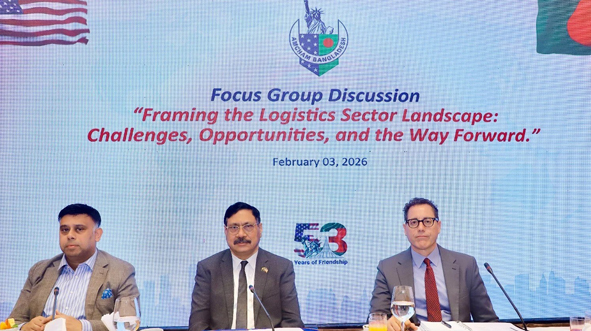
Bangladesh risks falling behind regional competitors unless it urgently cuts high logistics costs, closes policy implementation gaps and accelerates private-sector-led infrastructure development, speakers warned at a focus group discussion organized by the American Chamber of Commerce in Bangladesh (AmCham) recently.
The discussion, titled “Framing the Logistics Sector Landscape: Challenges, Opportunities, and the Way Forward”, was held at The Westin Dhaka and brought together representatives from garments, shipping, aviation, courier services, inland container depots, freight forwarding, development partners and officials from the US Embassy.
Opening the session, Syed Ershad Ahmed, president of AmCham Bangladesh, said logistics remains the backbone of supply chains but continues to lag behind regional peers. He noted that despite gradual improvements, the sector is still poorly understood domestically and inadequately prepared for rapid global shifts driven by automation, artificial intelligence, decarbonization, geopolitics and supply-chain resilience. He stressed the need to bridge critical knowledge and capacity gaps to support expanding trade and investment.
M Masrur Reaz, chairman of Policy Exchange Bangladesh, said logistics efficiency is central to export growth through cost reduction, faster delivery and productivity gains. He warned that Bangladesh’s heavy dependence on the Dhaka–Chattogram corridor, which handles nearly 70 percent of national trade, poses a structural risk, as highlighted by recent labor disruptions at Chattogram port. Reaz also pointed to weaknesses in implementing the National Logistics Policy, including government monopolies in rail and air cargo, weak inter-ministerial coordination and the absence of a central logistics authority.
Calling for increased private and foreign investment, Reaz highlighted opportunities in cold chain development, rail logistics, automation and expert-led infrastructure planning, citing projects such as the Matarbari Deep Sea Port, Bay Container Terminal and the third terminal at Hazrat Shahjalal International Airport.
Addressing air logistics, Mahbubul Anam, managing director of CF Global, said cargo handling costs at Dhaka airport are 20–25% higher than road transport, underscoring the need for better public-private coordination, policy support and modern equipment. He warned that rising e-commerce demand for express logistics could overwhelm existing capacity without swift reforms and noted the lack of direct cargo flights to the US despite clearance facilities for the EU.
From a development partner perspective, Nusrat Nahid Babi, senior transport specialist for South Asia at the World Bank, said the momentum for logistics reform built since 2022 must be reaffirmed by the new government through clear priorities and high-level consensus. She outlined a phased reform agenda covering policy simplification, multimodal connectivity, skills development, digitalization and investment, with immediate focus on operationalizing the National Logistics Policy 2025 and establishing a logistics division under the Prime Minister’s Office.
Md Moinul Huq, Citi country officer of Citibank N.A. Bangladesh, called for faster implementation of the Customs Act 2023, particularly clear rules on electronic documentation and payments. He also criticized the continued overreliance on letters of credit, urging more flexible settlement mechanisms to enhance trade competitiveness.
The discussion concluded with a strong call to shift from policy intent to execution, with participants urging swift implementation of the National Logistics Policy, structured private-sector engagement, investment in multimodal logistics hubs and faster rollout of digital trade initiatives to improve efficiency, resilience and job creation.
Photo Courtesy by : The Business Standard