Bangladesh’s graduation from the Least Developed Country (LDC) category marks a significant turning point in its economic journey. While the achievement reflects decades of progress, it also signals the beginning of a more competitive phase in which preferential market access will gradually decline. Going forward, Bangladesh will need to rely increasingly on productivity, innovation, investment and stronger trade partnerships rather than trade preferences alone.
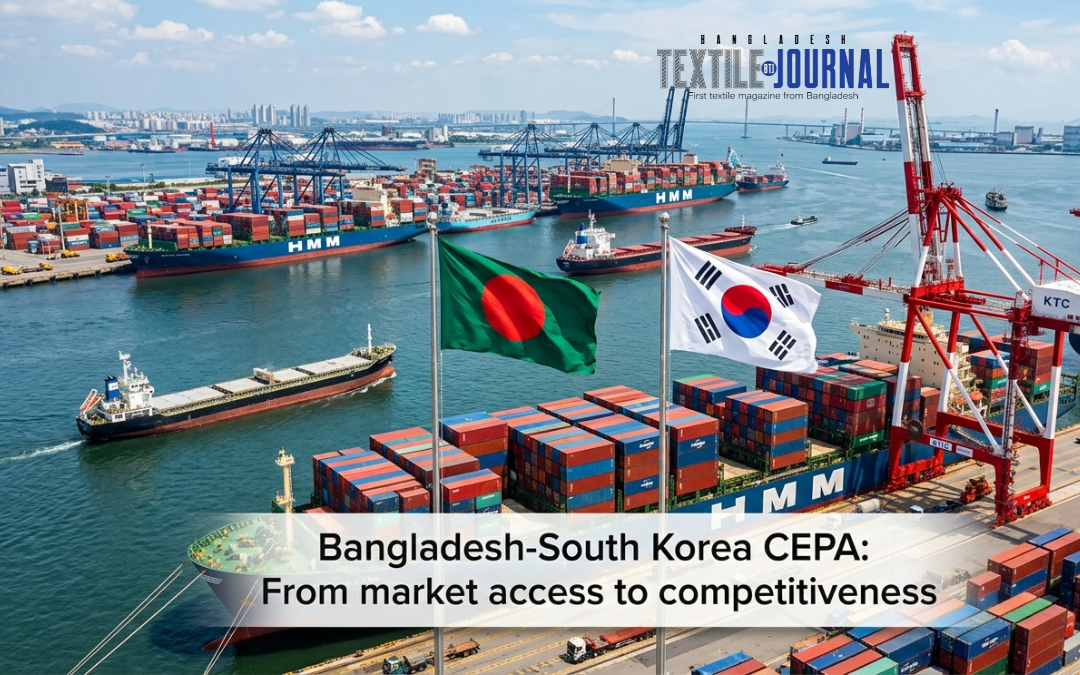
Against this backdrop, the proposed Comprehensive Economic Partnership Agreement (CEPA) between Bangladesh and South Korea carries strategic importance. The agreement should not be viewed simply as another trade deal; rather, it could become a platform for expanding investment, technology transfer, services and industrial cooperation between the two countries.
South Korea is one of the world’s most advanced industrial economies and imports more than $600 billion worth of goods annually. Yet Bangladesh’s exports to the Korean market remain relatively modest at around $600 million, with nearly 90 percent concentrated in the readymade garment (RMG) sector. While this demonstrates the strength of Bangladesh’s apparel industry, it also highlights the country’s limited export diversification.
The CEPA could help change this equation. Once implemented, 8,428 Bangladeshi products are expected to receive preferential access to the South Korean market. In addition to garments, promising sectors include leather and footwear, pharmaceuticals, home textiles, processed food, jute-based sustainable products, engineering goods and ICT-enabled services.
However, tariff concessions alone will not be enough to transform Bangladesh’s trade relationship with South Korea. Unlike a conventional free trade agreement, a CEPA can cover wider areas including investment, services, digital commerce, customs cooperation, intellectual property and the movement of professionals.
South Korea is already an important foreign investor in Bangladesh, with more than 200 Korean companies operating in areas including manufacturing, ICT and infrastructure. The experience of Vietnam demonstrates how Korean investment can contribute to industrial transformation. Vietnam’s emergence as a major manufacturing hub was supported not only by preferential market access but also by sustained Korean investment, technology transfer and integration into global supply chains.
Bangladesh has several comparable advantages, including a large young workforce, competitive production costs and an expanding industrial base. The challenge is to convert these advantages into higher-quality investment and stronger participation in global value chains. Much will depend on the country’s domestic investment environment.
This is where Bangladesh’s reform agenda becomes critical. Trade agreements can open foreign markets, but they cannot resolve structural weaknesses at home. Investors continue to consider the reliability of energy supplies, port efficiency, regulatory predictability, customs procedures, logistics and the overall ease of doing business when making investment decisions.
Bangladesh therefore needs to move faster on these reforms. As preferential trade advantages diminish after LDC graduation, improving the domestic business environment will become essential to maintaining export competitiveness.
At the same time, the country must rethink its export strategy. The next phase of economic development will require greater investment in technology, skills, research and development, innovation and higher-value manufacturing. Export diversification is no longer simply a desirable policy objective; it is an economic necessity.
The Bangladesh-South Korea CEPA should consequently be viewed as the beginning rather than the end of a new economic partnership. A trade agreement can create opportunities, but it cannot guarantee results. Whether the CEPA becomes a milestone in Bangladesh’s economic transformation or merely another signed agreement will depend largely on how effectively the country implements domestic reforms and prepares its industries to compete.
Competitiveness, rather than preferential treatment alone, will define Bangladesh’s next stage of economic development.
The Commerce Ministry deserves recognition for its efforts in advancing the CEPA process. At the same time, Bangladesh should continue pursuing ambitious trade agreements with other major economic partners, including the European Union, to secure market access, attract investment and strengthen the country’s position in the global economy.