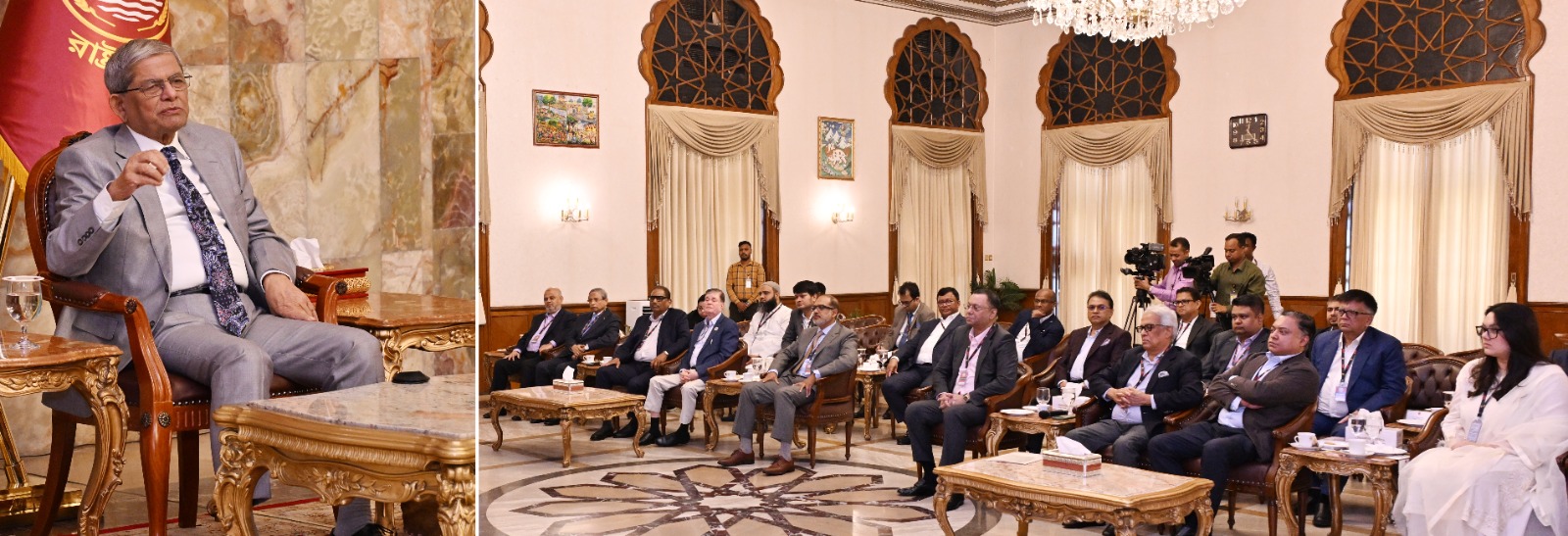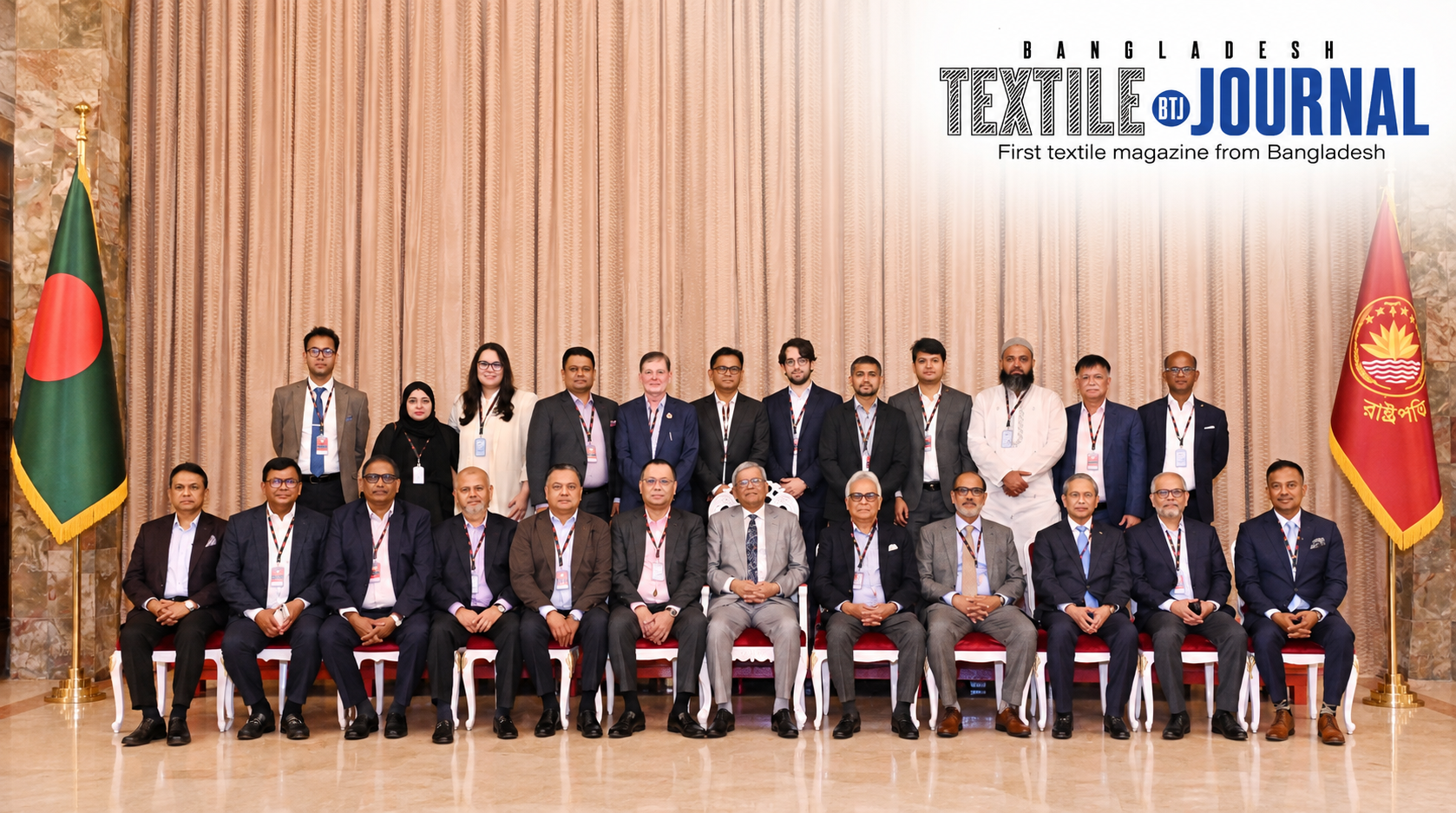
A 23-member delegation of the Bangladesh Textile Mills Association (BTMA), led by its President, Shawkat Aziz Russell, paid a courtesy call on President Mirza Fakhrul Islam Alamgir at Bangabhaban today, 21st September.
During the meeting, the BTMA President outlined the current state, prospects and challenges facing Bangladesh’s primary textile and spinning industries. He noted that gas supply conditions, particularly for the textile and spinning sectors, have improved significantly in recent times, contributing positively to industrial production.
On behalf of BTMA, he expressed sincere appreciation for the government’s initiatives to improve gas supplies and safeguard industrial production, employment and export capacity. He also called for the continuation of these improvements.
The meeting included detailed discussions on the prevailing conditions of the primary textile and export-oriented ready-made garment sectors, existing challenges and the policy support required for sustainable industrial development.
To strengthen the national economy, employment, foreign-exchange savings and export competitiveness following Bangladesh’s graduation from the Least Developed Country (LDC) category, BTMA submitted written proposals to the President seeking policy support in the following areas:
Key Proposals Presented by BTMA
- Maintaining restrictions on bonded imports of locally producible cotton yarn: BTMA requested the continuation of the decision under National Board of Revenue Order No. 51/2026/Customs/519, dated 7 September 2026, to withdraw bonded facilities for imports of 10–30-count cotton yarn under HS Headings 5205, 5206 and 5207, while allowing genuine exporters to import yarn against bank guarantees. According to BTMA, retaining the decision could reduce imports of locally producible cotton yarn and potentially save foreign exchange equivalent to approximately Tk 30,000 crore worth of yarn imported during FY2024–25.
- Restoring the local value-addition requirement: The association proposed reinstating the 30% local value-addition requirement for bank-guarantee-based raw-material imports by non-bonded industries. It also recommended ensuring a minimum 40% local value addition across all exports to strengthen export competitiveness following LDC graduation.
- Introducing an integrated Textile & Apparel Competitiveness Policy: BTMA called for a comprehensive policy framework aligned with competing countries, covering tariffs, taxation, energy, financing, export incentives and other relevant policy areas in an integrated manner.
- Ensuring uninterrupted gas supplies: The association requested that the improved gas supply situation in the industrial sector be maintained, with adequate pressure and uninterrupted delivery.
- Strengthening oversight of bonded facilities: BTMA proposed enhanced monitoring, verification and legal enforcement mechanisms to prevent the misuse of bonded facilities.
President Mirza Fakhrul Islam Alamgir listened attentively to the issues raised by BTMA representatives and acknowledged the importance of the challenges confronting the country’s primary textile industry. He assured the delegation that the proposals would receive due consideration and that the relevant ministries and government departments would take the necessary measures.
The President’s Military Secretary, Major General A.S.M. Bahauddin, SUP, SPP, ndc, afwc, psc, the Secretary of the Public Division, A.J.M. Salahuddin Nagari, and the Press Secretary were present during the meeting.
Representing BTMA were President Shawkat Aziz Russell, former President Abdul Hai Sarker, Vice President Md. Shamim Islam, Vice President Shafiqul Islam Sarker, along with former vice presidents, current and former directors, and other association leaders, comprising a total of 23 delegates.