

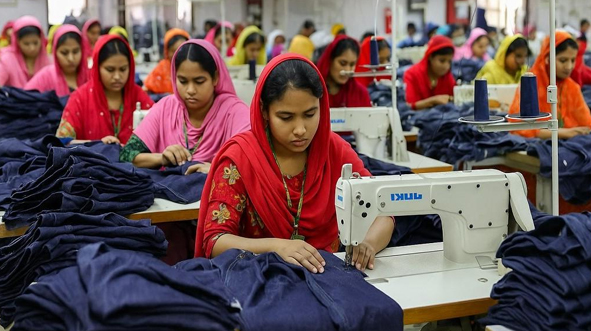
As Bangladesh and the United States conclude the second round of critical trade negotiations in Washington, key challenges remain unresolved—most notably, the steep 35% US tariff on Bangladeshi goods and a proposed 40% local value addition requirement for apparel exports. While the two sides have reportedly reached consensus on 80% of the conditions under discussion, these two issues continue to pose serious risks for Bangladesh’s ready-made garment (RMG) industry, especially the woven segment.
 The talks, held from 9–11 July, come just weeks before the 1 August implementation deadline for the new reciprocal tariff regime first announced by former President Donald Trump in April. For Bangladesh—whose apparel exports to the US totaled $7.6 billion in 2024, representing over 17% of its total export earnings—the outcome of these negotiations could have far-reaching consequences.
Woven garment industry in peril
A major sticking point is the US demand that Bangladeshi garments demonstrate at least 40% local value addition to qualify for the “Made in Bangladesh” label and receive duty concessions. Industry experts warn this could be disastrous for the woven garment sector, which heavily relies on imported fabrics, especially from China.
Currently, around 70% of the fabric used in woven exports is sourced from abroad, making it nearly impossible for many manufacturers to meet the new threshold under existing supply chain conditions.
“It is impossible to achieve 40% value addition with imported fabric,” said Md Hafizur Rahman, former Director General of the Ministry of Commerce’s WTO Cell. “To comply, we must develop strong backward linkages and start producing woven fabrics locally.” Mostafa Abid Khan, former member of the Bangladesh Trade and Tariff Commission, pointed out that the US excludes producer profits when calculating value addition—only local inputs and wages count. “This makes it even more difficult for our woven exports to qualify,” he told The Business Standard.
In contrast, the knitwear segment is relatively secure, with about 90% of its fabric demand met domestically, reducing its vulnerability to the proposed rule.
Industry voices marginalized
BGMEA President Mahmud Hasan Khan Babu expressed frustration at being excluded from the core negotiations. “We were not involved in the meetings directly—only asked for input on the final day,” he said. While he was told that the 35% tariff might be revised downward, no official confirmation or detailed negotiation outcomes have been shared with industry stakeholders. Babu also noted the lack of transparency: “We have no idea what was agreed upon. The government cited a non-disclosure agreement as the reason for withholding information, including discussions on Chinese investments.”
Despite these challenges, BGMEA has shown flexibility, indicating they may accept the 40% local value rule—if the US reduces the tariff to 15%.
Geopolitical tensions and china factor
The US side has raised concerns about rising Chinese investments in Bangladesh, particularly in the RMG sector. While local industry leaders argue that Chinese equity participation remains limited, Washington reportedly views the matter through a national security lens, adding a layer of geopolitical complexity to the trade discussions. Energy and Power Adviser Fouzul Kabir Khan acknowledged this broader scope: “The negotiations are no longer just about tariffs. The US is looking at our bilateral relationships with other countries as part of a wider trade-security framework.”
What’s next?
With just days left before the 1 August deadline, a third round of negotiations is expected—possibly held virtually or again in Washington. Commerce Adviser Sheikh Bashir Uddin and Security Adviser Khalilur Rahman are said to be optimistic about achieving a mutually acceptable agreement before the tariffs take effect. Industry leaders are urging the government to negotiate a tariff reduction to 10–20% while simultaneously investing in domestic woven fabric production to meet the local value requirement.
Conclusion
Bangladesh faces a double-edged challenge: navigating unprecedented tariff hikes and complying with a demanding value addition rule that could jeopardize its largest export industry. With geopolitical considerations influencing economic decisions, the outcome will hinge not only on trade logic but also on diplomatic agility. For Bangladesh, this is a crucial moment to align trade strategies with long-term industrial development and international partnerships.




Comment here