

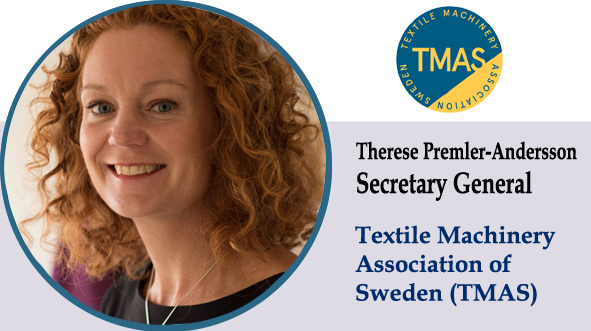
1. Please tell us about TMAS history in brief and it’s past leadership.
The Textile Machinery Association of Sweden (TMAS) was established in 1997 to bring together leading Swedish textile machinery manufacturers. The association represents companies known for innovation, quality, and sustainability. Since its inception, TMAS has focused on promoting Swedish textile technology globally. The members set the strategy and priorities, and the Board and the Secretary General collaborate to execute. Focus is innovation to address the evolving needs of the global textile industry.

2. How do you see Bangladesh Market? And share the beginning story of Swedish manufacturers who started to sell to Bangladesh.
Bangladesh is a significant market for Swedish textile machinery, driven by its thriving textile and garment sector. Swedish manufacturers began entering the Bangladeshi market during the 1990s as the country’s ready-made garment sector gained global prominence. They initially catered to the demand for high-quality, efficient, and sustainable machinery to support Bangladesh’s export-driven growth. Partnerships with local agents and direct engagement with factory owners were critical to establishing trust and market presence.
3. How is the progress curve of Swedish textile machinery sales to Bangladesh in terms of value for last 10 years?
Swedish textile machinery exports to Bangladesh have experienced fluctuations over the past decade but with a steady growth in terms of value. This growth aligns with the increasing investment by Bangladeshi Therese Premler-Andersson Secretary General Textile Machinery Association of Sweden (TMAS) BTJ Exclusive Interview manufacturers in automation, energy efficiency, and sustainable solutions. The adoption of advanced technology to meet international compliance and quality standards has driven the demand for Swedish machinery, particularly in weaving, dyeing, and finishing equipment.
4. Does Sweden has a trade body in Bangladesh as a part of Swedish embassy in Dhaka with which TMAS works to explore Bangladesh market? Do you get enough information about Bangladesh textile industries without hardship?
Sweden does not have a dedicated trade body specifically for textile machinery in Bangladesh. However, the Swedish embassy in Dhaka, along with Business Sweden, facilitates trade relationships and provides market insights. The TMAS members works closely with their local agents and partners to stay informed about market dynamics.
5. Does TMAS arrange yearly or bi-yearly solo country exhibition in Bangladesh for TMAS members? If not, do you have any plans to do such in near future?
TMAS has not yet organized a joint pavilion at an exhibition in Bangladesh, but several of our members actively participates in major textile fairs like DTG (Dhaka Textile and Garment Machinery Exhibition). While there are no immediate plans for an TMAS dedicated event, the association continually evaluates market opportunities. A TMAS event could be a future possibility if there is sufficient interest from its members and the Bangladeshi market.
6. Pros and Cons of the Bangladeshi Textile Market
Large-scale demand: As one of the world’s largest RMG exporters, Bangladesh offers immense potential for textile machinery.
Focus on modernization: Increasing adoption of automation and sustainability in factories aligns with Swedish technology strengths.
Price sensitivity: Bangladeshi buyers are often highly price-conscious, creating challenges for premium-quality products.
Political instability: Occasional political unrest and uncertainties in Bangladesh can impact the business environment.
7. Key TMAS players in Bangladesh
Prominent TMAS members active in Bangladesh include companies specializing in automation, sustainable solutions, and high-performance machinery, such as Vandewiele Sweden, imogo, and Svegea. Their expertise in production efficiency and sustainability aligns well with the demands of Bangladeshi manufacturers.
8. Views on sustainability and circular economy
Sustainability and circular economy are central to TMAS’s mission. Swedish manufacturers lead in developing energy-efficient machines, water-saving dyeing systems, and solutions to increase automation and minimize waste. Without compromising with the quality. TMAS emphasizes long-term partnerships to support Bangladeshi manufacturers in achieving sustainability goals and meeting global standards.
9. Does Swedish machinery manufacturers have any plan to set up their extended plant in Bangladesh? If so, please tell us a bit more about them.
While there are no confirmed plans for Swedish machinery manufacturers to set up extended plants in Bangladesh, the idea is interesting. Setting up local assembly or service centers could enhance after-sales support and reduce costs for Bangladeshi buyers. The decision would depend on market size, operational feasibility, and demand for localized production.
10. It is just from a curiosity to know, compare to other European textile machinery association, why was TMAS established so late in 1997, why not much earlier like VDMA, ACIMIT, SWISMEM or SYMATEX?
TMAS’s relatively late establishment compared to other European associations can be attributed to the unique characteristics of Sweden’s textile machinery industry. Swedish manufacturers historically focused on niche markets and innovation, reducing the urgency for a unified association. However, as global competition intensified, and Sweden became a member of the E.U., TMAS was formed to strengthen collaboration and promote Swedish technology more effectively.
11. What are the obstacles that your people faces while making new trade deals with Bangladeshi factory owners?
Cost concerns: Swedish machinery’s premium price can deter some buyers.
12. Any advice do you wish to say to our textile industry?
Invest in sustainability: Adopting green technologies to meet global environmental standards and attracting eco-conscious buyers.
Focus on innovation: Embracing automation and advanced machinery to enhance productivity and reducing reliance on manual labor.
Long-term partnerships: Collaboration with trusted suppliers like TMAS members for consistent quality and reliable support.
Training and development: Building a skilled workforce to maximize the potential of advanced machinery. Bangladesh’s textile industry has enormous potential, and continued modernization will secure its position as a global leader.





Comment here