

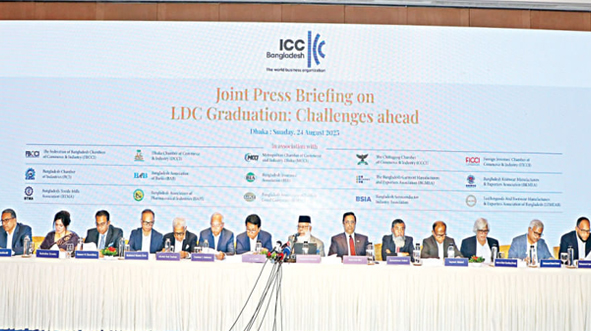
Leaders of Bangladesh’s major business chambers and trade associations have jointly urged the government to pursue an extension of the country’s Least Developed Country (LDC) graduation timeline to 2032, instead of the currently scheduled 2026, citing concerns over trade competitiveness and economic preparedness.
The call was made at a press conference titled “LDC Graduation: Challenges Ahead” held in Dhaka recently, where industry leaders warned that a premature graduation could expose the economy—particularly the readymade garment (RMG) sector—to severe external shocks.
BGMEA President Mahmud Hasan Khan said that while graduation is a matter of national pride, it also comes with challenges such as the loss of duty-free and quota-free (DFQF) access to key export destinations. “Our RMG industry, which contributes over 80% of national exports, will face additional tariffs ranging from 8% to 12% in the EU market alone if alternative trade agreements are not secured in time,” he cautioned. He further noted that the current global economic uncertainties, rising energy costs, and supply chain disruptions have already weakened the resilience of Bangladesh’s export-oriented industries. “We need more time to build competitiveness, diversify products, and move into higher value-added segments,” he added.
Leaders from the Federation of Bangladesh Chambers of Commerce and Industry (FBCCI), BKMEA, Dhaka Chamber of Commerce and Industry (DCCI), and other associations echoed the sentiment, urging the government to intensify diplomatic efforts at the United Nations and with major trade partners for securing a six-year extension.
They also highlighted the need for:
· Export diversification into non-RMG sectors such as leather, ICT, and agro-processed goods.
· Capacity building for small and medium enterprises (SMEs) to withstand post-graduation shocks.
· Stronger trade negotiations for GSP+ status in the European Union and new bilateral free trade agreements.
· Policy support for skills development, technology adoption, and green industrialization.
FBCCI leaders warned that without an extension, Bangladesh risks losing around $7 billion annually in export competitiveness, which could slow GDP growth and affect employment in labor-intensive industries.
Despite the concerns, speakers at the press conference reiterated that LDC graduation remains a landmark achievement for Bangladesh, showcasing its remarkable progress in poverty reduction, human development, and economic growth over the last decade.
They stressed that the country should not reject graduation, but rather seek more “transition time” to prepare its economy for the challenges of the global marketplace.






Comment here