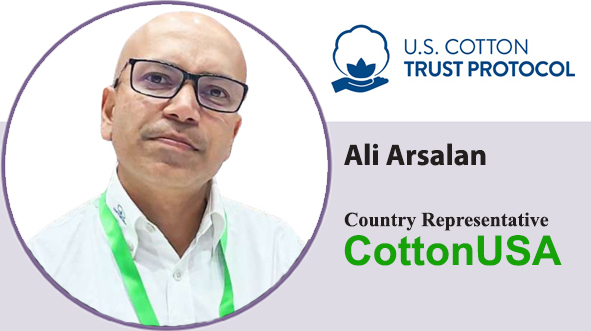
Bangladesh Textile Journal (BTJ) had the opportunity to speak with Mr. Ali Arsalan, Country Representative, Cotton USA, during ITMA ASIA 2025 in Singapore. We discussed the current status of American cotton, its opportunities in Bangladesh, and upcoming developments in the textile sector. The interview was taken by Shawkat Iqbal, Editor in Chief, BTJ.
BTJ: How was your experience at ITMA ASIA 2025 so far?
Mr. Ali Arsalan: Very good, thank you. The last two days were excellent. We also participated in ITMA Milan in 2023, and it was quite different there—mostly brands and exporters attend that event because it’s easier for them to travel. Here in Singapore, we are seeing more manufacturers, including many of our actual customers, because Singapore is more accessible, especially for Bangladeshi manufacturers, considering cost and visa convenience.
BTJ: Have you seen many Bangladeshi participants?
Mr. Ali Arsalan: Yes, quite a few. Mostly familiar faces in spinning, though we are also connecting with new people, particularly higher up in the garment sector. It’s a good opportunity to strengthen relationships and meet new potential partners.
BTJ: Can you update us on the current situation of American cotton?
Mr. Ali Arsalan: I recently visited the U.S., and the Texas crop was a little delayed but expected to begin ginning by the end of October. In Memphis, ginning already started, and in the Carolinas as well. California is slightly behind, but overall, the crop looks very good. Production estimates are around 14.5 million bales, though private shippers like Louis Dreyfus and Cargill may have slightly higher projections, around 15 million bales.
BTJ: We heard that American brands are increasingly seeking garments made from U.S. cotton. Can you elaborate?
Mr. Ali Arsalan: There are several factors driving this trend. First, the U.S. Cotton Trust Protocol provides a fully traceable program from cotton to garment, with environmental metrics for brands using verified cotton, which is a strong attraction.
Second, there’s an executive order issued by Donald Trump stating that for any product imported into the U.S., if at least 20% of its value comes from U.S. raw materials, that portion is exempt from duty. For example, in a $2 t-shirt, if the cotton cost is $0.40 and its American cotton, duty is calculated only on the remaining $1.60. Third, upcoming legislation, such as the Buy American Cotton Act (BCA), will offer tax credits to U.S. companies importing garments made from U.S. cotton, yarn, or fabric. While yarn and fabric credits are unlikely to impact Bangladesh significantly, there are tax incentives related to cotton that could benefit U.S. cotton sales globally.
BTJ: Do you expect U.S. cotton sales to Bangladesh to increase significantly?
Mr. Ali Arsalan: I hope so. Last season, Bangladesh accounted for around 8%–9% of U.S. cotton market share. Ideally, we would like to see this rise to 13%–14% in the coming year, potentially even higher depending on the implementation of these incentives.
BTJ: Will this growth require new customers?
Mr. Ali Arsalan: Not necessarily. Most U.S. cotton in Bangladesh was consumed by a limited number of mills or used sporadically. Growth will likely come from these existing mills increasing their usage. Consequently, other cotton origins may see a reduction in market share as U.S. cotton becomes more prominent.
BTJ: Thank you, Mr. Arsalan, and we wish you continued success for the remainder of the event.
Mr. Ali Arsalan: Thank you very much. It’s a pleasure to be here.