The United States has reduced the countervailing duty rate on Bangladeshi products from 20% to 19%, marking another step forward in bilateral trade relations between the two countries. At the same time, Washington has clarified that no reciprocal tariff benefits will apply to certain apparel products manufactured in Bangladesh using cotton and synthetic fibers imported from the US.
A bilateral agreement formalizing these decisions was signed in Washington, DC, on Monday night (February 9, Bangladesh time), according to sources at the Ministry of Commerce.
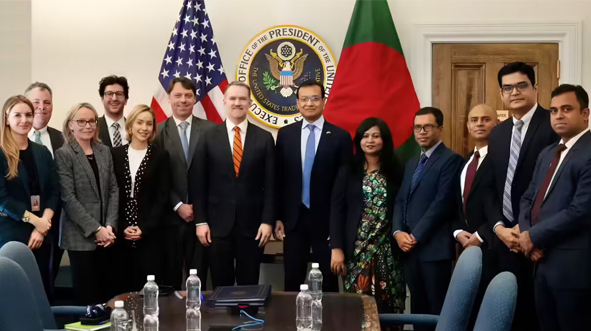
The agreement was signed on behalf of Bangladesh by Commerce Adviser Sheikh Bashiruddin and National Security Adviser Khalilur Rahman, while US Trade Representative (USTR) Ambassador Jamieson Greer represented the United States. The deal concludes nearly nine months of negotiations that began in April last year.
Commerce Secretary Mahbubur Rahman and Lutfe Siddiqui, special assistant to the chief adviser on international affairs, also took part in the discussions virtually.
Following the signing, Commerce Adviser Sheikh Bashiruddin described the agreement as a milestone in bilateral relations. “This agreement will take the economic and trade relations between Bangladesh and the United States to a new historical height. It will significantly expand opportunities for products from both countries to access each other’s markets,” he said.
National Security Adviser Khalilur Rahman, who led Bangladesh’s negotiating team, said the revised tariff structure would provide tangible benefits for exporters. “The reduction of the reciprocal tariff from 20% to 19% will offer additional competitiveness to Bangladeshi exporters. Moreover, the commitment to provide zero-duty benefits on selected textile and readymade garment products will inject new momentum into the RMG sector,” he noted. Officials at the Ministry of Commerce said the agreement has already received approval from the Advisory Council and will come into force once formal notifications are issued by both governments.
The latest adjustment follows a series of tariff revisions by the US. On April 2, 2025, President Donald Trump announced retaliatory tariffs on imports from around 100 countries, setting Bangladesh’s rate at 37%. That figure was reduced to 20% in August last year, and has now been further lowered to 19% under the new agreement.
In addition, the US has committed to introducing a special mechanism under which certain textile and apparel products made in Bangladesh using US-origin cotton and man-made fibers will qualify for zero reciprocal tariffs in the US market. Industry stakeholders view this provision as a potential incentive for deeper sourcing linkages between the two countries, although details of product coverage and implementation are yet to be announced.
The agreement is expected to have positive implications for Bangladesh’s export-oriented textile and apparel industry, particularly as the US remains the country’s single largest export destination.