EconomyBanking & FinanceInvestmentBusiness

Bangladesh’s foreign debt nearly triples in a decade, reaching $113.4 billion

BTJ News Desk
SHARE [addthis tool="addthis_inline_share_toolbox"]
Bangladesh’s external debt nearly tripled over the past decade, climbing to $113.44 billion at the end of 2025 from $38.77 billion in 2015, as the country’s reliance on foreign financing expanded to support infrastructure development, public investment and private-sector activities. According to the World Bank’s International Debt Statistics 2026, the country’s total external debt increased by approximately 193% over the 10-year period, placing Bangladesh among South Asia’s largest external borrowers. The debt stock rose steadily from $41.57 billion in 2016 to $51.07 billion in 2017 and $57.13 billion in 2018. It reached $62.48 billion in 2019 before accelerating to $73.56 billion in 2020 and $91.49 billion in 2021. The upward trend continued, with external debt reaching $96.95 billion in 2022, $101.38 billion in 2023, $104.50 billion in 2024 and $113.44 billion in 2025. Public and publicly guaranteed long-term external debt accounted for $83.46 billion of the total in 2025. Private-sector non-guaranteed external debt stood at approximately $9.87 billion, while short-term external debt amounted to $14.06 billion. The remaining amount included IMF credit and SDR allocations. The growing debt stock has also increased pressure on the country's repayment obligations. World Bank data show that Bangladesh's total external debt-service payments rose from $1.86 billion in 2016 to approximately $8.48 billion in 2025. Interest payments alone increased from $513.9 million in 2016 to $3.40 billion in 2025, reflecting the rising cost of servicing external borrowing. Bangladesh Bank data also indicate that external debt reached $113.52 billion at the end of December 2025, equivalent to 24.9% of gross domestic product. Public-sector external debt accounted for 20.5% of GDP. Economists have cautioned that although the country's debt burden remains manageable by several conventional indicators, rising repayment obligations, borrowing costs and foreign-exchange pressures require careful management. The challenge is particularly significant because Bangladesh depends heavily on export earnings, especially from the readymade garment sector, to generate foreign currency. Any sustained weakness in exports, remittances or foreign-exchange reserves could make debt repayments more difficult. The increasing cost of external debt also raises questions about the economic returns from large infrastructure and development projects. Foreign borrowing can support long-term growth when invested in productive infrastructure, industrial capacity, energy security and export diversification. However, projects that generate insufficient economic returns may place additional pressure on public finances. As Bangladesh prepares for its post-LDC economic transition, effective debt management will become increasingly important. Strengthening export competitiveness, attracting foreign direct investment, improving project selection and ensuring transparency in the use of borrowed funds will be essential to maintaining external financial stability. The central issue is no longer simply how much Bangladesh borrows, but whether the investments financed by those loans can generate sufficient economic growth and foreign-exchange earnings to meet future repayment obligations.

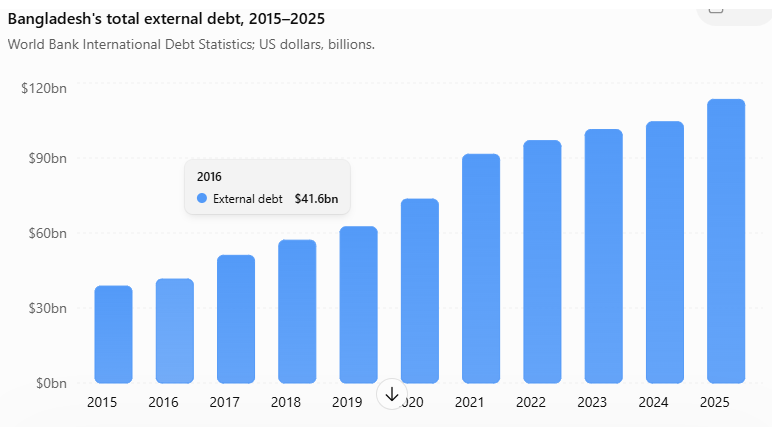
Bangladesh’s external debt nearly tripled over the past decade, climbing to $113.44 billion at the end of 2025 from $38.77 billion in 2015, as the country’s reliance on foreign financing expanded to support infrastructure development, public investment and private-sector activities.

According to the World Bank’s International Debt Statistics 2026, the country’s total external debt increased by approximately 193% over the 10-year period, placing Bangladesh among South Asia’s largest external borrowers.

The debt stock rose steadily from $41.57 billion in 2016 to $51.07 billion in 2017 and $57.13 billion in 2018. It reached $62.48 billion in 2019 before accelerating to $73.56 billion in 2020 and $91.49 billion in 2021.

The upward trend continued, with external debt reaching $96.95 billion in 2022, $101.38 billion in 2023, $104.50 billion in 2024 and $113.44 billion in 2025.

Public and publicly guaranteed long-term external debt accounted for $83.46 billion of the total in 2025. Private-sector non-guaranteed external debt stood at approximately $9.87 billion, while short-term external debt amounted to $14.06 billion. The remaining amount included IMF credit and SDR allocations.

The growing debt stock has also increased pressure on the country’s repayment obligations. World Bank data show that Bangladesh’s total external debt-service payments rose from $1.86 billion in 2016 to approximately $8.48 billion in 2025.

Interest payments alone increased from $513.9 million in 2016 to $3.40 billion in 2025, reflecting the rising cost of servicing external borrowing.

Bangladesh Bank data also indicate that external debt reached $113.52 billion at the end of December 2025, equivalent to 24.9% of gross domestic product. Public-sector external debt accounted for 20.5% of GDP.

Economists have cautioned that although the country’s debt burden remains manageable by several conventional indicators, rising repayment obligations, borrowing costs and foreign-exchange pressures require careful management.

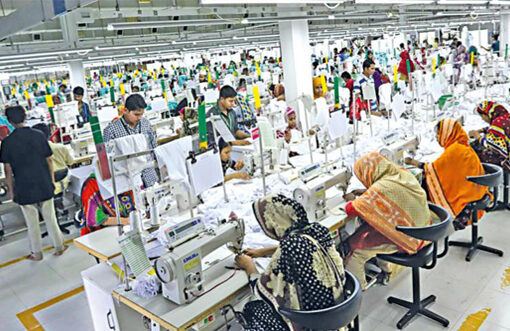
The challenge is particularly significant because Bangladesh depends heavily on export earnings, especially from the readymade garment sector, to generate foreign currency. Any sustained weakness in exports, remittances or foreign-exchange reserves could make debt repayments more difficult.

The increasing cost of external debt also raises questions about the economic returns from large infrastructure and development projects. Foreign borrowing can support long-term growth when invested in productive infrastructure, industrial capacity, energy security and export diversification. However, projects that generate insufficient economic returns may place additional pressure on public finances.

As Bangladesh prepares for its post-LDC economic transition, effective debt management will become increasingly important. Strengthening export competitiveness, attracting foreign direct investment, improving project selection and ensuring transparency in the use of borrowed funds will be essential to maintaining external financial stability.

The central issue is no longer simply how much Bangladesh borrows, but whether the investments financed by those loans can generate sufficient economic growth and foreign-exchange earnings to meet future repayment obligations.
SHARE [addthis tool="addthis_inline_share_toolbox"]