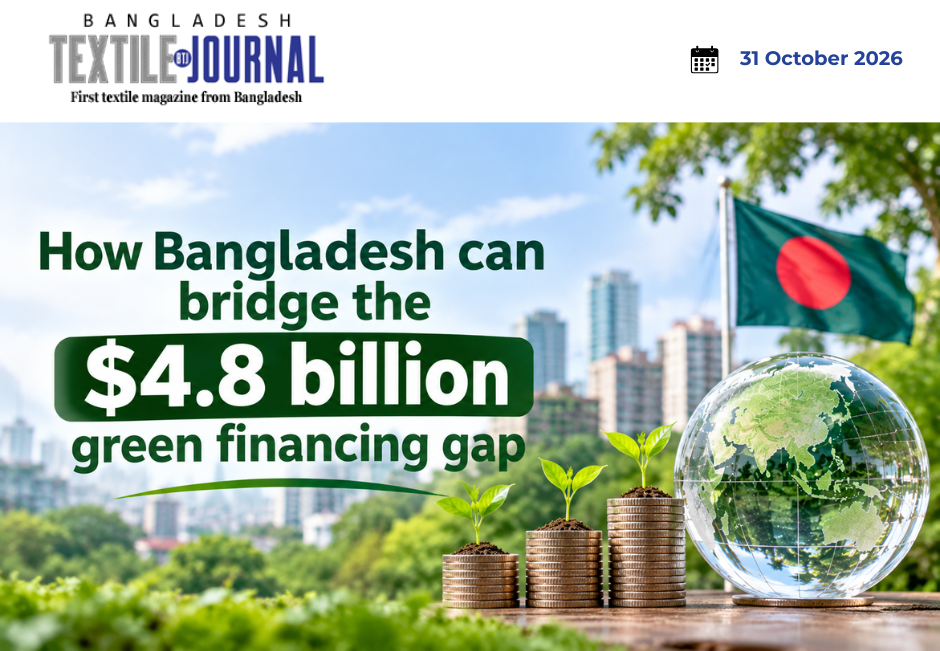
Bangladesh’s ready-made garment sector faces an estimated $4.8 billion green financing gap against a total investment requirement of $6.6 billion for 2025–2029. Industry experts warn that limited access to affordable finance could slow the sector’s transition to sustainable production and undermine its global competitiveness. At a Dhaka discussion on 29 October 2026, speakers highlighted the urgent need for green investment, accessible financing, and stronger public-private collaboration to reduce fossil-fuel dependence and support Bangladesh’s target of cutting greenhouse gas emissions by 50% by 2030.
Bangladesh needs a coordinated financing strategy involving the government, banks, development partners, international brands, and garment manufacturers. Key priorities should include:
- Expand affordable green loans: Banks should offer long-term, low-interest financing for renewable energy, energy-efficient machinery, wastewater treatment, and resource-efficient production.
- Introduce government-backed credit guarantees: This would reduce lending risks and help small and medium-sized factories access finance without excessive collateral requirements.
- Mobilise international climate finance: The government should work with multilateral development banks, climate funds, international buyers, and development partners to attract concessional loans, grants, and blended finance.
- Strengthen public-private partnerships: Government agencies, financial institutions, BGMEA, manufacturers, and global brands should jointly identify projects and share investment responsibilities.
- Prioritise measurable investments: Financing should target rooftop solar, energy efficiency, water recycling, cleaner production, and emissions reduction, supported by transparent monitoring.
- Ensure an inclusive transition: Smaller factories need technical assistance and simplified financing procedures, while investment programmes must protect workers’ livelihoods, particularly those of women.
Closing the $4.8 billion gap requires moving beyond conventional bank lending towards blended finance, risk-sharing, and international investment. With coordinated action, Bangladesh can accelerate factory-level decarbonisation, reduce energy costs, and strengthen the global competitiveness of its RMG sector.