Introduction
The textile and apparel industry has long been recognized as one of the key drivers of global economic growth, creating millions of jobs, supporting international trade, and meeting the clothing needs of a growing population. For decades, the industry’s success was measured by its ability to produce faster, cheaper, and at larger volumes. However, the landscape is changing rapidly.
Today, sustainability has become an important business consideration for manufacturers, brands, retailers, and consumers alike. It has become a critical business agenda driven by growing environmental concerns, climate change commitments, resource scarcity, evolving consumer expectations, and increasingly stringent regulatory requirements from major export markets.
The traditional “take-make-dispose” model that has dominated the textile value chain for generations is now being questioned. While this linear approach has contributed significantly to industrial development, it has also resulted in excessive consumption of water, energy, and raw materials, alongside increasing volumes of textile waste. As pressure mounts on the industry to reduce its environmental footprint, stakeholders across the value chain are searching for more sustainable and resilient production models.
In response, two concepts have emerged at the forefront of industry transformation: Green Manufacturing and Textile Circularity. Green manufacturing focuses on producing textiles with lower environmental impacts through efficient resource utilization, cleaner production technologies, and responsible environmental management. Textile circularity extends this vision beyond the factory gate by ensuring that products, materials, and resources remain in use for as long as possible through reuse, recycling, repair, and regeneration.
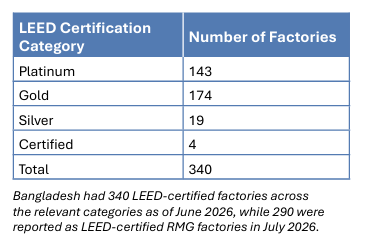
For Bangladesh, the relevance of these concepts is particularly significant. Over the past decade, the country has earned global recognition for its remarkable progress in sustainable manufacturing, becoming home to the world’s highest concentration of LEED-certified green garment factories. This achievement has strengthened Bangladesh’s position as a responsible sourcing destination and demonstrated the industry’s commitment to environmental stewardship.
However, the sustainability journey does not end with green factories. As global brands increasingly adopt circular business models and new regulations demand greater transparency, traceability, and resource efficiency, the next challenge for Bangladesh’s textile sector will be to move beyond sustainable production and embrace circularity across the entire value chain.
The future competitiveness of Bangladesh’s textile industry will not depend solely on production capacity or cost advantages. It will increasingly be defined by how effectively the industry can transform waste into value, reduce dependence on virgin resources, and create a more sustainable and circular manufacturing ecosystem. In this context, green manufacturing and textile circularity are no longer separate initiatives; they are complementary pillars shaping the future of the global textile industry.
Bangladesh’s Remarkable Journey in Green Manufacturing
Over the past decade, Bangladesh has emerged as a global benchmark for sustainable apparel manufacturing. Following significant investments in environmental compliance, workplace safety, resource-efficient technologies, and sustainable infrastructure, the industry has transformed its international reputation and strengthened its position within global supply chains.
Today, Bangladesh is widely recognized as the global leader in green apparel manufacturing.
In addition:
- 54 of the world’s top 100 LEED-rated factories are located in Bangladesh.
- 18 of the world’s top 20 LEED-rated factories are located in Bangladesh.
- Approximately 550 factories are currently awaiting LEED certification.
- Bangladesh achieved a record 38 new LEED certifications in 2025.
- Twenty additional factory units received LEED certification during the first half of 2026.
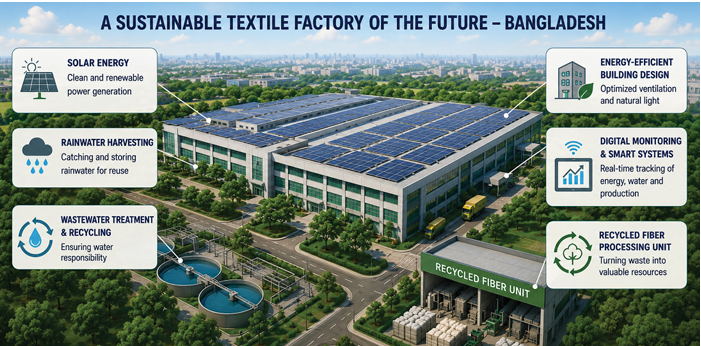
These achievements reflect substantial investments in:
- Energy-efficient machinery
- Water recycling systems
- Rainwater harvesting
- Renewable energy integration
- Heat recovery technologies
- Environmentally responsible chemical management
- Advanced wastewater treatment facilities
Beyond environmental benefits, these initiatives have enhanced operational efficiency, reduced long-term costs, strengthened buyer confidence, and positioned Bangladesh as a preferred sourcing destination for sustainability-focused global brands.
However, while green manufacturing has established a strong foundation, the next phase of sustainability is already taking shape.
The Evolution from Green Manufacturing to Circularity
Historically, sustainability efforts in the textile industry have concentrated on reducing environmental impacts during production. While these initiatives remain essential, they do not fully address the growing challenge of textile waste.
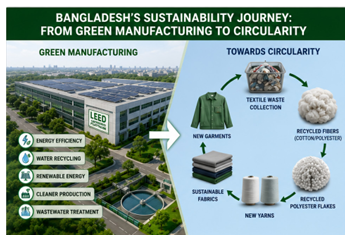
The future lies in transitioning from a linear production model to a circular textile economy.
The figure illustrates two different production systems:
Traditional Linear Model:
Raw Materials → Manufacturing → Consumption → Disposal / Landfill → Resource Loss
Circular Textile Economy:
Raw Materials → Manufacturing → Consumption → Collection → Reuse / Repair → Recycling → New Fibers & Fabrics → Manufacturing Again
In a circular economy, products and materials are continuously recovered, reused, and recycled rather than discarded. Waste is transformed into a resource, creating both environmental and economic value.
This transition represents one of the most significant shifts ever experienced by the textile industry.
Understanding Textile Circularity
Textile circularity is built upon three fundamental principles:
1. Eliminate Waste and Pollution: Waste should be designed out of products and manufacturing systems from the beginning rather than managed at the end of the process.
2. Keep Products and Materials in Use: Textile products should remain in productive use through reuse, repair, refurbishment, remanufacturing, and recycling.
3. Regenerate Natural Systems: Manufacturing practices should support environmental restoration and responsible resource management.
Unlike traditional sustainability approaches that focus primarily on reducing negative impacts, circularity aims to create systems where resources continuously generate value.
Green Manufacturing and Circularity: Two Complementary Approaches
Green manufacturing and textile circularity are often discussed independently. In reality, they are closely connected and mutually reinforcing.
| Green Manufacturing | Textile Circularity |
|---|---|
| Focuses on sustainable production processes | Focuses on sustainable product lifecycle |
| Reduces water, energy, and chemical consumption | Reduces waste generation and virgin resource dependency |
| Improves factory efficiency | Maximizes material utilization |
| Lowers production-related environmental impacts | Creates closed-loop material systems |
| Emphasizes cleaner production | Emphasizes resource recovery and reuse |
Table 2: Green Manufacturing vs Textile Circularity
Green manufacturing reduces environmental impacts during production, while circularity ensures that materials continue to create value long after their initial use.
Together, they form the foundation of a sustainable textile future.
Why Textile Circularity Matters for Bangladesh
Bangladesh’s textile and apparel industry processes millions of tons of fibers and fabrics annually. Alongside this production, substantial quantities of pre-consumer textile waste are generated through spinning, weaving, knitting, dyeing, finishing, cutting, and garment manufacturing operations.
Historically, much of this waste has been sold through informal channels or exported for recycling. However, advances in recycling technologies and increasing global demand for recycled materials are transforming textile waste into a valuable economic resource.
According to industry studies, Bangladesh generates hundreds of thousands of tonnes of pre-consumer textile waste annually, creating significant opportunities for recycling, resource recovery, and circular business models.
Circularity presents significant opportunities for Bangladesh:
- Improved resource efficiency
- Reduced dependence on virgin raw materials
- Lower environmental impact
- New business and investment opportunities
- Increased resilience against raw material price volatility
- Better alignment with buyer sustainability requirements
- Enhanced global competitiveness
For Bangladesh, textile waste should no longer be viewed as a disposal challenge but rather as a strategic resource.
Bangladesh’s Progress in Sustainable and Recycled Materials
While textile circularity is often discussed as a future direction for the industry, many Bangladeshi textile manufacturers have already taken important steps in this area over the last decade. Driven by buyer requirements, sustainability commitments, and increasing demand for responsible sourcing, the use of recycled and sustainable raw materials has become a regular part of business for many export-oriented mills.
Today, recycled cotton is being used by a number of spinning mills across the country. Cotton waste generated during spinning, weaving, knitting, and garment manufacturing processes is collected and reprocessed into recycled fibers and yarns. In addition to pre-consumer waste, some manufacturers have also started working with post-consumer textile waste recovered from used garments, particularly for products targeting brands with specific recycled-content requirements.
The use of recycled polyester has also grown significantly in recent years. Fabrics and garments made from recycled polyester, especially those derived from post-consumer PET bottles, are now widely supplied to international brands and retailers. As global brands continue to set ambitious targets for recycled content, many Bangladeshi mills have invested in the capability to develop and produce recycled polyester-based products on a commercial scale.
At the same time, the industry has expanded its use of other sustainable materials. Organic cotton, Better Cotton, TENCEL™ Lyocell, Modal, recycled nylon, hemp, linen, and various certified sustainable fibers are now regularly featured in fabric collections developed for international customers. What was once considered a niche market has gradually become part of mainstream product development for many mills.
The growing adoption of certifications such as GRS, RCS, OCS, and Better Cotton Chain of Custody standards further reflects this shift. Today, many buyers expect traceability and third-party verification of sustainability claims, making these certifications an important part of doing business in global markets.
Although there is still considerable room for improvement, these initiatives clearly indicate that Bangladesh is not starting its circularity journey from zero. The industry has already built valuable experience in recycled and sustainable materials.
The next challenge is to scale these efforts further, strengthen local recycling infrastructure, and create stronger linkages between textile waste generation and material recovery so that more value can be retained within the country.
Industry Examples and Market Response
The increasing use of recycled and sustainable materials is no longer limited to a few pioneering companies. Today, many export-oriented textile mills in Bangladesh are actively developing fabrics containing recycled cotton, recycled polyester, and other certified sustainable fibers for global brands and retailers.
Buyer interest in these products has grown significantly in recent years, particularly in European and North American markets where sustainability targets and environmental reporting requirements are becoming more stringent. As a result, recycled and sustainable materials are increasingly being incorporated into seasonal fabric developments and bulk production programs.
Several Bangladeshi manufacturers have also invested in certification systems, product traceability, and material verification processes to meet customer requirements. This shift indicates that sustainability is gradually becoming an integral part of product development and sourcing decisions rather than a separate initiative.
Global Regulations Driving the Circular Economy
The shift toward circularity is being accelerated by regulatory developments, particularly within the European Union, which remains one of Bangladesh’s largest export destinations.
Global brands are increasingly setting ambitious targets for recycled content, carbon reduction, and supply chain transparency. Simultaneously, policymakers are introducing regulations designed to promote circular production and responsible consumption.
| Regulation / Initiative | Focus Area | Expected Impact |
|---|---|---|
| Digital Product Passport (DPP) | Product traceability | Greater transparency requirements |
| Ecodesign for Sustainable Products Regulation (ESPR) | Product sustainability | Design for durability and recyclability |
| Extended Producer Responsibility (EPR) | Waste management | Increased responsibility for textile waste |
| Corporate Sustainability Reporting Directive (CSRD) | Sustainability disclosure | Enhanced reporting obligations |
| Carbon Reduction Initiatives | Climate action | Greater emphasis on carbon footprint management |
Table 3: Emerging International Sustainability Regulations Affecting Textile Exports
Future textile products entering major export markets will increasingly require:
- Verified sustainability information
- Supply chain transparency
- Product traceability
- Circular design attributes
- Recycled material content
Manufacturers that prepare proactively will be better positioned to maintain competitiveness in evolving global markets.
Circularity as a Business Opportunity
While sustainability is often discussed from an environmental perspective, circularity also presents significant business opportunities for Bangladesh’s textile industry.
As global brands continue to increase their use of recycled and lower-impact materials, manufacturers capable of offering circular solutions are likely to benefit from stronger customer engagement and access to new business opportunities. Recycled materials can also help diversify product portfolios and support value-added developments that align with emerging market trends.
In addition, improved resource utilization and waste recovery can contribute to greater operational efficiency over time. Materials that were previously treated as waste are increasingly being recognized as valuable resources that can generate economic returns.
As the global textile industry moves towards greater transparency and accountability, early investment in circular practices may also help manufacturers prepare for future regulatory requirements and maintain their competitiveness in international markets.
Key Challenges on the Road to Circularity
Despite growing momentum, several challenges remain. Although significant volumes of textile waste are generated, collection, sorting, and segregation systems are still fragmented. Ensuring a consistent supply of recyclable materials remains a challenge for large-scale circular initiatives.
Limited Recycling Infrastructure
Although Bangladesh generates substantial textile waste, large-scale textile-to-textile recycling facilities remain limited.
Collection and Segregation of Textile Waste
Although Bangladesh generates a considerable volume of textile waste every year, the collection, sorting, and segregation processes remain fragmented in many cases. The quality and consistency of recyclable materials largely depend on effective waste management practices throughout the supply chain.
For circular systems to operate efficiently, waste must be collected, classified, and processed in a systematic manner. Strengthening these processes will be important for increasing recycling rates and ensuring a reliable supply of materials for future circular initiatives.
Technology and Investment Requirements
Advanced recycling systems, traceability platforms, and digital solutions require significant investment.
Supply Chain Complexity
Successful circularity requires collaboration among fiber producers, textile mills, garment manufacturers, brands, recyclers, policymakers, and consumers.
Skills Development
New capabilities related to sustainability reporting, circular product design, recycling technologies, and digital traceability are becoming increasingly important.
Policy and Regulatory Readiness
The industry must continue preparing for future sustainability requirements and international compliance expectations.
Addressing these challenges will require coordinated action from all stakeholders.
Strategic Roadmap for Bangladesh
Bangladesh has already built a strong foundation for sustainability through investments in green manufacturing, resource efficiency, and environmentally responsible production practices. These achievements provide a solid platform for expanding circular initiatives across the textile value chain.
Figure 2: Strategic Roadmap Toward Textile Circularity
The diagram presents the following progression:
- Green Manufacturing Foundation
- Resource Efficiency
- Waste Segregation & Collection
- Textile Recycling Infrastructure
- Recycled Fiber Integration
- Digital Traceability Systems
- Circular Product Design
- Circular Textile Economy
To accelerate progress, industry stakeholders should focus on:
- Expanding textile recycling infrastructure
- Encouraging recycled fiber adoption
- Investing in traceability technologies
- Promoting circular product design
- Strengthening industry-academia collaboration
- Supporting sustainability-focused innovation
- Developing supportive policies and incentives
By building upon its green manufacturing achievements, Bangladesh can position itself as a global leader in circular textile production.
Opportunities for the Future
The transition toward circularity is not simply an environmental obligation—it is a business opportunity.
Manufacturers that embrace circular principles can benefit from:
- Stronger buyer relationships
- Enhanced brand reputation
- Reduced material costs
- Improved operational efficiency
- New revenue streams from waste recovery
- Better compliance with emerging regulations
- Increased long-term competitiveness
As sustainability increasingly influences sourcing decisions, circularity is expected to become a critical differentiator within global textile supply chains.
The manufacturers that invest today will be the industry leaders of tomorrow.
Conclusion
Bangladesh’s textile and apparel industry has come a long way in its sustainability journey. Over the past decade, the sector has invested heavily in green buildings, resource-efficient technologies, wastewater treatment, and environmentally responsible manufacturing practices. The achievement of 290 LEED-certified factories is a reflection of the industry’s commitment to sustainable growth and its ability to adapt to changing global expectations.
However, sustainability requirements are evolving. Today, buyers are looking beyond factory certifications and focusing on the entire product lifecycle from raw material sourcing and production processes to waste management, recycling, and end-of-life solutions. As a result, textile circularity is gradually becoming an important part of future sourcing and business decisions.
For Bangladesh, this presents both a challenge and an opportunity. The industry generates a considerable amount of textile waste every year, much of which still has untapped value. With the right investments in recycling infrastructure, traceability systems, innovation, and collaboration across the supply chain, these materials can become valuable resources for future production.
The good news is that Bangladesh is not starting from scratch. The foundation has already been built through years of progress in green manufacturing. The next step is to expand that success by incorporating circular practices into the broader textile value chain.
The transition will not happen overnight, nor will it be achieved by manufacturers alone. It will require coordinated efforts from brands, suppliers, policymakers, recyclers, technology providers, and research institutions. But as global demand for sustainable and circular products continues to grow, those who prepare today will be better positioned for the future.
Bangladesh has already proven that it can lead in sustainable manufacturing. The coming years will determine how successfully the industry can convert that leadership into a truly circular textile ecosystem—one that creates value from waste, conserves resources, and supports long-term growth for both the industry and the environment.
References
1. Bangladesh Garment Manufacturers and Exporters Association (BGMEA). (2026). Green Factory Initiative and LEED-certified Factories in Bangladesh. Dhaka, Bangladesh. Available at: www.bgmea.com.bd
2. New Age Bangladesh. (2026). Bangladesh now has 290 LEED-certified RMG factories. Published 15 July 2026. Available at: https://www.newagebd.net/post/apparel/306174/bangladesh-now-has-290-leed-certified-rmg-factories
3. Ellen MacArthur Foundation. (2017). A New Textiles Economy: Redesigning Fashion’s Future. Cowes, United Kingdom. Available at: www.ellenmacarthurfoundation.org
4. Textile Exchange. (2025). Materials Market Report 2025. Textile Exchange, Texas, USA. Available at: www.textileexchange.org
5. Textile Exchange. (2025). Circularity Resources and Circular Economy Framework. Textile Exchange, Texas, USA. Available at: www.textileexchange.org
6. Reverse Resources. (2024). Bangladesh Textile Waste and Circularity Opportunities Assessment. Tallinn, Estonia. Available at: www.reverse-resources.com
7. European Commission. (2024). Ecodesign for Sustainable Products Regulation (ESPR). Brussels, Belgium. Available at: https://environment.ec.europa.eu
8. European Commission. (2025). Digital Product Passport (DPP): Enhancing Product Traceability and Circularity in the European Market. Brussels, Belgium. Available at: https://single-market-economy.ec.europa.eu
9. United Nations Environment Programme (UNEP). (2024). Sustainability and Circularity in the Textile Value Chain. Nairobi, Kenya. Available at: www.unep.org
10. World Economic Forum. (2024). The Future of Circular Fashion and Sustainable Textile Value Chains. Geneva, Switzerland. Available at: www.weforum.org
11. United Nations Industrial Development Organisation (UNIDO). (2024). Promoting Circular Economy and Resource Efficiency in Textile Manufacturing. Vienna, Austria. Available at: www.unido.org
12. Better Cotton. (2025). Annual Report and Global Cotton Sustainability Initiatives. Geneva, Switzerland. Available at: www.bettercotton.org
Author Bio
K. M. Ziauddin Mahamud
K. M. Ziauddin Mahamud is a textile professional with extensive experience spanning textile engineering, product development, marketing, sales, and business management. He currently serves as Manager, Sales and Marketing (Fashion) at Zaber and Zubair Fabrics Ltd., where he is responsible for global business development and works closely with international buyers to drive innovation in value-added and sustainable woven fabric solutions.
Mr. Mahamud is currently pursuing an M.Sc. in Textile Engineering (Textile Engineering Management) and holds a Postgraduate Diploma in Textile Industry Management from the Bangladesh University of Textiles (BUTEX). In addition, he earned a Master of Professional Marketing (MPM) from the University of Dhaka and a B.Sc. in Textile Engineering from the University of South Asia. His professional and research interests focus on product diversification, sustainable fabric innovation, textile value-chain upgrading, industry management, and global market strategy.