The Scale of an Invisible Problem
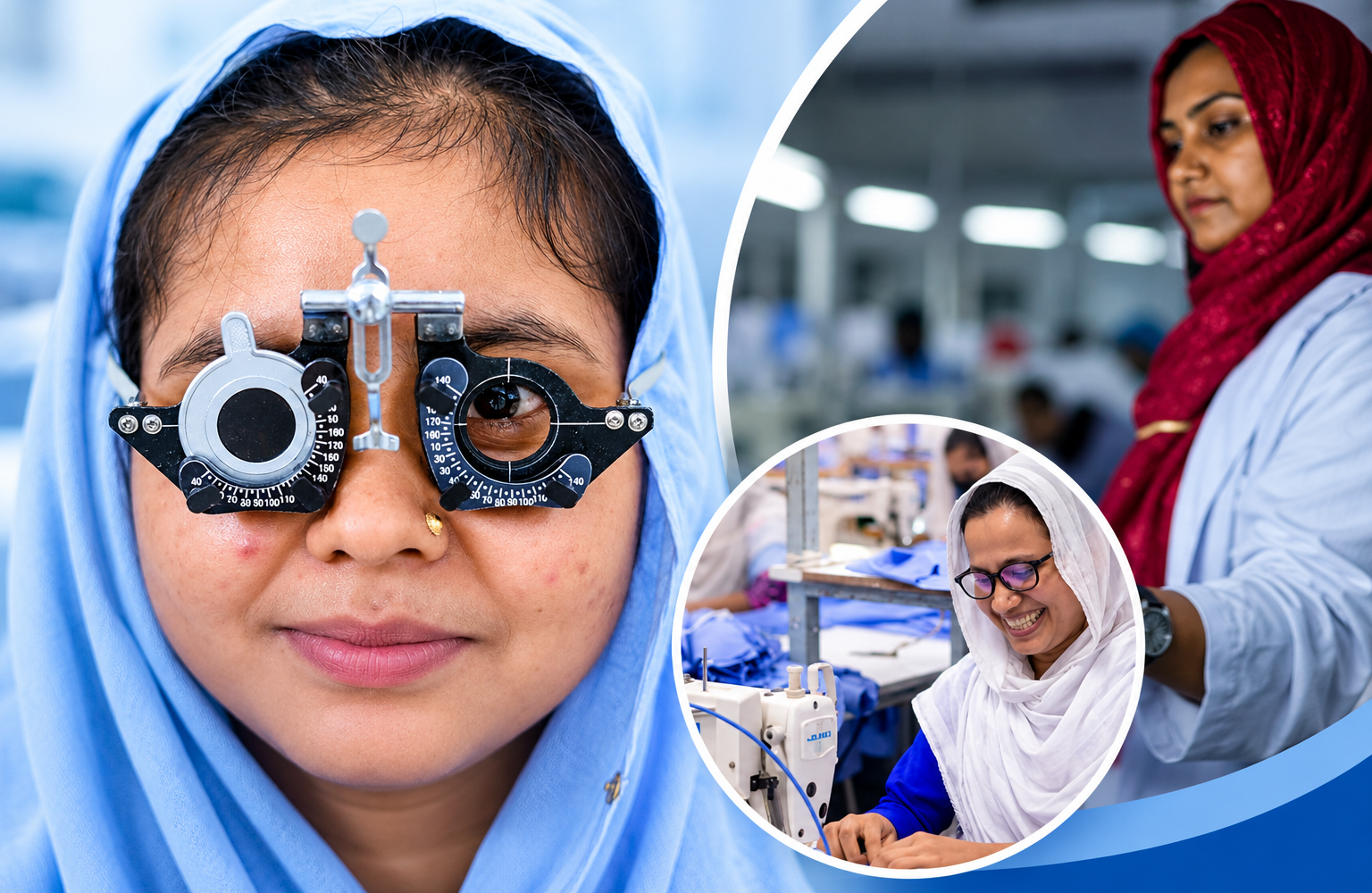
Refractive error is easy to overlook precisely because it does not announce itself. A worker who has never had her eyes tested does not know that her fatigue, her slowed pace, or her difficulty threading a needle stems from a correctable condition rather than a lack of skill. VisionSpring estimates that 30–37% of screened factory workers require corrective eyewear — a finding echoed at Masco Group, where the Associated Press reported that nearly a third of the roughly 5,000 workers screened left with a new pair of glasses. Ruma Aktar, a sewing machine operator at the factory, described the change in plain terms: threading a needle that once took her a long time now takes only moments.
The Evidence Behind the Intervention
The productivity case is not speculative. The PROSPER trial (Lancet Global Health, 2018) provided near glasses to 751 tea pickers in Assam and recorded a 21.7% productivity gain against a randomised control group. PROSPER II (British Journal of Ophthalmology, 2026), replicating the design inside Indian garment factories with 682 workers, found a 5.7% increase in hourly output — with every dollar invested returning approximately USD 3.37 within twelve weeks.
Two rigorous, peer-reviewed trials, conducted years apart in different settings, point to the same conclusion: correcting vision is one of the highest-return interventions available to labour-intensive manufacturing.
A Dual Return: For Workers, For Employers
The value of CVW is best understood as a genuine win-win. For workers, corrected vision means fewer headaches and less fatigue, faster and more accurate stitch work, fewer safety incidents, and a realistic path to higher output-linked earnings. For employers, the same intervention translates into reduced absenteeism, lower defect and wastage rates, and improved morale on the factory floor.
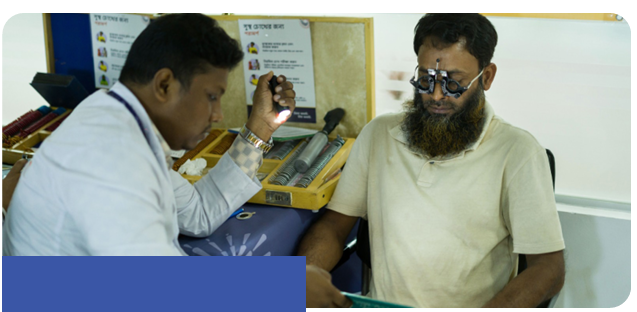
Following VisionSpring’s structured methodology — preliminary factory-level discussion, formation of a multi-departmental Vision Champion team, technical on-site screening, and dispatch of custom power eyewear — the programme is designed for operational integration rather than one-off charity. Its sustainment model, requiring at least twice-daily PA announcements for 60 days post-screening, ensures the intervention is not a single event but an embedded habit of eyewear use and care.
Beyond the Balance Sheet
Much of the value CVW creates will never appear in a compliance audit or a carbon inventory. An operator who finishes her shift without eye strain, reads her child’s homework by evening, or qualifies for a promotion she once could not reach — these outcomes sit outside conventional ESG metrics but are precisely why supply chain sustainability work exists. After a decade spent building decarbonisation, traceability, and compliance programmes across this industry, few interventions offer this ratio of cost to human dignity.
The Case for Scale
Clear Vision Workplaces is not a pilot in need of validation — it is a proven model in need of adoption. Brands, factory groups, and compliance bodies operating in Bangladesh, India, and Vietnam have an opportunity to fold vision screening into existing worker welfare and productivity agendas at minimal cost and demonstrable return. The evidence is published, the unit economics are favourable, and the human impact is immediate. The remaining question is not whether the intervention works, but how quickly the industry chooses to act on it.
References
- Ϻ PROSPER I, Lancet Global Health, 2018;6(9):e1019 e1027, DOI: 10.1016/S2214-109X(18)30329-2.
- Ϻ PROSPER II, British Journal of Ophthalmology, published online 27 April 2026, DOI: 10.1136/bjo-2025-328563.
- Ϻ Additional coverage: Associated Press, Washington Post, and Deutsche Welle field reporting from Masco Group, 2026.
About the Author
Mohammad Abdul Qaium
Sustainability Manager
OVS Hong Kong Sourcing Ltd. (Bangladesh Liaison Office)
Emial: abdul.qaium@ovs.it