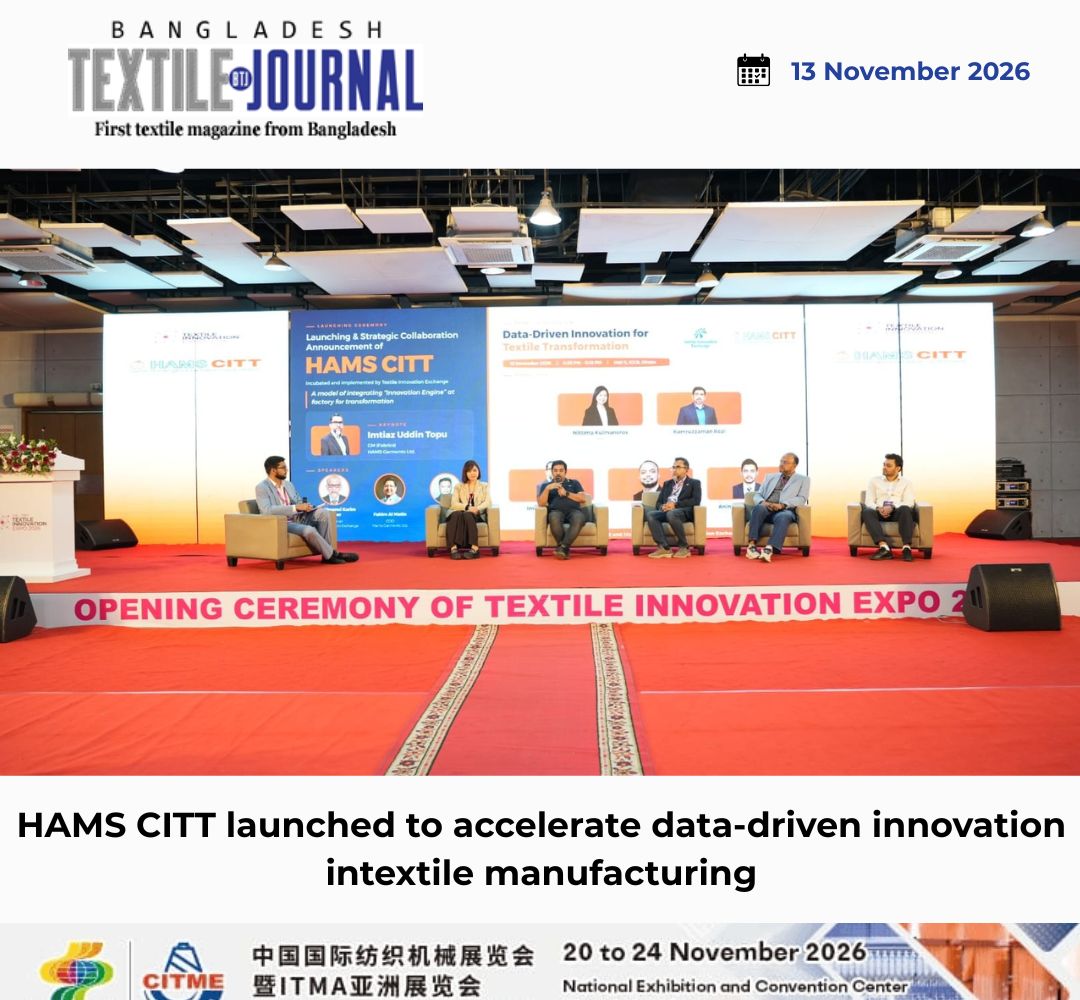
HAMS Garments Ltd. officially launched its Center of Intelligence for Textile Transformation (HAMS CITT) at the TIE–ITET Textile Innovation Expo 2026 at the International Convention City Bashundhara (ICCB), Dhaka.
The initiative is being incubated and implemented by Textile Innovation Exchange (TIE) to strengthen factory-level innovation by integrating shop-floor intelligence, production data, academic research and advanced technologies into a structured innovation ecosystem.
Designed as an internally hosted innovation platform, HAMS CITT aims to connect factory operations with researchers, universities, technology providers, brands and industry experts to develop practical, scalable and measurable solutions for manufacturing challenges. The center aspires to enhance digitalization and automation across HAMS operations, improve workforce capabilities, support Digital Product Passport (DPP) readiness and strengthen traceability systems.
According to the agreement between HAMS Garments Ltd. and Textile Innovation Exchange (TIE), TIE will play a central role in strengthening and operating HAMS CITT through six strategic service components.
These include building institutional innovation capability, developing data readiness and decision-support systems, facilitating global innovation intelligence and technology adoption, coordinating applied research and sustainable product development initiatives, supporting commercialization and wider industry adoption of innovations, and enhancing communication and global positioning.
Through its ecosystem of industry experts, research institutions, technology providers and implementation partners, TIE will help transform HAMS CITT into a structured platform that converts factory-level challenges into practical, scalable and commercially viable solutions.
As the incubation partner, TIE will support HAMS CITT through innovation capability development, formation of cross-functional innovation and research circles, expert and university engagement, technology scouting, pilot project implementation, innovation documentation, case study development and international visibility initiatives.
Leveraging the broader Textile Innovation Exchange ecosystem and the implementation experience of Textile Today Innovation Hub, the platform seeks to transform innovation from isolated projects into a structured and repeatable factory practice.
The launching ceremony featured a keynote presentation by Imtiaz Uddin Topu, GM (Fabrics), HAMS Garments Ltd. Speakers included Fahim Al Matin, COO, HAMS Garments Ltd.; Ziaur Rahman, Founder, Dialogue Partners; and Engr. Ehsanul Karim Kaiser, Chairman, Textile Innovation Exchange.
Following the launch, a panel discussion titled “Data-Driven Innovation for Textile Transformation” brought together representatives from global brands, sourcing companies, manufacturers and chemical solution providers.
The panel featured Nittima Kulmanoros, Regional Brand & Retail Manager, APAC, Business Division Textile Solutions, CHT; Kamruzzaman Real, Project Lead, H&M; Adil Hossain, Fabric Technical Manager, Next Sourcing Services Ltd.; Imtiaz Uddin Topu, GM (Fabrics), HAMS Garments Ltd.; Tareq Amin, Member Secretary, Textile Innovation Exchange and Founder & CEO, Textile Today Innovation Hub; and Anindya Sundar Golder, Brand Solutions Manager, Archroma. The discussion was moderated by Najmus Sakib, Coordinator, Textile Innovation Exchange.
The discussion focused on improving the quality, consistency and usability of factory data, particularly as European Union regulations and emerging Digital Product Passport (DPP) requirements increase the need for reliable product traceability.
It also highlighted the importance of connecting industry challenges with academic research, technology solutions and collaborative innovation to help manufacturers convert operational data into measurable improvements.
Through HAMS CITT, the company seeks to establish a structured approach to innovation, enabling factories to identify challenges, test solutions and scale successful initiatives. The initiative also presents a model for strengthening industry–academia collaboration and supporting Bangladesh’s transition towards more competitive, resource-efficient and sustainable textile manufacturing.