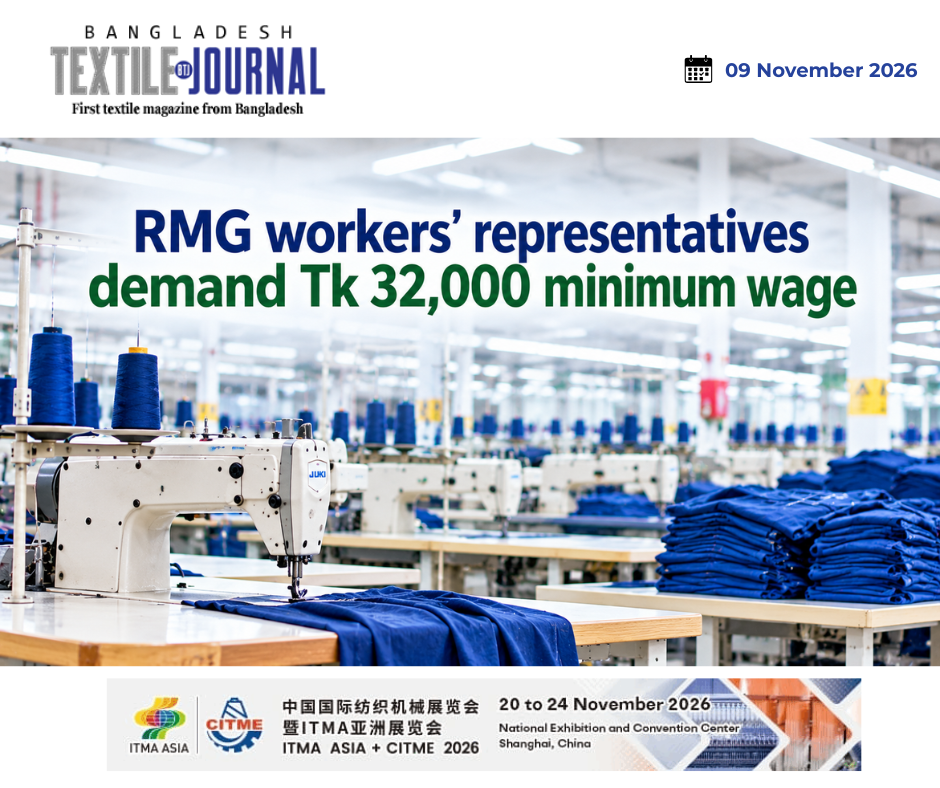
Labour representatives on Bangladesh’s Minimum Wages Board have proposed a minimum monthly wage of Tk 32,000 for workers in the export-oriented readymade garment (RMG) industry, citing persistent inflation and rising living costs.
The proposal was submitted at the board’s second meeting, held in Segunbagicha, Dhaka, on November 9. It comes amid growing demands from garment workers for a minimum wage of Tk 30,000, as inflation over the past four years has significantly reduced their purchasing power. The current minimum monthly wage stands at Tk 12,500, introduced in late 2023.
According to the workers’ representative, the proposed wage structure sets monthly minimum salaries at Tk 48,000 for Grade 1, Tk 43,000 for Grade 2, Tk 38,000 for Grade 3 and Tk 32,000 for Grade 4, the lowest existing grade. Newly recruited entry-level or apprentice workers would receive Tk 30,000.
Babul Akhter, the newly appointed workers’ representative on the board, said the proposal considered market prices, inflation, housing rent, healthcare expenses and children’s education costs. He noted that a family of four would require Tk 45,000–60,000 per month to meet its basic needs, although the workers’ side had moderated its demand in consideration of the industry’s financial capacity.
Syed Azad Subhani, chairman of the Minimum Wages Board, said the employers’ representatives had requested seven working days to submit their proposal, citing difficulties in visiting factories amid labour unrest in several industrial areas. Following discussions, the board granted them four working days, warning that it would proceed without the employers’ proposal if the deadline was missed.
Subhani said the board had unanimously agreed to visit factories across different categories in major labour-intensive industrial areas before its next meeting. He added that the board was considering workers’ purchasing power, the industry’s financial capacity and relevant national and international provisions while reviewing the proposed wage structure.
The chairman estimated that approximately four million workers were employed in the RMG sector, supporting a similar number of dependent families. He also confirmed that detailed justifications, grade structures and job classifications would be discussed at the board’s next meeting.
The proposed wage revision comes at a critical time for Bangladesh’s garment industry, as factory owners face mounting pressure to maintain industrial stability while balancing rising production costs and international competitiveness.