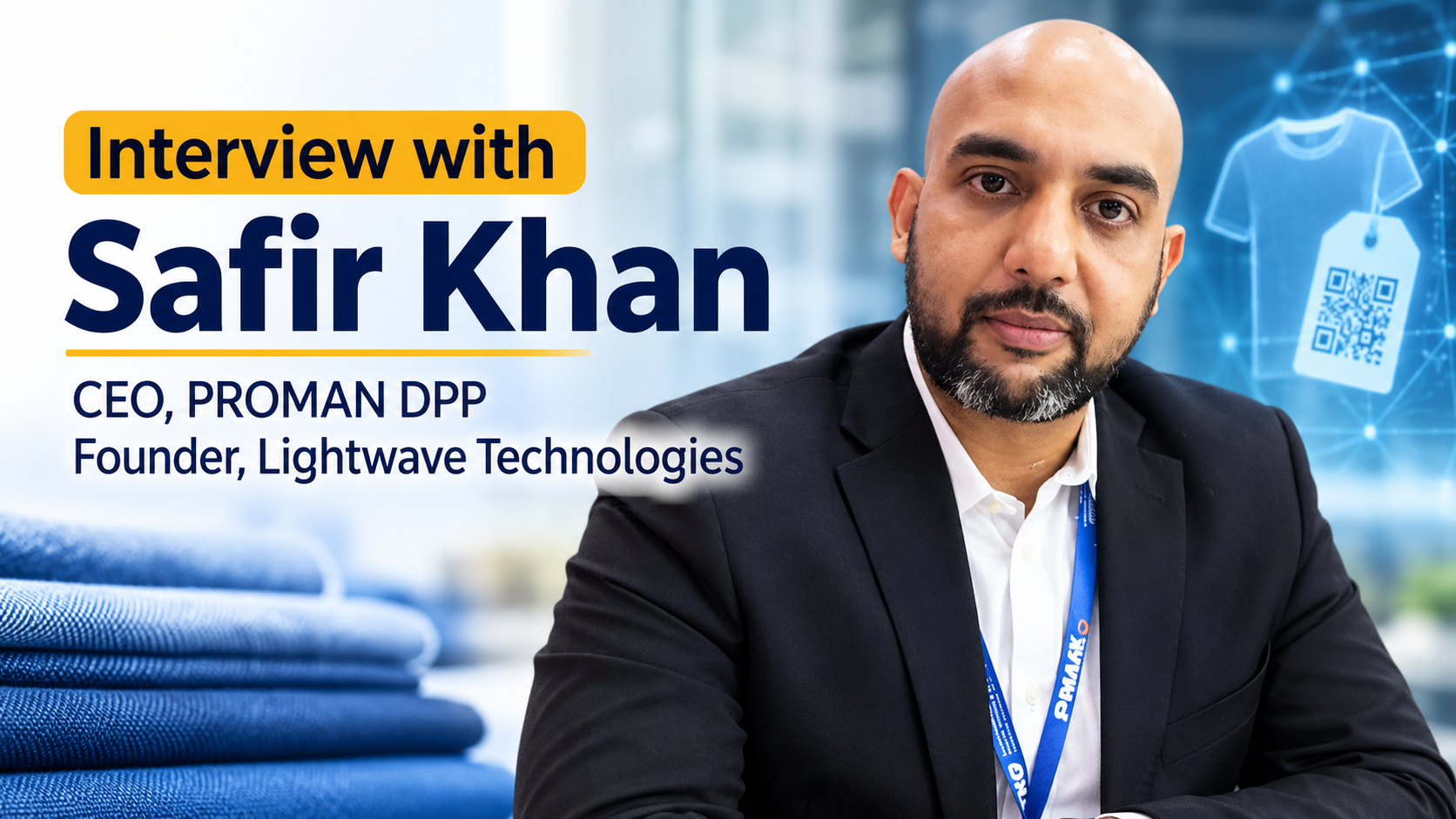
Bangladesh Textile Journal (BTJ): Please introduce PROMAN DPP and explain what the Digital Product Passport (DPP) actually is.
Safir Khan: PROMAN DPP is a solution designed to help manufacturers comply with the European Union’s upcoming Digital Product Passport requirements, which are expected to become mandatory for apparel exports to the EU from 2027 onwards.
A Digital Product Passport is essentially a digital identity for every garment. Unlike traditional care labels that contain only basic information such as size or brand, the DPP provides comprehensive product information. Through a simple QR code, users can access material composition, raw material sources, environmental impact, product lifecycle information, certifications and complete supply chain details.
In simple terms, the DPP combines all critical product information into a single digital passport that can be accessed instantly by customs authorities, buyers and consumers.
BTJ: Is PROMAN one of the first companies in Bangladesh offering a Digital Product Passport solution?
We believe we are among the first companies introducing a comprehensive DPP platform in Bangladesh. While several organisations are working on similar concepts, only a handful have reached the pilot stage.
PROMAN itself is a Silicon Valley-based company with operations in Bangladesh, and we recently launched this DPP solution specifically for the textile and apparel industry.
BTJ: How did PROMAN enter the traceability business?
Safir Khan: Before launching PROMAN DPP, we worked with the World Bank and Coca-Cola on traceability-related projects. Those experiences gave us strong expertise in supply chain transparency.
We realized that textile traceability would become one of the most important compliance requirements globally, especially with new European regulations. That encouraged us to develop a dedicated Digital Product Passport platform.
BTJ: How is a Digital Product Passport different from a traditional ERP system?
That’s an important distinction. An ERP system is generally a static database. Information remains unchanged until someone manually updates it.
A Digital Product Passport is a live and dynamic system. Every time someone scans the QR code, the system automatically verifies certifications and related information in real time.
For example, if a factory claims to have an OEKO-TEX certification, the system can instantly verify whether that certification is still valid.
BTJ: We heard that your system uses blockchain technology. Why is blockchain necessary?
Safir Khan: One important requirement of DPP is that product information should remain available throughout the product’s lifecycle—even if a company ceases to exist.
If all information remains inside a single company’s database, there is always a risk of losing that data.
Blockchain solves this challenge by storing data securely in a decentralised environment where no single company owns or controls the information.
Access remains encrypted and highly secure while ensuring long-term availability.
BTJ: What business models do you offer to the manufacturers?
Safir Khan: We provide two flexible options.
Manufacturers can either purchase Digital Product Passports on a pay-as-you-go basis or choose a subscription model.
Pricing depends on factory size and annual production volume. Based on the number of products requiring Digital Product Passports, we prepare customized commercial proposals for each customer.
BTJ: How long does implementation take for a factory?
Surprisingly, implementation is extremely fast.
Our platform is a plug-and-play solution. There is no complicated installation or lengthy system integration process. A factory can register, create its profile, upload product information and begin generating Digital Product Passports within a single day.
BTJ: Does a factory need to invest in additional servers or IT infrastructure?
No. Companies do not need to purchase servers or expensive hardware.
However, they must obtain a GS1 Digital Link (GTIN), which provides a globally unique product identification number. This identifier enables precise product traceability at batch level.
For example, it allows authorities to identify exactly which factory produced a garment, on which date, using which materials and suppliers.
BTJ: Is GS1 mandatory for Digital Product Passport implementation?
Absolutely.
Without GS1 identification, it becomes impossible to achieve the level of traceability required under the Digital Product Passport framework.
At border control, customs authorities need to distinguish between identical garments produced in different factories and different countries. GS1 provides that unique identity.
BTJ: Can you give an example of how DPP improves traceability?
Imagine a global brand like H&M orders 100,000 identical white shirts from factories in Bangladesh, India and the Philippines.
Today, customs officials only see an H&M shirt.
With Digital Product Passport, they will instantly know which specific factory produced each garment, where the raw materials came from, who supplied those materials and the complete manufacturing history of that individual product.
That level of transparency is exactly what future global supply chains will require.
BTJ: Finally, what message would you like to give to Bangladesh’s textile and apparel manufacturers?
Safir Khan: My message is simple: start preparing now.
Digital Product Passport should not be viewed as a burden. It is an opportunity to improve transparency, strengthen buyer confidence and position Bangladesh as a future-ready sourcing destination.
The earlier manufacturers begin adopting traceability systems, the easier the transition will be when DPP becomes mandatory for exports to the European Union.