Navigating complexity in a circular textile economy
The journey of fibres across fashion supply chains is a long and complex one. Many of the challenges in implementing sustainable practices are attributed to this complexity. Simultaneously, it is widely acknowledged that a transition to sustainable fashion systems will require deep collaboration amongst its stakeholders and common goal setting.
The implementation of regulation such as EPR (Extended Producer Responsibility), ESPR (Eco-design for Sustainable Product Regulation) and the accompanying DPP (Digital Product Passports (DPPs)) is seen as a pathway to better transparency and a wider spread understanding of fashion supply chains. Yet there is still a long way to go before cross-sector transparency and sustainability are achieved. Design as a translation practice (Baule and Caratti, 2016) is a key supporter of collaboration and innovation towards sustainable goals, the Garment Lifecycle Map is an example of how design research connects actors in the industry.
The principles of LCA which underpins much of the discourse on environmental impact reduction include a full lifecycle perspective (Mutambo et al., 2024). A range of research projects have been exploring ways of communicating across the divide between data-driven technical approaches and their translation to design features (Forst et al., 2023; Goldsworthy et al., 2017). Recent tools and methods to support designers advocate for a full lifecycle approach, highlighting that it is essential to consider all stages of a product’s journey from production to regeneration to enable circularity (WRAP, 2023).
Development of a full lifecycle visualisation for textile products
The garment lifecycle map is the result of a series of research projects in which fibre circularity was a key component. These were built on collaboration between multiple areas of expertise, from material science to community activators.
The concept for the tool was initiated as part of the HEREWEAR project, a large-scale research project funded by the European Commission to foster innovation for bio-based, local and circular textiles (HEREWEAR, 2024). As part of a state-of-the-art review of biobased materials, the foundations were laid to enable understanding and discussion of the raw materials, transformation processes, and end of life trajectories for different material types. The structure for the tool was developed through a classification of over 50 biobased materials, through the identification of the fibres and processes they are made from. This work was supported by a series of expert interviews to validate the classification structure and the categories. A balance between simplicity and accuracy was key to achieving a level of information useful to designers. In subsequent work, mostly through the Future Observatory (Arts and Humanities Research Council / Design Museum) funded ‘New Composites’ project (Forst, 2024), the model was further developed to guide designers in using it in their material discovery journeys.
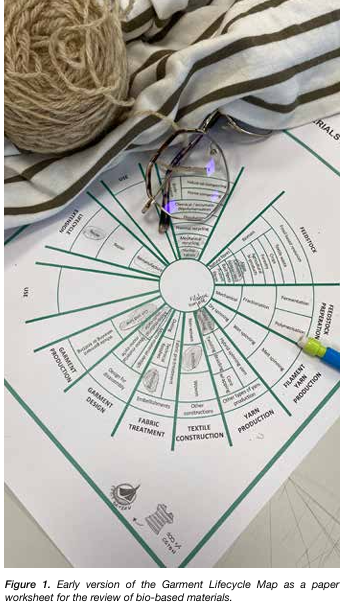
Figure 1. Early version of the Garment Lifecycle Map as a paper worksheet for the review of bio-based materials.
In these projects, the map took the form of an analogue tool, a card that was used and tested in workshops with design students, fashion brands and industry stakeholders. Gradually and through exchanges with experts and users, the vocabulary and structure were refined to lead to the development of the digital version of the map, this time targeted towards the general public.
The Garment Lifecycle Map
The digital tool was produced as an exhibit for the Design Museum (London)’s ‘Tomorrow’s Wardrobe’ exhibition. It is a product of a tight collaboration between Laetitia Forst and digital design studio Acre. Studio Acre provided the graphic identity of the platform and contributed greatly to the user-friendly reading of the technical information within, including diagrams and illustrations. The Design Museum curation team collaborated to enable a public-adequate output.
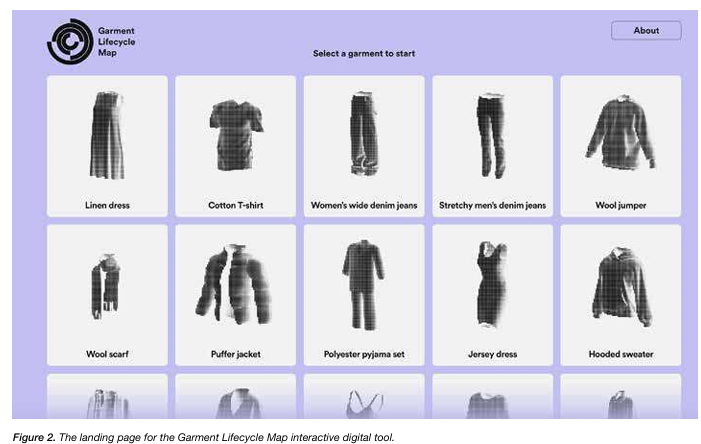
The landing page of the digital platform offers a choice of 20 garments as an initial demonstration sample. This sample covers the main product types that can be found in a UK wardrobe, including women’s and men’s wear, casual, party, and outwear.
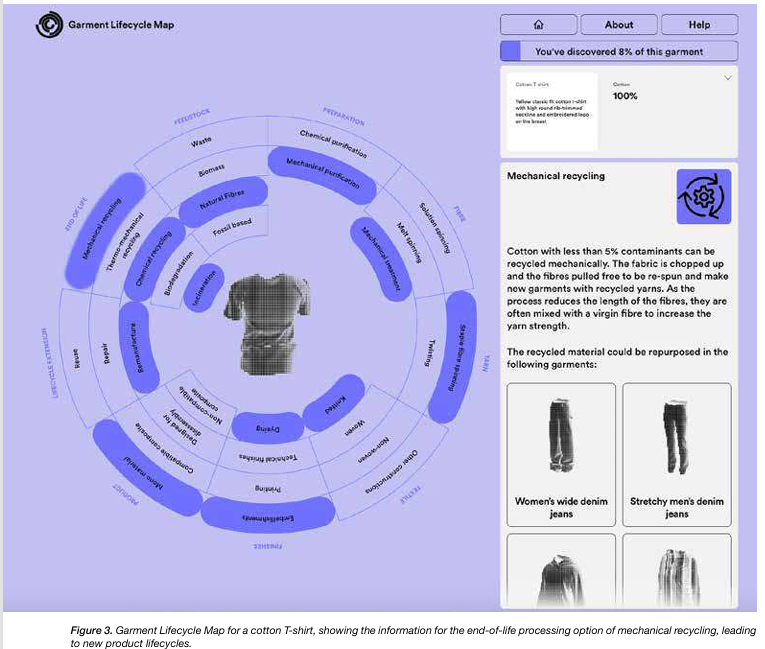
Once a garment selected, the user lands on the lifecycle map for this specific choice. The garment lifecycle map is represented as a circle, with slices allocated to each phase such as ‘raw materials’, ‘yarn production’, ‘fabric finishing’, ‘use’, ‘lifecycle extension’, ‘end-of-life’. Within each slice, different sections mark the options available for any fibre type, for example by listing fibre types across natural and synthetic fibres, or the types of fabric construction method.
The format of the visualisation encourages to think of garments following circularity principles of lifecycle extension and material recovery at end of life. When the garment selected is recyclable, the map will show the type of clothing that can include these recycled fibres in the product’s next life, clicking through to the next garment (as shown in figure 3 above with the ‘women’s wide denim jeans’ or the ‘stretchy men’s denim jeans’). When the garment selected is not recyclable, the explanation text will detail what is preventing fibre recovery such as the presence of a contaminating fibre or of non-recyclable trims.
The digital map’s aim is to support an increased awareness of garment lifecycles, including knowledge of fibre types, production and transformation processes, and how these affect circularity. When we know what our clothes are made of, it can be easier to take care of them and recycle them correctly at end of life.
Limits and future research
As a full lifecycle visualisation of materials to products, the garment lifecycle map holds a limited amount of information for each process, prioritising an overview over in-depth descriptions. In this sense, a user will not necessarily be told what each relevant process for a material is, but they will be able to visualise what parts of the lifecycle they currently have visibility on, and which ones require further attention. When used by a member of the public, it can provide a learning experience and impact garment use behaviour, in the hands of a designer, it might help highlight key leverage points for circular design.
From a designer’s point of view, knowing where materials come from and where they will go after use can be a difficult task, one that must be added to an already high-intensity and fast-paced job. The tool supports the visualisation of a product’s lifecycle, helping decision makers get an overview of the stages of processing where they might be able to action low-impact material or process switches. Tracing a product’s journey across the map has supported designers in identifying where more transparency in their supply chains could be needed.
The tool currently functions as a learning experience with top-level information, but further research and development could pair environmental assessment data with the different lifecycle stages to support decision making in a product’s development.
Opportunities for collaboration with the development of this tool are welcome, please get in touch.
Author Bio
Laetitia Forst,
Research Fellow in Circular Textile Design,
University of the Arts London, UK
Laetitia Forst is a circular textile design researcher at the University of the Arts London (UAL). She holds a master’s degree in textile design from ENSAD Paris, and a PhD on the subject of design for disassembly from UAL. Her work engages multidisciplinary collaborations, bridging the gap between material technology and design to support a shift to circularity in industry. She has been involved in a range of UK and EU funded research project pushing the boundaries of sustainable and circular textile. For instance the Remodelling fashion project explored future scenario building as a transformation method for businesses, the HEREWEAR project championed bio-based, circular and local innovation for textiles, and the Quantifying Circularity project developed carbon calculation methods for design for recycling. She has recently led on a further three UKRI funded projects: the Weaving for Reuse project, developing disassemblable textiles for in holistic fashion design, the New Composites project, setting guidelines for circular textile design with next-gen materials, and the Scaling Circularity project, developing a proof of concept for fashion product inventory classification for recyclability. In all projects, her focus is always on the role of design and textile experimentation to achieve sustainability.
References
Baule, G., Caratti, E., 2016. Introduction: Design and Translation, in: Proceedings of DRS 2016 International Conference: Future – Focused Thinking. Presented at the DRS16, Design Research Society, Brighton, UK.
Forst, L., 2024. Circular design with next gen materials: Guidebook.
Forst, L., Goldsworthy, K., Hildenbrand, J., Sánchez Domene, D., 2023. Lifecycle Design: A method for supporting design decision-making with LCA knowledge in an interdisciplinary research project. Presented at the PLATE 5th Product Lifetimes and the Environment Conference, Aalto University, Finland.
Goldsworthy, K., Peters, G., Sandin, G., 2017. Towards a Quantified Design Process: bridging design and life cycle assessment, in: Conference Proceedings. Presented at the Circular Transitions 2016, p. 14.
HEREWEAR, 2024. Herewear Hub [WWW Document]. Herewear Hub. URL https://herewear.tcbl.eu/node (accessed 1.26.26).
Mutambo, N., Peirson-Smith, A., KeChi-Okafor, C., Irving-Munro, A., Sheridan, K.J., Prendergast-Miller, M.T., Namdeo, A., Stanton, T., Gallidabino, M.D., James, A., 2024. Mapping the Environmental Impact Assessment Landscape in the Fashion and Textile Industries: Critical Gaps and Challenges. Sustainability 16, 8377. https://doi.org/10.3390/su16198377
WRAP, 2023. Circular Design Toolkit for Fashion and Textiles.