

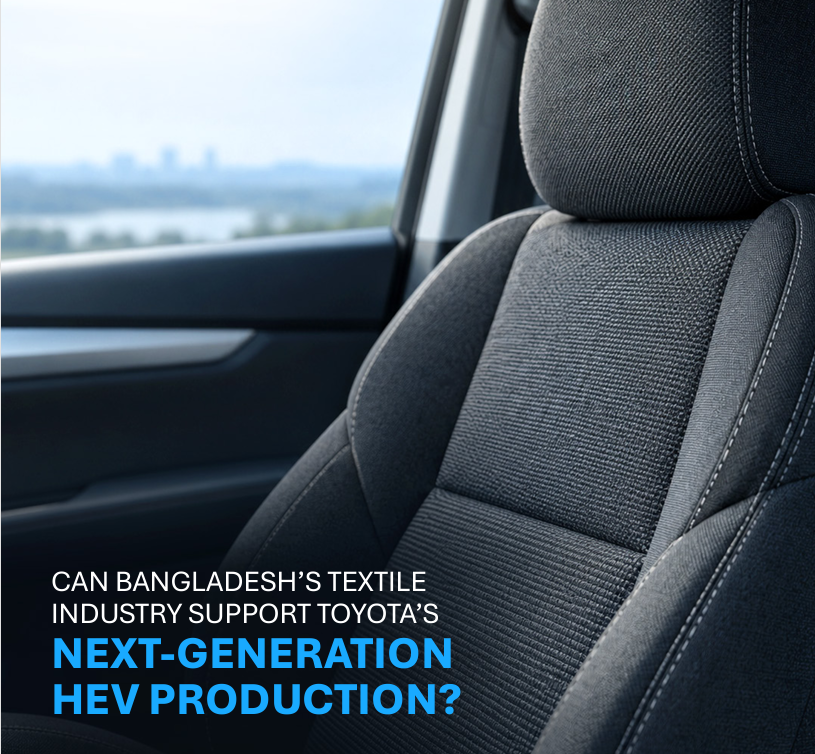
Bangladesh is approaching an industrial opportunity that could reshape its manufacturing identity. For decades, the country has built its global reputation around ready-made garments. Its textile ecosystem now extends across spinning, weaving, knitting, dyeing, finishing, nonwovens, accessories and increasingly sophisticated recycling and technical textile capabilities.
At the same time, Toyota is strengthening its presence in Bangladesh and promoting hybrid electric vehicles (HEVs) as an important pathway toward sustainable mobility. This raises a strategic question that goes beyond automobile sales or assembly:
Can Bangladesh manufacture the technical textiles and textile-based components required by the next generation of vehicles?
The answer today is partly yes—but Bangladesh is not yet ready for deep automotive-textile localization at Toyota’s highest standards. The opportunity, however, is substantial if the country prepares systematically.
An automobile is also a textile product
When automotive manufacturing is discussed, attention usually goes to engines, batteries, transmissions, electronics and metal components. Yet modern vehicles contain an extensive textile and nonwoven ecosystem.
Automotive textiles include seat upholstery and trim, airbags, seat belts and webbing, carpets, floor coverings, headliners, door-panel fabrics, trunk liners, acoustic insulation, thermal insulation, filtration materials and various reinforcement products.
Toyota itself has used advanced polymer- and textile-related materials in vehicle interiors. The company has previously highlighted bio-PET-based materials for applications including seat trim and floor carpets in hybrid vehicles.
This creates an interesting connection with Bangladesh’s textile industry.
The country already possesses enormous fabric conversion capacity. The challenge is to transform that capacity into automotive-grade engineered products.
Bangladesh already has a foothold
There is already evidence that Bangladesh can manufacture textile-based automotive components for Japanese supply chains.
Japanese company TS Tech Bangladesh, operating at Adamjee EPZ, produces seat-trim covers for export to Japan. Its products are used in vehicles associated with Honda, Suzuki, Yamaha and Kawasaki. The factory produces hundreds of thousands of units annually and has invested in automation and advanced production technologies.
This is strategically important.
It demonstrates that Bangladesh can meet demanding Japanese requirements in at least some automotive textile applications.
But supplying a limited range of seat-trim products is very different from creating a complete automotive technical-textile ecosystem.
HEVs raise the technical bar
A hybrid electric vehicle combines an internal combustion engine with an electric motor, battery, power electronics and sophisticated control systems. Its material requirements therefore go beyond those of conventional vehicles.
Potential textile and nonwoven applications include:
- Acoustic and thermal insulation;
- High-performance interior materials;
- Filtration products;
- Lightweight nonwovens;
- Protective and reinforcement materials;
- Advanced carpets and headliners;
- Specialized coated and laminated fabrics.
However, Bangladesh should remain realistic. Battery cells, high-voltage systems, power electronics, sensors and electronic control units require technological capabilities that the country does not yet possess at sufficient scale.
Therefore, the smartest strategy is progressive localization rather than immediate full localization.
Garment expertise is an advantage—but not enough
Bangladesh’s textile industry has several important advantages: a large manufacturing base, skilled workers, established spinning and fabric production, synthetic-fibre capability, dyeing and finishing, technical sewing, accessories production and an extensive supplier network.
But automotive manufacturing operates under a different quality philosophy.
In apparel, a defective product may be rejected by the buyer. In automotive manufacturing, a defective component can become a safety, warranty or product liability issue.
Automotive suppliers therefore operate under rigorous quality-management systems such as IATF 16949, together with processes including APQP, PPAP, FMEA, SPC, MSA, traceability and strict change control.
For Bangladesh, this means the future automotive supplier cannot compete on low labour costs alone. It must compete on:
quality + consistency + engineering + traceability + delivery + cost + sustainability.
The transformation must therefore be from cut-and-sew manufacturing to engineered manufacturing.
Japan can become Bangladesh’s technology bridge
Japan could play a particularly important role in this transition.
Recent initiatives involving Japanese cooperation have focused on developing Bangladeshi supporting industries and helping local manufacturers participate in Japanese high-technology supply chains, including automotive-related production.
This approach should be expanded.
Instead of waiting for automobile manufacturers to establish large-scale local supply chains, Bangladesh could actively create supplier-development programmes connecting Japanese OEMs and Tier-1 suppliers with Bangladeshi textile and manufacturing companies. The objective should be knowledge transfer, certification, product development and long-term supplier qualification.
What Bangladesh should do now
- Establish an Automotive Technical Textile Mission
Government agencies, BIDA, BTMA, BGMEA, universities and Japanese partners should jointly identify 20–30 automotive textile products suitable for initial localization. - Build international-standard testing facilities
Bangladesh needs reliable domestic laboratories for testing abrasion, tensile strength, flammability, colour fastness, dimensional stability, heat resistance, ageing and other automotive requirements.
Without credible testing infrastructure, localization will remain dependent on overseas laboratories. - Develop automotive-quality expertise
Bangladeshi manufacturers need specialists capable of implementing:
IATF 16949 → APQP → PPAP → FMEA → SPC → traceability → lean manufacturing.
This requires training engineers and managers—not simply adding sewing operators. - Invest in product engineering
The next generation of textile companies should employ material engineers, automotive designers, R&D specialists, quality engineers and product development teams.
The goal should be to develop materials rather than simply manufacture specifications supplied from overseas. - Start with Tier-2 and Tier-3 opportunities
Bangladesh does not need to become a direct Toyota Tier-1 supplier immediately.
A more realistic pathway is to supply approved materials and components to Japanese and global Tier-1 suppliers and gradually move upward in the value chain.
Reality versus opportunity
So, can Bangladesh support Toyota’s future HEV production with technical textiles?
Today: partially.
Bangladesh already demonstrates the ability to produce selected automotive textile components for Japanese supply chains.
Within the next three to five years: potentially much more.
With targeted investment in nonwovens, automotive fabrics, testing, coating, lamination, technical sewing and quality systems, Bangladesh could become a meaningful supplier of automotive textile products.
Longer term: the opportunity is much larger than Toyota Bangladesh.
The objective should be to create an automotive technical-textile ecosystem capable of serving Toyota, Honda, Suzuki, Yamaha, Nissan and global Tier-1 suppliers across Asia.
From garment exporter to manufacturing partner
Bangladesh’s apparel industry is approaching a strategic crossroads.
The country cannot depend indefinitely on low-cost basic apparel production. The next chapter should be about value addition:
- From cotton to synthetic fibres.
- From garments to engineered fabrics.
- From fashion textiles to technical textiles.
- From sewing to engineering.
- From supplier to development partner.
Toyota’s expanding presence therefore represents more than an automobile opportunity. It could become a test of whether Bangladesh can transfer its world-class textile manufacturing capabilities into technologically demanding industries.
Bangladesh already has much of the foundation: factories, workforce, textile expertise, Japanese business connections and a huge manufacturing ecosystem.

Author Bio
Ahamed Sorowar is a Textile Engineer and Team Leader, Merchandising at Asian Regency Limited, a leading apparel sourcing and liaison office in Dhaka. With over 18 years of experience in Bangladesh’s textile and apparel industry, he has worked with prominent organizations including Asmara International Ltd., Sunman Group, and Labib Group. His professional expertise spans global sourcing, merchandising, product development, supply chain management, and international buyer relations across Europe, the United States, Canada, and Japan.
He holds a graduate degree from City University and a postgraduate degree from Southeast University. He is the Founder and Convener of Branding Bangladesh RMG, Founder President and Advisor of the Textile Engineers Alumni Association of City University (TEAACU), Executive Board Member of the Apparel Merchandiser Foundation of Bangladesh (AMFB), former Organising Secretary of the Association of Textile Engineers and Technologists (ATET), and Head of Branding & Career Consultancy at Textile Xperts. He regularly writes and speaks on textile innovation, sustainability, sourcing strategy, industry competitiveness, and the future transformation of Bangladesh’s RMG sector.


