For most of the last century, a towel was sold by touch.
The buyer walked into a shop, pressed the pile between two fingers, and decided. Online, that gesture does not exist. The shopper has a photograph, a price, and a few lines of text, and has to imagine what the cloth will feel like after twenty washes.
We have been selling towels online in Brazil since August 2009, from Brusque, in Santa Catarina, one of the country’s textile regions. In August 2026, we published our first annual study of the Brazilian towel market, built on 21,546 real orders placed between January and July 2026, 46 months of transaction seasonality, twelve months of search data, and two checkout surveys. What we found changed the way we write a product page, and we hope some of it may be useful to manufacturers and exporters as well.
The First Surprise: Price is not the Objection
We asked 502 shoppers what worried them most before finishing the purchase. Quality and softness came first, with 22.3 per cent. Will it really be soft? Will it be what I expected?
High price was the main concern of 2.2 per cent. Shipping cost worried 16.1 per cent, and 17.3 per cent said their worry was simply that they had never bought from us before.
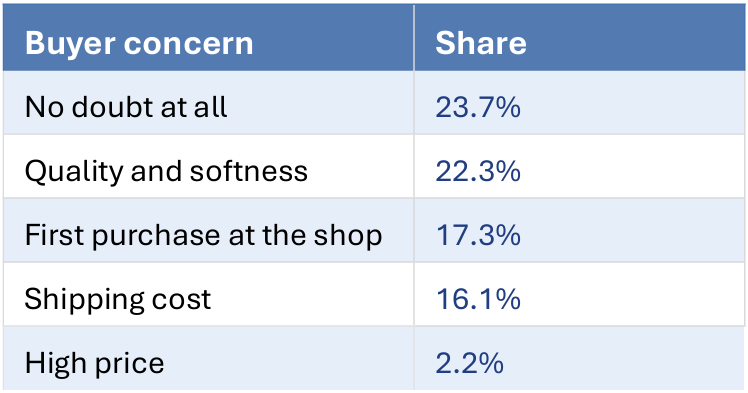
Table 01: What worried buyers most before finishing the purchase
Ϻ Checkout survey | 502 answers | 2026
Source: Annual Study of the Brazilian Towel Market 2026, Casa da Toalha.
For anyone selling home textiles, that order of concerns is worth a second look. Roughly ten times more people hesitated over quality than over price. A discount is always welcome, but it does not seem to answer the question they are actually asking.
The Second Surprise: The Consumer Learned The Vocabulary
Grammage used to be a mill word. It lived on spec sheets and in sourcing meetings.
In twelve months of Google Search Console data, searches using technical terms such as bath towel 500 GSM and what is the best GSM for a bath towel produced more than 20,000 impressions for a single shop. A second cluster, around hotel towels, produced roughly 15,000. The consumer is borrowing the hospitality industry as a quality benchmark, and borrowing our vocabulary to do it.
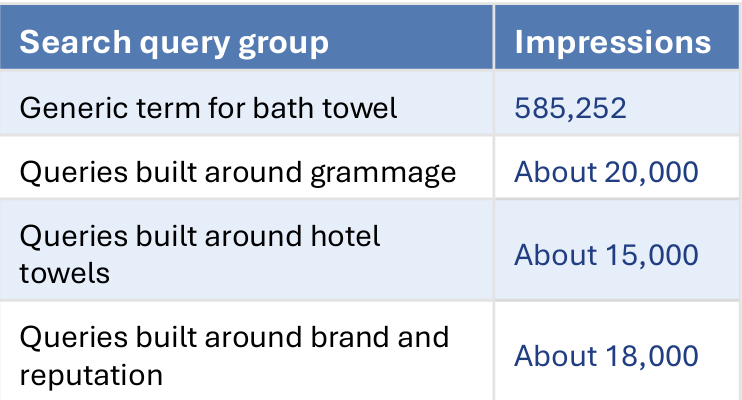
Table 02: Search impressions reaching a single Brazilian shop
Ϻ August 2025 to July 2026, Source: Annual Study of the Brazilian Towel Market 2026, Casa da Toalha.
We think that is good news for manufacturers. Technical accuracy became a selling argument rather than a complication.
Grammage Alone Can Still Mislead
There is one detail worth mentioning, because it affects the way buyers compare quotes.
Grammage is weight per square metre. It says nothing about how many square metres you are buying.
A bath towel of 78 by 145 cm at 500 g/m2 carries roughly 565 grams of cotton. A towel of 70 by 135 cm at the same 500 g/m2 carries roughly 472 grams. The same figure on the label, and almost twenty per cent difference in cloth.
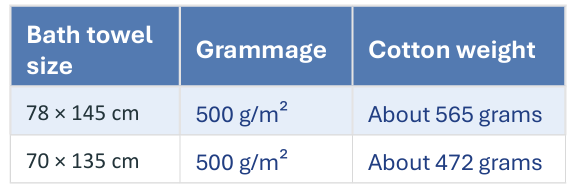
Table 03: Grammage against actual cloth. Calculated cotton weight at the same stated grammage. Same figure on the label, close to 20 per cent less cloth.
Ϻ Source: Annual Study of the Brazilian Towel Market 2026, Casa da Toalha.
Any buyer can redo that calculation in ten seconds, and it is very easy to leave it off a product page. We left it off for years. Once we began publishing grammage together with dimensions, the comparison became a fairer one.
Towels Are Bought As Sets, Not As Replacements
Of every 100 units of bath revenue, 89.70 came from five-piece sets and kits. Single towels accounted for 9.70. The average order was around 332 Brazilian reais.
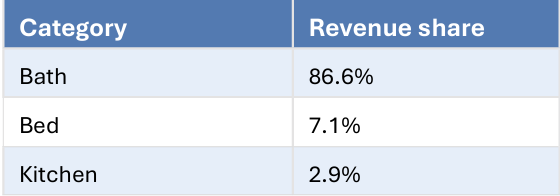
Table 04: Revenue by category
Ϻ 21,546 orders | January to July 2026
Source: Annual Study of the Brazilian Towel Market 2026, Casa da Toalha.
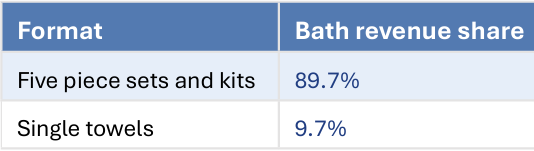
Table 05: Bath revenue by format
Ϻ 21,546 orders | January to July 2026
Average order value: 332.13 Brazilian reais
Source: Annual Study of the Brazilian Towel Market 2026, Casa da Toalha.
Brazilians tend not to replace one worn towel. They renew the whole bathroom at once. That has gentle consequences for packaging, for colour coordination across pieces, and for the way a range is built. A beautiful single towel can simply be a harder sell here than a coordinated set, because of the way the customer shops.
November Is The Month
Across the whole measured series, from October 2022 to July 2026, November was the peak in every single year: 3,251 transactions in November 2022, 3,968 in 2023, 5,736 in 2024, and 4,271 in 2025. In November 2024, sales nearly doubled against a typical month.
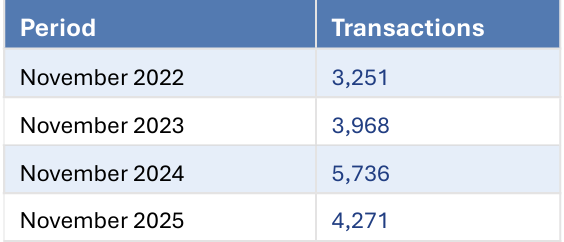
Table 06: November transactions
Ϻ The peak month in every measured year
Source: Annual Study of the Brazilian Towel Market 2026, Casa da Toalha.
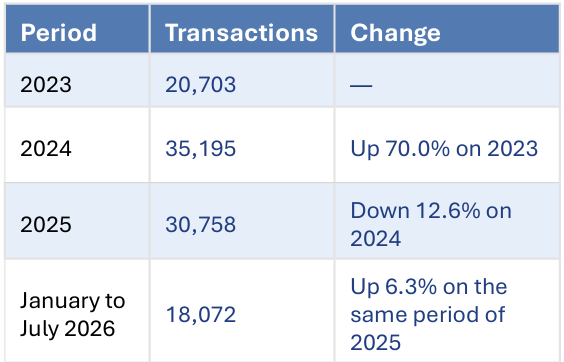
Table 07: Transactions per year
Ϻ Annual totals and partial year comparison
Source: Annual Study of the Brazilian Towel Market 2026, Casa da Toalha.
The second wave is the southern hemisphere winter, June to August. The quietest stretch is December to February. Brazilians renew towels on Black Friday and in the cold, not at Christmas.
Reputation Closes the Sale
Among buyers who told us what gave them the confidence to pay, 12.4 per cent named a consumer reputation platform and 7.1 per cent named other customers’ reviews and photos. Together, roughly one in five.
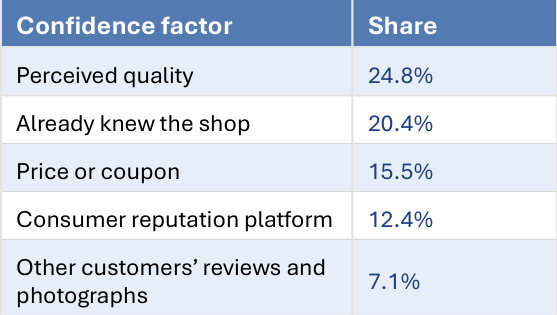
Table 08: What gave buyers the confidence to pay
Ϻ Checkout survey | 226 answers over one week | 2026
Source: Annual Study of the Brazilian Towel Market 2026, Casa da Toalha.
For an exporter, this may translate into something simple. The review layer of the retailer becomes part of your product. If the retailer cannot show it, the cloth is judged on a photograph alone.
What We Changed, And What We Still Cannot Answer
The study led us to rewrite product pages around composition, grammage, yarn type, dimensions, and finishing, and to stop leading with promotional pricing. It also showed us where we had gone wrong ourselves.
For years, we registered each colour as a separate product instead of treating colour as a structured attribute. When we sat down to analyse the history, roughly three quarters of order lines had no usable colour value. We cannot publish a colour preference breakdown this year. The information existed inside the business without being structured in a way a machine could read, and we suspect we are not alone in that.
We publish the limitations openly. The base reflects the customers of one shop, not a probabilistic sample of Brazil. The 226-response survey covers one week and is treated as a signal rather than a conclusion.
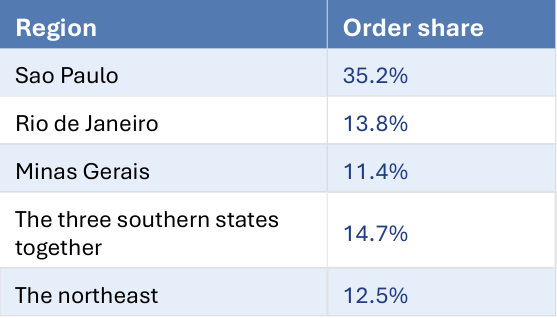
Table 09: Orders by region
Ϻ 21,546 orders | All 27 Brazilian federal units represented
Source: Annual Study of the Brazilian Towel Market 2026, Casa da Toalha.
Why We made it Open
The aggregated table behind every figure in the study is published as a CSV under a CC BY 4.0 licence. Any journal, mill, or student can download it, check our arithmetic, and correct us if we got something wrong.
Product discovery is moving from lists of links towards direct answers written by digital assistants. Those systems can only repeat what is written clearly, structured, and verifiable. The technical knowledge that used to live with the sales staff on the shop floor now has to survive the journey to the product page, to the data feed, and finally to the answer given to a shopper who will never touch the towel before paying for it.
That is the challenge we are working on here in Brusque, and we would be glad to hear how colleagues in Bangladesh are seeing it.
About Casa da Toalha
Casa da Toalha is a Brazilian online retailer specialising in towels and bed, table, and bath linens. Founded in August 2009 by the entrepreneur Ana Carolina Nielson, the company is based in Brusque, Santa Catarina, and holds a trademark registered with the INPI, Brazil national institute of industrial property.

Author Bio
Ana Carolina Nielson
Founder of Casa da Toalha, Brazil
Ana Carolina Nielson is the founder of Casa da Toalha, a Brazilian online retailer of towels and bed, table and bath linens. She started the company in August 2009 in Brusque, Santa Catarina, one of the textile regions of Brazil. Since 2026, she has published an annual study of the Brazilian towel market, with open data.