BTJ: Please introduce yourself and tell us about your professional journey?
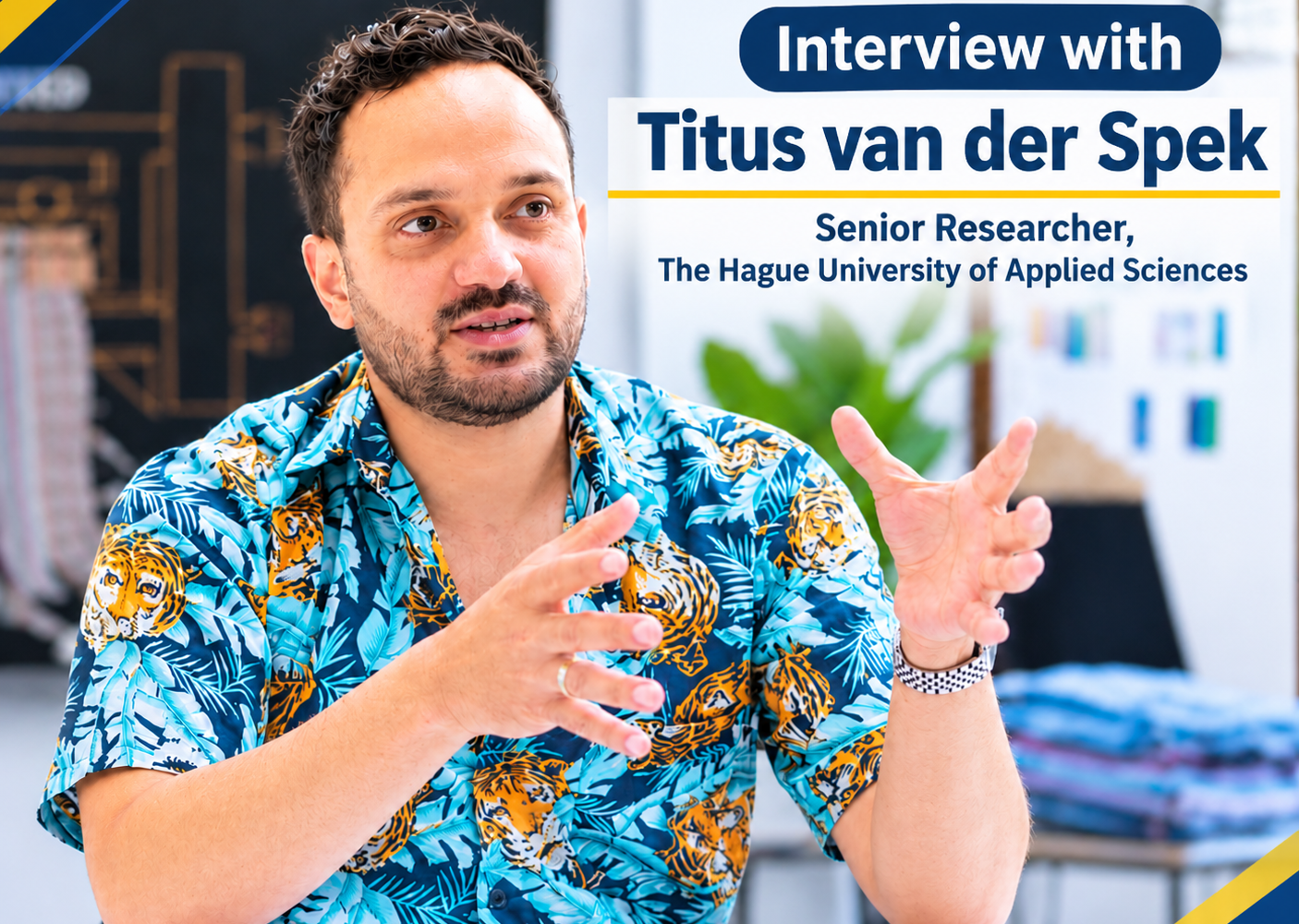
Titus van der Spek: I am a Senior Researcher at The Hague University of Applied Sciences in the Netherlands, where I work within the Sustainable Business Models research group. My work focuses primarily on textile circularity and on strengthening collaboration between Bangladesh and the Netherlands in building more circular textile value chains.
I have a unique personal connection with Bangladesh. My mother is Bangladeshi and my father is Dutch. I spent part of my childhood in Dhaka before continuing my education in India and later completing my PhD in Social Entrepreneurship at the University of Essex in the UK. Since then, Bangladesh has remained at the centre of much of my research and professional work.
BTJ: What inspired you to focus on circularity and sustainable textiles?
Titus van der Spek: My earlier research focused on entrepreneurship and supporting small businesses. Gradually I became more interested in understanding the broader systems in which businesses operate.
Sustainability cannot be achieved by looking at individual companies alone. It requires understanding policies, supply chains, markets and consumer behaviour.
Circularity became a natural extension of this systems-thinking approach. The textile industry is one of the world’s most important sectors for testing circular economy principles because it connects manufacturing, consumers, waste management and environmental impacts.
BTJ: How do you define circularity?
Titus van der Spek: For me, circularity means designing products and supply chains so that waste is considered from the very beginning—not after products become waste.
Today’s textile industry largely follows a linear model: produce, consume and dispose.
Circularity asks a different question: “How can we design products so they already have a second life built into them?”
Instead of simply recycling waste, we should redesign products, materials and business models so waste is minimized before it is even created.
BTJ: How do you define sustainability?
Titus van der Spek: Sustainability is the ability to sustain—not only the environment but also businesses, communities and future generations.
A truly sustainable system balances People, Planet and Profit. Environmental responsibility alone is not enough. Businesses must remain commercially viable while respecting workers’ rights and protecting natural resources.
BTJ: Is overconsumption one of the biggest obstacles to sustainability today?
Titus van der Spek: Absolutely. We now live in a culture of overconsumption. Fashion has shifted from four seasonal collections to new collections almost every week.
This encourages consumers to buy more clothing than they actually need. At the same time, garment quality has declined significantly. Many products today are intentionally designed with shorter lifespans, making them difficult to repair or recycle.
This trend is fundamentally incompatible with sustainability.
BTJ: Who is responsible for the sustainability challenge—the brands, manufacturers, governments or consumers?
Titus van der Spek: The answer is simple: everyone.
Consumers, brands, manufacturers, governments and even raw material suppliers all influence the system. No single stakeholder is solely responsible.
Instead of blaming one another, the industry needs greater collaboration. Circularity encourages us to look at the entire ecosystem rather than isolated actors.
BTJ: Can Bangladesh move beyond being a volume-driven manufacturing hub to becoming a global sustainability leader?
Titus van der Spek: Yes, and I believe Bangladesh has a real opportunity.
With increasing global competition, countries need clear competitive advantages. Bangladesh already has strong manufacturing capabilities. If it positions itself as Asia’s leading sustainable manufacturing hub, it could become a global benchmark.
That means moving from reacting to international regulations toward proactively defining what sustainable manufacturing should look like in 2030 and beyond.
BTJ: Do you think many manufacturers still misunderstand sustainability?
Titus van der Spek: In some cases, yes.
Many businesses still associate sustainability only with environmental compliance or buyer requirements. Sustainability should instead be viewed as something that benefits Bangladesh itself.
Clean rivers, healthy ecosystems, efficient resource use and stronger businesses all contribute to national prosperity. Sustainability should be embraced because it creates long-term value—not simply because overseas buyers demand it.
BTJ: If Bangladesh wants to accelerate circular transformation, which areas should be prioritized first?
Titus van der Spek: Over the next decade, I expect the strongest focus to be on:
- Digital Product Passport (DPP)
- Supply chain traceability
- Data collection and transparency
- Waste management
- Circular product design
However, I would encourage Bangladesh not to stop at recycling waste. The real opportunity lies in redesigning products and manufacturing systems from the beginning to eliminate waste altogether.
BTJ: Why has traceability become so important in the global textile industry?
Titus van der Spek: Traceability was introduced with positive intentions—to improve transparency, ensure responsible sourcing and strengthen accountability throughout supply chains.
However, implementation also creates significant costs. Manufacturers often bear the burden of meeting increasingly complex reporting requirements without receiving corresponding financial support from buyers.
The challenge is ensuring that traceability improves sustainability without placing excessive pressure on manufacturers.
BTJ: What impact will the EU’s Digital Product Passport (DPP) have on Bangladesh?
Titus van der Spek: Digital Product Passport will become one of the most significant developments affecting textile exports to Europe.
Manufacturers will increasingly need digital systems capable of documenting the complete lifecycle of products—from raw materials to finished garments.
Regulations will continue evolving, so companies should actively monitor policy developments rather than waiting until compliance becomes mandatory.
BTJ: What is the ‘TextileHack’ initiative?
Titus van der Spek: ‘TextileHack’ is an educational programme developed in collaboration with BGMEA University of Fashion & Technology (BUFT), Bangladesh Apparel Exchange and Dutch academic partners.
The programme teaches students circular economy principles, sustainability challenges and innovation methodologies. Participants identify industry problems and develop practical business solutions before presenting them to industry leaders.
Because of its popularity, TextileHack is now being transformed into a digital learning platform that will eventually serve around 1,000 students per semester.
BTJ: Can you tell us about the STAGE initiative with BAYLA?
Titus van der Spek: STAGE is a three-year programme jointly developed by The Hague University of Applied Sciences and the Bangladesh Apparel Youth Leaders Association (BAYLA), with funding from the Dutch Enterprise Agency (RVO) and support from the Embassy of the Netherlands.
The programme provides executive-level training for factory owners and senior industry leaders on circular business strategies. Participants develop customized sustainability roadmaps for their factories and are later connected with Dutch brands and technology providers through exclusive matchmaking sessions to encourage collaborative innovation.
BTJ: What role should collaboration play in achieving circularity?
Titus van der Spek: Collaboration is essential.
Manufacturers, brands, designers, technology providers, universities and governments must work together much earlier in the product development process. Instead of simply producing according to buyers’ specifications, manufacturers should actively contribute to product design, material selection and circular innovation.
Only through collaborative thinking can we create products that are designed for multiple life cycles.
BTJ: Finally, what message would you like to share with Bangladesh’s textile and apparel industry?
Titus van der Spek: Bangladesh has already established itself as one of the world’s leading apparel manufacturing countries. The next challenge is not simply producing more garments—it is producing smarter, more sustainable garments.
If Bangladesh embraces innovation, invests in future leadership, adopts circular business models and takes a proactive role in shaping global sustainability standards, it has every opportunity to become the world’s leading sustainable textile manufacturing hub.
The future belongs to those who are willing to think beyond today’s challenges and design tomorrow’s solutions.