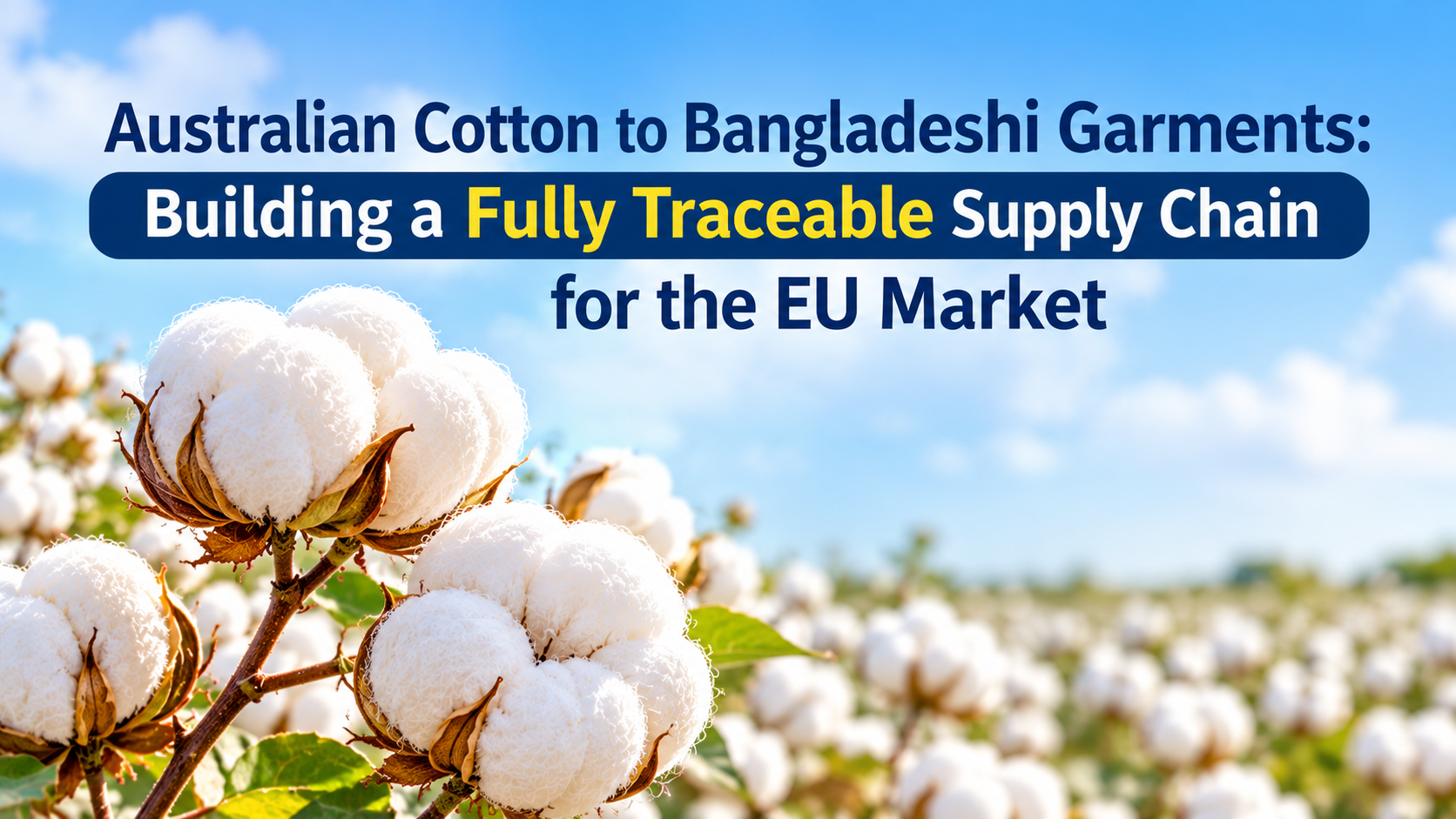
Australia and Bangladesh occupy opposite ends of the cotton value chain, but they have been building and expanding their trade partnership for many years now.
Australia is a major producer of premium raw cotton, well recognised for its fibre quality, consistency, low contamination and increasingly, measurable sustainability performance. Bangladesh, meanwhile, has developed one of the world’s largest textile and garment industries and is a vital supplier to fashion brands in many markets including Europe, US and Asia.
Connecting these strengths creates a compelling proposition – garments manufactured in Bangladesh from high-quality Australian cotton, supported by credible farm-to-product traceability and designed to meet the European market’s rising expectations for environmental and social transparency.
The opportunity is greater than simply selling more cotton. It is about building a differentiated, lower-risk and verifiable supply chain – from an Australian field to a finished garment sold in Europe.
Australia’s Place in the Global Cotton Market
Australia is one of the world’s largest cotton producers and depending on the year, they are the fourth largest exporter behind Brazil, US and India. More than 99% of the crop is exported to markets across Asia and the sub-continent, namely, China, Vietnam, Thailand, Indonesia, Bangladesh, India and to a lesser extent Pakistan and Türkiye.
As a predominantly irrigated crop, production varies with seasonal conditions and water availability. Nevertheless, Australia has demonstrated an ability to produce large, crops. USDA’s March 2026 outlook estimated production of 4.65 million bales in 2025/26 and forecast 4.9 million bales in 2026/27. USDA Foreign Agricultural Service.
Australia’s competitive position is therefore not based on volume alone. It rests on delivering a highly consistent package of fibre performance, supply reliability, traceability and sustainability credentials.
For Bangladesh, which must import almost all the cotton used by its spinning sector, diversification is important. West African cotton currently holds the largest share of the Bangladeshi market, while Brazil, India and the United States are also major suppliers. Australian cotton can complement these origins, particularly where mills need high-grade fibre, reduced contamination risk, dependable spinning performance or a traceable raw material for premium export programmes.
Quality That Translates into Mill Performance
Australian cotton is widely regarded as one of the world’s highest-quality upland cottons. The Australian Cotton Shippers Association (ACSA) provides data on typical quality characteristics including:
- Staple length of approximately 29–32 millimetres
- Strength of around 29–34 grams per tex
- Uniformity generally between 81 and 83
- Predominantly Strict Middling and Middling grades
- Consistent fibre properties and low contamination
These characteristics matter because spinning performance depends on much more than the headline purchase price of a bale.
Longer, stronger and more uniform fibre can support higher yarn strength, finer counts, lower end-break rates and more stable processing. Consistency between bales also makes blending and machine settings easier to manage. In turn, mills may benefit from higher productivity, fewer stoppages and less problems with yarn quality.
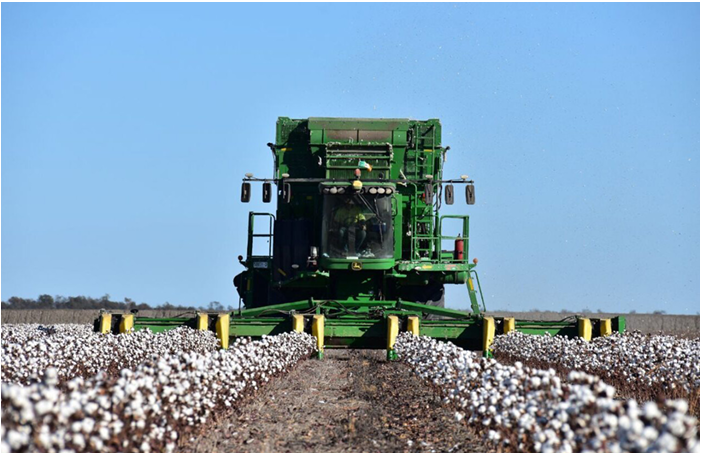
Australian cotton is mechanically harvested and ginned efficiently in the most modern ginning facilities. Australian classing rooms are monitored using ICA Bremen standards which have recognised it as one of the worlds least-contaminated cotton growths. The latest technology is employed in these classing rooms with machine classing used for colour and leaf. The supply chain from farm to gin is the most efficient and highly organised of any cotton exporting country.
Its reputation for bright colour, longer and stronger fibre, low trash and minimal foreign matter is particularly valuable, where contamination can create significant costs in spinning, dyeing and garment production.
For a spinner, lower contamination risk means fewer foreign-fibre faults, reduced clearing and sorting requirements, more consistent dye uptake and fewer fabric or garment claims. These operational benefits should be included when comparing the total value of cotton origins and not just the cost per pound. Every bale can be consumed with minimal waste produced.
Sustainability Built on Measurement and Improvement
Australian cotton is often described as one of the world’s most sustainable cottons. That claim should not be treated as a universal or absolute ranking. Sustainability depends on the indicators, boundaries and methodologies being used.
Australia’s stronger case is that it combines high productivity with extensive research, grower-level management systems and long-term measurement of environmental performance.
The Australian cotton industry produces an annual Sustainability Report that focuses on the pillars of “Planet, People, Paddock”. Water efficiency is a central part of that story with Australia being the driest inhabited continent, and water use in cotton production is highly regulated and closely scrutinised.
Industry reports indicate that, in most seasons, around 50% less water is now required to produce a bale of cotton than in 1997. Improvements have come from research and development into plant breeding, producing higher yields with better quality, soil-moisture monitoring, water budgeting, improved irrigation infrastructure and more precision farming methods to provide precise water application.
Australian Cotton Sustainability Report 2024
This does not mean that cotton has no water impact. Nor does it mean that every farm uses the same quantity of water. Results vary between regions, production systems and seasons. The credible message is one of substantial, measured improvement accompanied by continued responsibility for water stewardship.
Australia’s myBMP programme provides a further foundation. It covers areas such as soil health, water management, pesticide use, biodiversity, biosecurity, energy efficiency and workplace health and safety. Certified myBMP farms can also participate in the Better Cotton system through the alignment between the two programmes.
The Responsible Agriculture Advantage
Australian growers increasingly employ practices associated with regenerative agriculture, including minimum or zero tillage, crop rotation, controlled traffic, cover crops, retention of crop residues, integrated pest management and the protection or restoration of native vegetation.
These practices can improve soil structure, reduce erosion, support beneficial insects, build resilience and help farms retain moisture.
This continued focus on improving production whilst managing soil health and resources is a story that is well known to those Bangladeshi spinners that regularly visit Australian farms to understand where and how their cotton is produced.
That relationship and understanding will become increasingly important as European authorities scrutinise vague, selective or unsupported environmental claims.
From Bale Identity to Garment Traceability
Australia already has an important starting point for traceability. Every Australian cotton bale carries a unique barcode identifier, allowing it to be linked to its gin and production area.
But bale traceability is not the same as finished-garment traceability.
The chain becomes more complex when bales are opened and blended at the spinning mill. Yarn may subsequently be combined, knitted or woven into fabric, dyed, finished, cut and assembled across several facilities. If product identity and transaction records are not maintained at each transformation, the link to the original cotton can be weakened or lost.
An important development occurred in 2025, when physically traceable Better Cotton became available from participating Australian myBMP/Better Cotton farms through the Better Cotton Platform.
This provides a more scalable route for brands seeking verified Australian origin, although individual programmes must still define whether traceability is country-level, farm-level, segregated or based on controlled mixing.
There is also the question of who pays for this extra supply chain management and handling, the burden cannot be pushed back to the grower as it sends the wrong signal on valuing the extensive work done at farm level.
Preparing for the European Market
European regulation is changing what brands need to know about their products and supply chains. Under the EU Ecodesign for Sustainable Products Regulation (ESPR), textiles are a priority category for future product-specific requirements. The framework provides for Digital Product Passports that can make relevant product and sustainability information accessible electronically.
The European Commission indicates that companies will receive a transition period following the adoption of applicable delegated acts which are outlined for implementation in 2027.
European Commission Digital Product Passport
Other relevant developments include the EU Forced Labour Regulation, corporate sustainability due-diligence requirements and stricter scrutiny of environmental claims.
Collectively, these measures increase the commercial value of knowing:
- Where the cotton was grown
- Who processed and handled it
- Which chain-of-custody model was used
- What environmental and social standards were applied
- Whether claims are supported by primary evidence
- How product information can be independently verified
Traceability should also extend beyond the raw fibre. A European market garment needs credible evidence concerning Bangladeshi spinning, fabric production, wet processing, chemical management, labour conditions and garment manufacture. Strong provenance at farm level cannot compensate for weak controls later in the chain.
Responsible Procurement in Bangladesh
Australian cotton commands a premium over other growths such as West African, US, Brazil and Indian cottons. Buying Australian cotton needs to be treated as a strategic procurement decision rather than only a spot-price comparison.
The spinner should assess total cost in use, including:
- Fibre yield and waste
- Yarn realisation
- Machine efficiency
- Contamination-removal costs
- Yarn strength and evenness
- Dyeing and finishing consistency
- Inventory and financing requirements
- Claims and compliance risk
- Potential access to higher-value customers
The commercial question is whether better processing, lower risk and improved market positioning compensate for that premium.
For many commodity yarn applications, the answer will depend on price and specification. For higher-count, contamination-sensitive or traceable programmes, the value proposition may be considerably stronger.
A Logistical Advantage
Australia’s proximity to Asia can shorten the physical supply chain. Australian industry analysis has reported shipping times of approximately 14–21 days to Asian markets, compared with 50+ days from Brazil on some routes.
Actual transit times to Bangladesh vary by loading port, transhipment route, carrier and port congestion, but are within a range of 20–24 days. Australia can offer a more definitive lead-time advantage over the United States and Brazil.
For Bangladeshi mills, shorter lead times can reduce pipeline inventory, financing exposure and the risk of receiving cotton after market or production requirements have changed. It can also enable faster replenishment when garment orders shift unexpectedly.
This advantage is especially relevant as global brands demand shorter production cycles while simultaneously requiring more information about materials and suppliers.
Data Management
The Australian cotton industry is investing in a central traceability platform, managed independently of growers and merchants, which will hold significant data required for current and future sustainability, traceability and reporting requirements.
This project is a response to market signals that continue to demand more and more data but do not necessarily understand the critical nature of this farm-level data, nor the value contained therein. Centralising the data accounts for uniform data collection and dissemination as well as protecting the interests of the grower and industry.
Bangladesh continues to be an important market for Australian cotton, but increasingly we are acknowledging the growth in imports of garments from Bangladesh. Australian brands and retailers have mapped their supply chains and are strongly focused on sourcing Australian cotton for their products, Bangladesh spinners through to garment manufacturers can do this for them.
Partnership and Future Opportunities
In 2021, the Australia-Bangladesh Investment Framework Arrangement was established. This is not a Free Trade Agreement, but it identifies obstacles and areas where trade can be enhanced.
Two-way trade has grown strongly and is now worth approximately A$5.2 billion. Australian exports to Bangladesh reached about A$3.8 billion in 2025, according to Australia’s Department of Foreign Affairs and Trade, DFAT.
Bangladesh country brief
As Bangladesh transitions out of the UN’s Least Developed Country (LDC) status – scheduled for 2026 but could be extended – Australian cotton can support that transition by helping Bangladeshi manufacturers extend beyond low-cost garment production.
During a recent Austrade promotion of Australian Natural Fibres in Dhaka, the Australian Cotton and Wool industries came together to promote the value of these fibres from quality through to provenance.
There will continue to be opportunities open up for Australian cotton with Bangladeshi spinners. The cotton industry is a relationship driven business and when the value proposition aligns, ultimately, we have a people-to-people strength and understanding to underpins this future development.
Author Bio
Eimear McDonagh is a highly respected leader in the Australian cotton and agricultural sector, bringing 29 years of industry experience, extensive international networks and deep expertise across cotton, sustainable agriculture, supply chains and global trade. Her career is defined by professionalism, integrity, strategic insight and a strong ability to connect people, businesses and markets to create sustainable commercial opportunities.
As Director of Agri Vision Australia, Eimear is passionate about advancing sustainable and traceable Australian agricultural products and strengthening their position in global markets. Her extensive industry knowledge enables her to anticipate market and industry shifts, navigate complex commercial environments and build lasting relationships across the agricultural value chain.
Eimear joined the board of the International Cotton Association in 2019 and currently serves as the First Vice President, reflecting her standing and influence within the global cotton industry. In this leadership role, she contributes an Australian perspective to the international cotton community and supports greater collaboration, transparency and sustainable growth across the global cotton trade. She is also a co-founder of the ICA’s Women in Cotton initiative, raising the profile of women across the cotton value chain and advocating for more women in leadership positions.