

A case of political strategy over trade logic
Overview
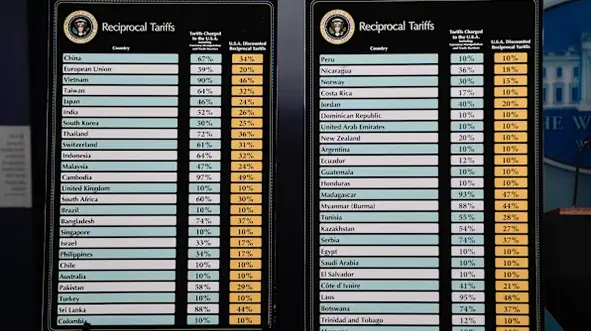
In a significant policy move, the United States under the Trump administration has imposed a 35% tariff on Bangladeshi products, citing a reciprocal tariff strategy. However, an analysis of the US trade deficit with Bangladesh and its competitors such as Vietnam and India reveals a stark inconsistency, indicating the decision may be more politically motivated than economically justified.

Trade gap analysis: disparity in tariff vs. deficit
| Country | US trade deficit (2024, in USD billion) | Tariff rate imposed by US |
| Bangladesh | 6.06 | 35% |
| Vietnam | 123.46 | 20% (reduced from 46%) |
| India | 45.80 | 26% |
Despite having the lowest trade surplus with the US among the three, Bangladesh has been subjected to the highest tariff. This contradicts the principles of a genuine “reciprocal” tariff policy, where nations with larger trade surpluses should face steeper penalties.
Bangladesh’s trade standing
· Bangladesh is the 52nd largest trading partner of the United States.
· In 2024, it exported goods worth $8.36 billion to the US and imported $2.29 billion, creating a trade gap of $6.06 billion in its favor.
· Comparatively, Vietnam and India, with trade surpluses many times greater than Bangladesh’s, enjoy lower tariff rates.
Analysts’ perspectives: Political motives over economic fairness
Experts argue that this tariff structure lacks economic rationale and instead reflects a geo-political strategy:
· Prof. Dr. Selim Raihan (Dhaka University) stated that the US tariffs are not aligned with WTO rules and appear to be based on political leverage rather than economic data.
· Dr. Masrur Reaz (Policy Exchange Bangladesh) emphasized that these actions are not just about trade volumes but about the US’s broader strategic interests, such as:
o Encouraging defense-related exports,
o Influencing bilateral political alliances,
o Rewarding nations with stronger diplomatic ties and lobbying power.
This has allowed Vietnam to negotiate down its tariff from 46% to 20%, showcasing how strong negotiation capacity and political access can influence trade outcomes.
Bangladesh’s weaker lobbying and diplomatic shortfall
The lack of proactive diplomacy and effective lobbying in Washington has placed Bangladesh at a disadvantage. In contrast, India and Vietnam:
· Maintain stronger bilateral dialogues,
· Leverage political connections within the US administration,
· Align strategically with US interests in the Indo-Pacific region.
This differential treatment is not only economically unjust but also sets a dangerous precedent that smaller, less influential countries may be penalized more severely than their larger counterparts.
Violation of WTO principles
The tariffs, as imposed, violate the core principles of non-discrimination under the World Trade Organization (WTO). WTO guidelines prohibit member nations from imposing arbitrary or politically motivated tariffs that do not reflect mutual trade balances or agreed-upon terms.
Recommendations: Multi-dimensional strategy for Bangladesh
1. Engage US political networks
Bangladesh must move beyond traditional trade talks and initiate high-level political dialogues. Establishing contacts with influential figures in the Trump administration and the Republican leadership is crucial.
2. Build strategic alliances
Strengthening ties with key US allies and engaging think tanks and lobbyists in Washington can help advocate for Bangladesh’s interests more effectively.
3. Strengthen economic diplomacy
Equip the Ministry of Commerce and foreign missions with resources and training for economic negotiation. Deploy specialized teams to advocate for fair trade practices.
4. Join forces with similar countries
Bangladesh can form alliances with other nations like Indonesia, Thailand, and South Africa—who also received tariff letters—to collectively protest the policy under the WTO framework.
5. Seek WTO Intervention if Necessary
If bilateral talks fail, Bangladesh should consider escalating the issue to the WTO dispute settlement body, challenging the discriminatory nature of the tariffs.
Conclusion
35% tariff on Bangladeshi products by the US is disproportionate, unjustified, and clearly motivated by political interests rather than trade logic. With a relatively modest trade surplus, Bangladesh should not be penalized more than its competitors with significantly higher trade imbalances.
To protect its export-driven economy, especially the ready-made garment (RMG) sector, Bangladesh must adopt a holistic strategy combining trade diplomacy, political outreach, and multilateral engagement to reverse this unjust tariff decision. The outcome of these efforts will be crucial not only for tariff relief but also for preserving Bangladesh’s long-term credibility and competitiveness in global trade.








Comment here