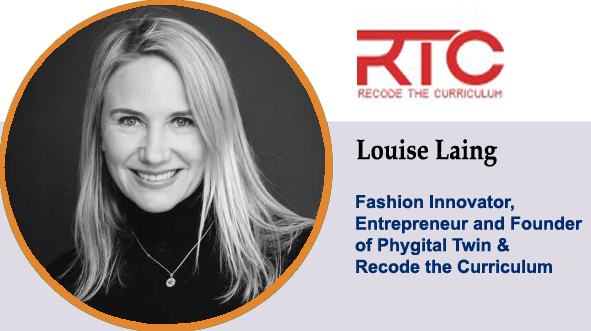
Louise Laing is a global fashion leader and entrepreneur redefining the future of fashion at the intersection of creativity, technology, and commerce. With more than 20 years of experience across heritage houses, emerging designers and startups, she has become recognized as a leading voice in the new era of ‘phygital fashion’, where digital and physical products coexist seamlessly.

Her corporate career began with senior leadership roles at Burberry and Reiss, where she delivered multi-million-pound efficiencies across sourcing, development, and supply chain. Later, as CEO of Shrimps, Louise spearheaded the brand’s international expansion and e-commerce growth, significantly increasing both revenue and profitability while protecting its creative identity. These experiences gave her a dual perspective: How to scale global luxury houses with heritage at their core, and how to accelerate nimble startups breaking into new markets.
Motivated by the inefficiencies she witnessed, long lead times, excess waste, and outdated systems, Louise left corporate leadership to become a founder. She launched PhygitalTwin, an AI SaaS platform that turns one 3D design into two monetizable outputs: a rigged, game-ready skin and a print-ready file for physical merchandise. What once cost around $500 and 8 hours per asset can now be produced for under £50 in minutes.
PhygitalTwin taps into a global shift already underway. The gaming industry is worth $180 billion annually, with 75 percent of that revenue driven by micro-personalization such as avatars, cosmetics, and digital fashion. Platforms such as Roblox ($2.9B), Fortnite ($5.5B), and GTA ($7.7B) have proven the scale of this opportunity. Roblox alone paid $352M to creators in 2024, showing how significant the creator economy has become. The wider avatar economy is already worth $77B, growing 20–30 percent annually, and digital fashion alone will reach $6.8B by 2025. Louise’s platform sits at the center of this transformation, building the infrastructure that allows creators, brands, and labels to launch phygital collections with no inventory risk and global fulfilment built in.
At the same time, she is tackling fashion’s most persistent bottleneck through her second venture, PHYGEN. The global apparel market is worth $1.7 trillion, but brands still spend billions annually on technical design and pattern engineering. The average cycle from sketch to factory handover takes 6–8 weeks, with 4–6 physical samples per style, each adding thousands in cost and weeks in delay. PHYGEN which is in development will collapse that workflow into hours, producing factory-ready patterns, graded size sets and full tech packs inside a simple SaaS system. Using constraint-aware parametric logic and real-time 3D simulation, it integrates seamlessly into existing CAD and PLM tools, automating what has long been manual and fragmented.
Together, PhygitalTwin and PHYGEN form a powerful ecosystem: one transforming how brands engage consumers, the other reengineering how products are made. The result is speed, efficiency, and sustainability at a scale the industry urgently needs.
Beyond her ventures, Louise is committed to inspiring the next generation. She founded Recode the Curriculum, a foundation that empowers girls to see technology as a creative and entrepreneurial pathway. Too many still believe “tech is not for me” shaped by education systems, lack of role models and risk aversion. Recode the Curriculum uses hands-on experiences and visible role models to change that mindset, embedding tech as something playful, creative, and confidence-building.
A recognized thought leader, Louise has spoken at the World Economic Forum in Davos, appeared on BBC Radio and advises global brands on how to embrace digital transformation. Her philosophy is simple: innovation is not optional. With consumer behavior shifting rapidly, 87 percent of Gen Z game weekly and 50 percent already buy digital goods, brands that fail to adapt will lose relevance.
Louise believes the next decade will be defined by phygital commerce, AI-powered design systems, and experience-driven consumer engagement. Her mission is to help brands and creators embrace this future with confidence, imagination, and a clear path to profitability.
Interview with Bangladesh Textile Journal
BTJ: You’ve held senior leadership roles at Burberry, Reiss and Shrimps before founding your own ventures. What motivated your transition from corporate leadership to entrepreneurship?
Louise Laing: I reached a point where I wanted to fix the problems I kept seeing from the inside. Long development cycles, wasted samples, and outdated systems were slowing the industry down. Entrepreneurship gave me the freedom to design solutions from scratch, rather than patching old ones.
BTJ: At Shrimps, you successfully drove e-commerce and international expansion. What leadership lessons from that experience still guide you today?
Louise Laing: That growth and creativity are not opposites; they can fuel each other. At Shrimps, we had to pivot quickly to meet demand, but always in a way that stayed true to the brand’s creative voice. That balance between agility and identity is something I apply to every venture.
BTJ: Having scaled both heritage brands and startups, how does your leadership style adapt to these very different contexts?
Louise Laing: In heritage houses, leadership is about protecting legacy and building consensus. In startups, it is about experimentation, agility, and resilience. I have learned to move between the two: respecting tradition where it matters, understanding the barriers to change, therefore, building with this in mind, never being afraid to test, fail fast, and move forward.
BTJ: PhygitalTwin merges digital assets with physical products. What was the spark that inspired you to create this platform?
Louise Laing: Watching my daughters and their friends in gaming worlds like Roblox made me realize how important digital identity has become. For Gen Z and Gen Alpha, what they wear online matters as much as what they wear offline. I wanted to build a bridge, so that one design could live in both spaces.
BTJ: How do you see the concept of phygital fashion evolving over the next five years?
Louise Laing: It will not feel like a niche anymore, it will simply be fashion. Fans will expect to buy a digital skin and receive the same hoodie at home. Identity, commerce, and community will merge seamlessly across digital and physical.
BTJ: Can you share an example, where a brand used PhygitalTwin to reduce waste or cut lead times significantly?
Louise Laing: We launched a limited collection last year with one of Roblox’s renowned creators, WhoseTrade. Jonathan Courtney, the founder has sold over 40 million virtual items. We took the best sellers, launched the collection, and it sold out within 20 mins. This approach of knowing what the customer wants and agile manufacturing, eliminates waste and costs.
BTJ: What do you think are the biggest misconceptions brands have about integrating digital fashion into their business models?
Louise Laing: That it is a gimmick or just about ‘skins.’ In reality, it is a structural shift. Digital-to-physical pipelines open up new revenues, reduce costs, and give consumers more reasons to engage deeply with brands. Engagement is much higher on games than Instagram, with longer times being spent playing these games, and the players are having positive experiences, which means it’s a great opportunity for brands to get their brand story across and acquire new customers.
BTJ: PHYGEN is tackling one of fashion’s bottlenecks: pattern cutting. What role do you see AI playing in creative industries like fashion?
Louise Laing: AI’s role in creative industries like fashion is not to replace creativity, but to remove friction. In pattern cutting, it helps automate repetitive, manual tasks—though this will take time to mature. AI tools are improving rapidly, with fewer hallucinations, and soon the ability to design directly in CAD and automatically visualize that garment on a 3D model will become seamless. This shift will have a major impact in reducing costs early in the design process. Right now, 3D is incredibly valuable, but its primary role is to visualize fit and functionality, which typically comes later in the critical path. With AI, we can bring that efficiency forward, accelerating decision-making and minimizing wasted effort. This will have a significant impact in reducing costs early in the design process. For example, 3D is a powerful tool, but its main use today is to visualize whether a pattern fits well and that typically comes later in the critical path.
BTJ: How does your AI-powered approach balance design freedom with production efficiency?
Louise Laing: By baking production logic into the background. Designers can explore freely, but the system will ensure the output can actually be manufactured, complete with graded size sets and tech packs. It is creativity upfront, efficiency underneath.
BTJ: Many companies struggle with integrating new digital tools into legacy CAD and PLM systems. How does PHYGEN help overcome that challenge?
Louise Laing: We are building PHYGEN to plug into the tools teams already use. Instead of asking brands to replace systems, it will integrate with CLO, Browzwear, Gerber, and Lectra, so adoption feels like an upgrade, not a disruption.
BTJ: What new revenue models do you envision emerging from the intersection of gaming, music, and fashion?
Louise Laing: Phygital drops will become standard. Imagine buying a digital outfit during a concert in Roblox and receiving the physical twin through Shopify the next day. Co-created collections with fans are another huge opportunity
BTJ: How do you see consumer expectations changing as they experience phygital products?
Louise Laing: They will expect immediacy, personalization and sustainability by default. For the next generation, there is no division between digital and physical, they want continuity across both worlds.
BTJ: What advice would you give to young professionals entering fashion now, especially those wanting to combine creativity with tech and entrepreneurship?
Louise Laing: Be fearless at the intersections. Learn tools outside your comfort zone such as AI, 3D, gaming and experiment widely. The most exciting opportunities in fashion will happen, where creativity and technology overlap.