



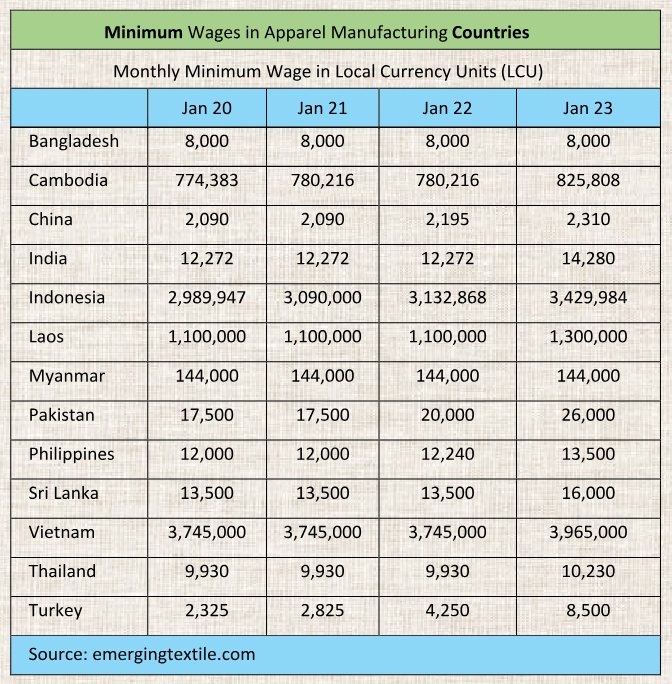
Amid high inflation and massive hike in the price of daily essentials, the minimum wages were raised in a series of origins.
The most of the apparel manufacturing countries are emerging economy and the impact of the current global economic turmoil, post-Covid-19 impacts, and the war are more visible.
So, the labor unions of the apparel manufacturing countries including Bangladesh have been demanding reform of the minimum wage board for a long time.
Among top apparel manufacturing countries, in Cambodia, the minimum wage gained 5.8% from its level a year earlier, whereas being increased by 9.5% in Indonesia.
Moreover, in the Philippines, minimum wages climbed by 10.3% on average, in local currency units (LCU), where in Vietnam, the same minimum wage rose by 5.9%.
In China, the largest apparel exporter of the world, the average growth reached 5.2% if considering Eastern provinces where apparel manufacturing is mostly concentrated.
Bangladesh did not raise its minimum wage which is adjusted every five years according to the law.
The minimum wage is still at Tk8,000 per month at apparel factories, unchanged since January 2019.
However, very recently, the government of Bangladesh has sought names of representatives from the apex trade body of the country’s readymade garment (RMG) sector – the BGMEA and the BKMEA – regarding assessment of the minimum monthly wages of its workers.
In this regard, the Department of Labour (DoL) under the Ministry of Labour and Employment has sent letters to the trade bodies.
In the meantime, various labour organizations of the RMG sector have been demanding a new wage board amid high inflation and massive hike in the price of daily essentials. They demanded wages in a variety of ranges from Tk20,000-Tk25,000 per month.
In Turkey, the minimum wage was doubled in the past 12 months, as a result of a 80% jump in consumer prices.
In Sri Lanka where the inflation rates reached about 65%, the minimum wage increased by 18.5%.
Long-term jump in nominal wages
Considering the past eight years back to January 2015, minimal wages have been everywhere raised significantly.
Vietnam experienced a 34% increase, whereas Bangladeshi workers got 51%.
In Turkey, the minimum wage surged by 567%.
In US$ terms, minimum wages have less significantly risen, due to a fall in local currency values.
In Sri Lanka, the minimum wage even fell 38%, losing 35% in Myanmar and 17% in Turkey.
Hiding poor results in real terms
Whatever the rise in nominal wages in local currency units, the impact remained limited or even positive for apparel trade.
Taking into account the impact of inflation over the last eight years, real minimum wages plunged by 15% in Bangladesh, 32% in Myanmar and 31% in Sri Lanka.
In eight years, real wages only rose 2% in Pakistan, 8% in Vietnam, climbing by 19% in Turkey (see our last table below).
Although affective wages could be above the minimum level at apparel factories -but also below minimum wages in many cases – the slight increase over the long term reflects the difference between commitments of retailers and brands and the naked statistical reality.
What Bangladeshi manufacturers and labour leaders say?
Speaking to the media, BKMEA Executive President Mohammad Hatem said they are agreed with the governmental decision regarding minimum wages whereas BGMEA Vice-President Shahidullah Azim also confirmed they were willing to send representatives.
In various conferences and events, Bangladeshi apparel manufacturers said that though the minimum wage for the apparel worker is Tk8,000, in the most of the factories, they earn more as per their experiences, efficiencies, and the situation of the concerned factories.
Labour leader Babul Akhtar told the media that they welcomed the move of the government and they want representation from the IndustriAll Bangladesh Council (IBC) in the wage board to negotiate minimum monthly wages.
He also said that IBC represents almost 90% of the RMG workers. We also demand a minimum wage of Tk23,000 monthly for the RMG workers.






Comment here