Chamber leaders stress need for deeper regional cooperation
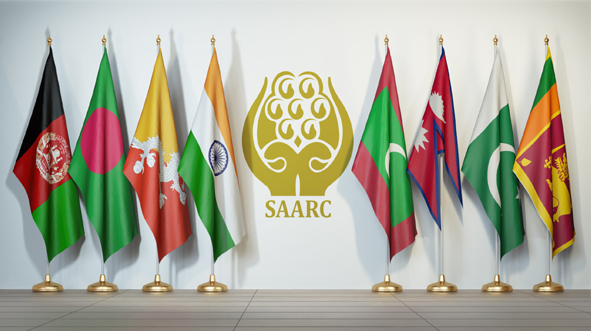
The reciprocal tariffs imposed by the United States under Donald Trump’s administration could turn into the biggest opportunity yet for boosting intra-regional trade among SAARC nations, said Md Jashim Uddin, President of the SAARC Chamber of Commerce and Industry (SCCI), at a high-level trade conference in Dhaka cerently.
Speaking at the “Advancing Global and Regional Trade & Investment” conference, jointly organised by the SCCI and the Federation of Bangladesh Chambers of Commerce and Industry (FBCCI) at The Westin, Jashim Uddin stressed that shifting global dynamics demand urgent action from South Asia to strengthen economic ties.
Tariffs as a catalyst for regional trade
“Many countries are turning inward with protectionist policies in response to the US tariffs, reshaping traditional trade routes. For South Asia, this is not just a challenge—it is our biggest opportunity,” said Jashim.
He highlighted that intra-regional trade in South Asia remains at only $38.7 billion, which accounts for a mere 8% of the region’s total exports. By comparison, intra-regional trade accounts for 22% in ASEAN and 45% in the European Union.
“We are losing enormous potential. Our FDI figures are moving in a positive direction, but we are still counting in millions when we should be aiming for billions,” he added.
Geopolitical shifts and supply chain realignment
Global economic shifts, driven by wars in Ukraine and the Middle East, supply chain restructuring, and a weak recovery following the pandemic, are reshaping trade flows, he noted.
“The world is searching for a ‘China Plus One’ strategy—looking for new, reliable manufacturing hubs. With a nearly $5 trillion combined economy, a population of 2 billion—mostly young and dynamic, and a strategic location, South Asia is perfectly placed to take that role,” Jashim said.
He also warned against “invisible walls” created within the region through political divisions, bureaucratic hurdles, and lack of harmonisation in trade policies.
Calls for stronger connectivity and harmonisation
Bhavesh R. Trivedi, Director of the SAARC Secretariat, said global geopolitical realignments are forcing South Asia to rethink its economic approach. He urged SAARC members to:
- Improve road and rail connectivity for trade,
- Simplify customs procedures, and
- Harmonise product standards across the region.
“South Asia is home to more than 1.8 billion people and is one of the most dynamic and diverse regions globally. It cannot afford to remain disconnected in the face of global shifts,” Trivedi stressed.