VDMA Highlights Innovations for Bangladesh Textile Industry Efficiency, Automation, Sustainability in Focus
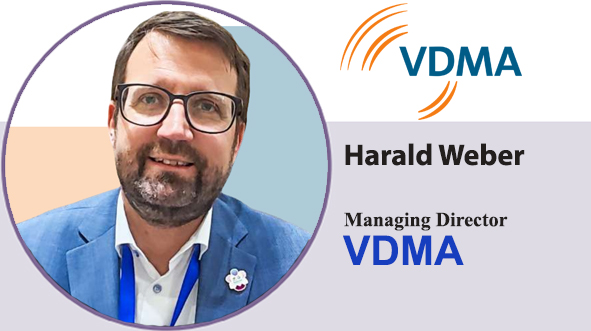
Bangladesh Textile Journal spoke with Mr. Harald Weber, Managing Director, VDMA, during the ongoing textile machinery exhibitions in Singapore. VDMA represents the interests of German textile machinery manufacturers globally, with a focus on innovation, efficiency, digitalization, and sustainability. The interview was taken by Shawkat Iqbal, Editor in Chief, BTJ.
BTJ: Mr. Weber, thank you for your time. Can you briefly introduce VDMA’s focus for this exhibition?
Harald Weber: Thank you. At VDMA, we aim to showcase the latest innovations in efficiency, automation, digitalization, and sustainability. Bangladesh is a very important market for German textile machinery, especially in spinning and weaving. Our members have longstanding relationships here, providing tailored solutions rather than just standard machinery.
BTJ: How was your experience during the exhibition so far?
Harald Weber: It’s been excellent. The exhibition is seeing strong international visitor numbers, including attendees from Bangladesh, India, Vietnam, Egypt, and China. The response reflects the global competitiveness and interest in German machinery. Even though investments slowed recently due to overcapacity and market challenges in China, India, and Turkey, Bangladesh continues to be among the top export markets for German machinery.
BTJ: What challenges and opportunities do German manufacturers see in Bangladesh?
Harald Weber: The global situation is challenging, and investments in spinning and weaving have been lower over the last year. However, this is also an opportunity for European manufacturers to strengthen their position by offering innovative, customer-oriented solutions. Companies focusing on automation, efficiency, and sustainability are particularly valued, especially when machinery can be adapted to individual customer needs.
BTJ: Can you highlight some of the innovations your members are presenting?
Harald Weber: Certainly. Several efficiency and automation solutions are on display. For example, automated can transport systems streamline material handling in spinning mills. We are also presenting technologies for energy and water savings, as well as chemical-use optimization, which help mills reduce operational costs.
Our members are also integrating AI and digitalization into machinery, offering insights into production efficiency and predictive maintenance. This combination of innovation and sustainability reflects VDMA’s commitment to the evolving needs of the textile industry, including the Bangladeshi market.
BTJ: How do you see the role of German machinery in Bangladesh’s textile sector?
Harald Weber: Germany remains a key technology partner for Bangladesh, particularly for spinning, weaving, and finishing. The focus is no longer just on selling machinery, but on long-term partnerships, tailored solutions, and after-sales support. This helps manufacturers maintain a competitive edge globally. We expect that as market conditions stabilize, investments will pick up, and German machinery will continue to play a pivotal role in increasing efficiency, sustainability, and quality in Bangladesh’s textile industry.
BTJ: Thank you for sharing these insights, Mr. Weber.
Harald Weber: It was my pleasure. VDMA is committed to supporting Bangladeshi manufacturers with cutting-edge technology and sustainable solutions for years to come.