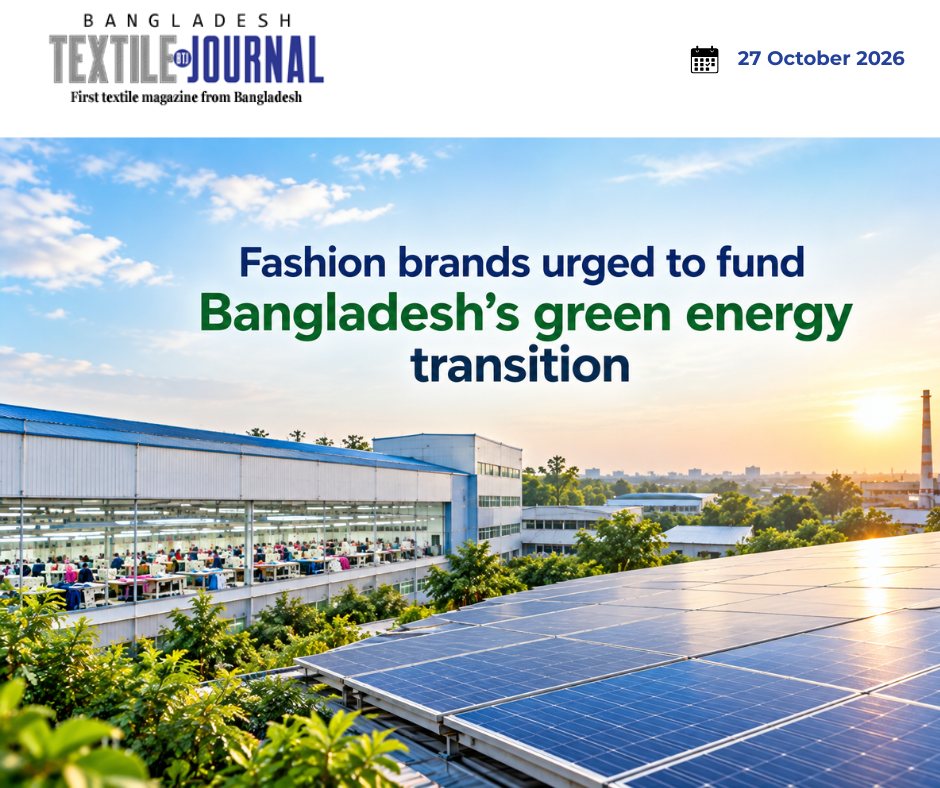
Global fashion brands must help finance Bangladesh’s transition to clean energy, industry stakeholders said at a Dhaka dialogue on 26th October, Monday, calling for affordable financing, fair purchasing practices and stronger worker protections.
A study by Stand.Earth Research Group estimates that 15 international fashion brands could help Bangladesh reduce carbon-di-oxide emissions by 1.26 million tonnes annually by 2040, with cumulative reductions of 8.59 million tonnes.
However, the 2025 Fossil Free Fashion Scorecard found that only six of 42 major fashion brands provided suppliers with decarbonisation financing, while just one offered support without increasing suppliers’ debt burden.
The findings were discussed at a multi-stakeholder dialogue titled From Framework to Action: Advancing a Multi-Stakeholder Initiative for a Just Transition in Bangladesh’s Fashion Industry. The event was jointly organised by Stand.Earth, Oxfam in Bangladesh and Breaking the Silence (BTS).
Speakers stressed that the shift towards renewable energy and cleaner production must be accompanied by skills development, safer workplaces and fairer sourcing practices to protect garment workers, particularly women.
Chief guest Kazi Rafiqul Islam, MP and a member of the Parliamentary Standing Committee on the Ministry of Planning, said the energy transition was an economic and social transformation that must not compromise employment, fair wages, workplace safety or social security.
Rachel Kitchin, senior campaign manager at Stand.Earth, called for collective, shared or grant-based financing to help factories cover energy-efficiency costs. She also proposed industry-wide funding mechanisms to mobilise resources for climate action.
Representatives from labour organisations and development groups also argued that factory owners could not shoulder the costs alone. They called for coordinated support from international brands, the government, development partners and financial institutions to ensure that decarbonisation protects livelihoods while advancing climate justice.