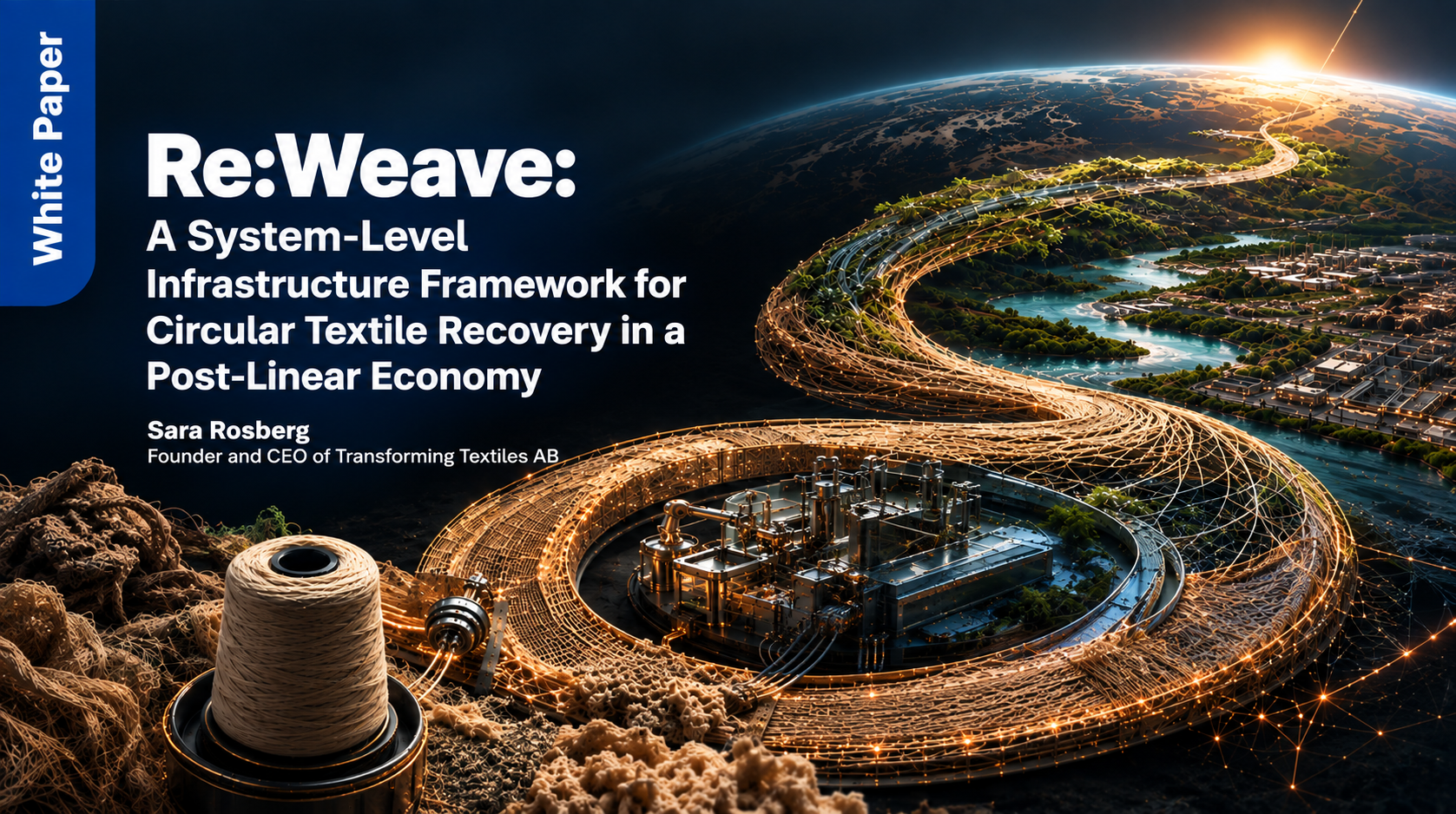
“From the earth we rose, and to the soil we shall return, a cycle now mirrored in the scientific logic of circular systems.”
Sara Rosberg
Executive Summary
The global textile industry is entering a structural transition in which circularity, traceability, and lifecycle accountability are becoming prerequisites for market access. Emerging regulatory frameworks, including the European Union’s Ecodesign for Sustainable Products Regulation (ESPR), Digital Product Passport (DPP), Corporate Sustainability Reporting Directive (CSRD), and Corporate Sustainability Due Diligence Directive (CSDDD), are reshaping how textiles must be designed, tracked, recovered, and verified (European Parliament & Council of the European Union, 2024a, Arts. 1–5, 11; European Parliament & Council of the European Union, 2022, Art. 19a; European Parliament & Council of the European Union, 2024b, Arts. 5–11).
This paper introduces Re:Weave as a system-level infrastructure framework for circular textile recovery in high-volume manufacturing ecosystems such as Bangladesh. Rather than treating circularity as an isolated recycling challenge, Re:Weave integrates material architecture, automated recovery, biological regeneration, modular infrastructure, and AI-driven coordination into a unified operational model.
The framework is built around four primary pillars: Hybrid Textiles, AI Soil Transformation, Modular Systems, and Autonomous Recycling Clusters (ARC), supported by a fifth intelligence layer coordinating lifecycle data, compliance, and recovery flows. Its material foundation builds on the patented Sense-Tex smart yarn platform developed by Transforming Textiles AB, combined with regolith-inspired basalt fibre systems, keratin-based binders, dual-spinning architectures, conductive fibres, and removable piping-based sensor systems.
By linking material design with compliance infrastructure and fibre-to-fibre recovery, Re:Weave reframes textiles not as disposable consumer products, but as intelligent and regenerative infrastructure systems.
1. Introduction
The global textile industry remains structurally dependent on a linear “take-make-dispose” model of production. This model extracts virgin resources, converts them into short-lifecycle products, and ultimately disposes of them through landfill, incineration, or low-grade downcycling. Despite increasing awareness of sustainability challenges, less than 1% of textile material is recycled into new garments, while global textile production continues to exceed 100 billion garments annually (Ellen MacArthur Foundation, 2017, pp. 20, 36).
The environmental consequences are substantial. Textile production contributes to greenhouse gas emissions, freshwater depletion, chemical pollution, and material waste across global supply chains (Niinimäki et al., 2020, pp. 189–193). At the same time, the increasing complexity of blended materials, coatings, dyes, and embedded technologies has made end-of-life recovery more technically challenging and economically inefficient.
For Bangladesh, this transition is particularly significant. The country is one of the world’s largest textile exporters, with official investment data reporting approximately USD 38.48 billion in textile and apparel export earnings in 2024 (Bangladesh Investment Development Authority, 2025). The European Union remains Bangladesh’s largest export market, making upcoming EU sustainability regulations directly relevant to the future competitiveness of Bangladeshi manufacturers (European Commission, 2025, Trade picture).
The urgency of this transition is increasing rapidly. Under emerging sustainability frameworks, companies face rising landfill taxation, extended producer responsibility obligations, compliance costs, and potential financial penalties linked to sustainability reporting and environmental claims. Under the CSDDD framework, severe non-compliance may result in penalties linked to annual turnover (European Parliament & Council of the European Union, 2024b, Arts. 27–29). Simultaneously, greenwashing regulations are increasing scrutiny around unverifiable sustainability claims (European Commission, 2023, Arts. 3–10).
The cost of inaction is therefore no longer environmental alone; it is industrial and economic.
This paper argues that textile circularity cannot be solved through recycling technologies alone. It requires a new form of integrated infrastructure linking material design, lifecycle intelligence, automated recovery, biological regeneration, and regulatory compliance into a continuous system.
Re:Weave is proposed as one such framework.
2. Regulatory and Economic Transition
The regulatory environment surrounding textiles is undergoing a structural transformation. The European Union’s ESPR establishes new requirements related to durability, repairability, recyclability, and lifecycle transparency for products placed on the EU market (European Parliament & Council of the European Union, 2024a, Arts. 1–5).
Central to this transition is the Digital Product Passport (DPP), which introduces structured lifecycle data requirements intended to improve traceability, transparency, and circular management throughout the supply chain (European Parliament & Council of the European Union, 2024a, Art. 11). This means textile products will increasingly require verifiable information regarding fibre composition, production history, environmental impact, and end-of-life recovery pathways.
Simultaneously, the Waste Framework Directive strengthens obligations related to waste prevention, reuse, recycling, and extended producer responsibility (European Parliament & Council of the European Union, 2008, as amended 2025, Arts. 4, 8a). Additional frameworks, including CSRD and CSDDD, extend sustainability accountability beyond products to include reporting systems, due diligence processes, and supply-chain oversight (European Parliament & Council of the European Union, 2022, Art. 19a; European Parliament & Council of the European Union, 2024b, Arts. 5–11).
These frameworks collectively reshape textile economics.
Historically, competitive advantage in textile manufacturing has largely been driven by production volume and labour cost efficiency. Emerging regulatory structures now introduce additional competitive factors, including:
• Lifecycle traceability.
• Material recoverability.
• Verified sustainability claims.
• Compliance readiness.
• Circular infrastructure capability.
For export-dependent manufacturing economies such as Bangladesh, this transition represents both a challenge and an opportunity. Manufacturers capable of integrating circular production, data infrastructure, and recovery systems may increasingly become preferred strategic partners for global brands facing regulatory pressure.
Circularity is therefore no longer a niche sustainability initiative. It is becoming a condition for long-term industrial competitiveness.
3. The Re:Weave Framework
Re:Weave is proposed as a circular textile infrastructure framework organized around four primary operational pillars and one overarching intelligence layer.
The four primary pillars are:
• Hybrid Textiles.
• AI Soil Transformation.
• Modular Systems.
• Autonomous Recycling Clusters (ARC).
The fifth layer functions as an AI-driven coordination system integrating lifecycle data, material routing, compliance verification, and recovery management across the entire infrastructure.
This architecture reflects circular economy scholarship emphasizing that circular transitions require systemic redesign rather than isolated technological interventions (Geissdoerfer et al., 2017, pp. 759–762; Kirchherr et al., 2017, pp. 224–229).
Rather than treating textiles as passive consumer goods, Re:Weave approaches textiles as active infrastructure systems capable of carrying information, supporting recovery, and participating in continuous material cycles.
4. Pillar 1: Hybrid Textiles – Sense-Tex, Regolith Fibre, and Keratin Binding
The first pillar forms the material foundation of Re:Weave.
At its core is Sense-Tex, the patented five-fibre smart yarn platform developed by Transforming Textiles AB. In Re:Weave, Sense-Tex is combined with mineral-derived fibres such as basalt or lava-stone fibre, keratin-based binders, conductive fibres, and removable piping-based sensor architectures.
The technical lineage partially draws inspiration from the Moon Fibre project developed by RWTH Aachen University and the European Space Agency, where lunar regolith simulants were investigated for fibre production and structural textile applications (ESA ACT, n.d.; RWTH Aachen University, n.d.). ESA’s activities portal notes that Moon Fibres were successfully spun from regolith simulant material (European Space Agency, n.d.).
In Re:Weave, this principle is translated into terrestrial and dual-use applications.
The proposed hybrid textile architecture uses a dual-spinning nozzle concept in which a functional inner Sense-Tex layer is combined with an outer mineral-based protective layer. The inner layer supports sensing, conductivity, moisture management, and traceability functions, while the outer basalt or lava-stone layer contributes thermal resistance, structural resilience, abrasion resistance, and fire resistance.
Keratin functions as a biological binder capable of connecting mineral and organic components while remaining compatible with circular recovery systems. Research on keratin biomaterials has demonstrated relevance for biodegradable composites and advanced material applications due to favourable structural and chemical properties (Rouse & Van Dyke, 2010, pp. 999–1014).
A key innovation within this pillar is the piping-based sensor architecture.
Rather than embedding rigid electronics permanently into garments, Re:Weave integrates sensors and fibre-based energy systems within removable piping structures stitched into the textile. Conductive fibres replace traditional wiring, enabling industrial washing, flexibility, and scalability.
These piping structures act as “veins” within the textile system, supporting:
• Data transmission
• Distributed sensing
• Fibre-based energy systems
• Modular replacement and repair
Because the piping itself is produced from Sense-Tex-compatible materials, it can be dismantled and separated during end-of-life recovery processes.
This design directly addresses a growing problem within wearable technology systems: electronic integration methods that conflict with recyclability and regulatory compliance.
Within the context of DPP and ESPR requirements, hybrid textile systems such as Sense-Tex offer a pathway toward material-level traceability and recovery-compatible smart textiles.

TTAB acknowledges the invaluable peer review contributions of K.M. Ziauddin Mahmud up to this point. All subsequent additions reflect post-review developments.
Additional Innovations Post Peer Review
The following developments occurred after completion of the peer-review process and are presented as a post-review addendum.
Since completion of the peer-review process, Re:Weave has been formalised and expanded into a six-pillar architecture. Pillar 5, Infrastructure OS, develops the original coordination layer into a governed operational system connecting material identity, telemetry, lifecycle status and authorised actions across existing enterprise and specialist systems. The pillar incorporates human oversight, cybersecurity and auditability as core governance requirements.
Pillar 6, Material Intelligence, introduces the Circular Material Passport, which links information concerning material composition, provenance, testing, use history, return status and verified recovery outcomes. The passport is intended to provide traceable evidence across the material lifecycle and to support future compliance with the European Union’s product-information and Digital Product Passport requirements. However, it should not be interpreted as a regulatory passport or certification in its current form.
The 2025–2026 EU regulatory shift
These additions have become increasingly relevant following the European Union’s recent sustainability and circularity reforms. The revised Waste Framework Directive establishes harmonised extended producer responsibility requirements for textiles and footwear, with the aim of financing and improving collection, sorting, reuse and recycling systems (European Parliament & Council of the European Union, 2025a).
Under the Ecodesign for Sustainable Products Regulation, large enterprises are prohibited from destroying unsold apparel, clothing accessories and footwear from 19 July 2026, subject to specifically defined derogations (European Parliament & Council of the European Union, 2024b, art. 25; European Commission, 2026). Textiles and apparel have also been prioritised in the EU’s 2025–2030 Ecodesign Working Plan for the development of future product-specific requirements concerning durability, reparability, recycled content, recyclability and product information (European Commission, 2025).
From 12 August 2026, the Packaging and Packaging Waste Regulation introduces additional requirements concerning packaging sustainability, recyclability, material composition, labelling and lifecycle management (European Parliament & Council of the European Union, 2025b).
From 27 September 2026, national measures implementing the Empowering Consumers for the Green Transition Directive also strengthen the evidentiary requirements for environmental claims, sustainability labels and consumer information concerning durability and circularity (European Parliament & Council of the European Union, 2024a, art. 4).
Although a textile-specific Digital Product Passport is not yet a blanket legal requirement in 2026, the direction of EU policy creates a clear need for reliable, interoperable and auditable lifecycle information.
Pillar 6 has therefore been designed as compliance-ready evidence infrastructure rather than as a claim of regulatory certification.
Beyond textiles: water as the next input
Textiles remain Re:Weave’s first physical input and validation pathway rather than the system’s final boundary. Water is proposed as the next infrastructure domain, applying the same governed decision logic; observe, contextualise, route, condition and record, while retaining domain-specific sensing, treatment, safety, permitting and operator responsibility.
This expansion aligns with the EU Water Reuse Regulation, the recast Drinking Water Directive and the revised Urban Wastewater Treatment Directive, which collectively increase expectations concerning water quality, monitoring, reuse, energy neutrality, pollution control and resource recovery (European Parliament & Council of the European Union, 2020a, 2020b, 2024c). Re:Weave does not replace specialist water-treatment systems, competent authorities or certification bodies. Instead, it provides a governed coordination and evidence layer through which operational decisions and recovery outcomes can be recorded, audited and communicated.
Note: The original ‘fifth layer’ (AI-driven coordination system) has been expanded and renamed as Pillar 5: Infrastructure OS to reflect its evolved governance and operational role.
References (APA 7th Edition)
Bangladesh Investment Development Authority. (2025). Textiles and apparel. https://investbangladesh.gov.bd/investment-sector/textiles-apparels/
CalRecycle. (2024). Responsible Textile Recovery Act (SB 707). California Department of Resources Recycling and Recovery. https://calrecycle.ca.gov/epr/textiles/
Ellen MacArthur Foundation. (2017). A new textiles economy: Redesigning fashion’s future (pp. 20, 36). Ellen MacArthur Foundation.
European Commission. (2021). Commission Recommendation (EU) 2021/2279 on the use of the Environmental Footprint methods to measure and communicate the life cycle environmental performance of products and organisations (Annex I). https://eur-lex.europa.eu/eli/reco/2021/2279/oj
European Commission. (2023). Proposal for a Directive on substantiation and communication of explicit environmental claims (Green Claims Directive) (Arts. 3–10). https://eur-lex.europa.eu/legal-content/EN/TXT/?uri=CELEX:52023PC0166
European Commission. (2025). EU trade relations with Bangladesh (Trade picture section). https://policy.trade.ec.europa.eu/eu-trade-relationships-country-and-region/countries-and-regions/bangladesh_en
European Parliament & Council of the European Union. (2008, as amended 2025). Directive 2008/98/EC on waste (Waste Framework Directive) (Arts. 4, 8a, 10–11). https://eur-lex.europa.eu/eli/dir/2008/98/oj
European Parliament & Council of the European Union. (2022). Directive (EU) 2022/2464 as regards corporate sustainability reporting (CSRD) (Art. 19a). https://eur-lex.europa.eu/eli/dir/2022/2464/oj
European Parliament & Council of the European Union. (2024a). Regulation (EU) 2024/1781 establishing a framework for the setting of ecodesign requirements for sustainable products (ESPR) (Arts. 1–5, 11). https://eur-lex.europa.eu/eli/reg/2024/1781/oj
European Parliament & Council of the European Union. (2024b). Directive (EU) 2024/1760 on corporate sustainability due diligence (CSDDD) (Arts. 5–11, 27–29). https://eur-lex.europa.eu/eli/dir/2024/1760/oj
European Parliament & Council of the European Union. (2024c). Directive (EU) 2024/825 empowering consumers for the green transition through better protection against unfair practices and through better information (Arts. 1–3). https://eur-lex.europa.eu/eli/dir/2024/825/oj
European Parliament & Council of the European Union. (2024d). Directive (EU) 2024/1785 on industrial emissions (IED) (Arts. 11–15). https://eur-lex.europa.eu/eli/dir/2024/1785/oj
European Space Agency. (n.d.). Moon fibres. ESA Advanced Concepts Team. https://www.esa.int/gsp/ACT/projects/moon_fibres/
European Space Agency. (n.d.). Moon Fibres. ESA Activities Portal. https://activities.esa.int/4000132008
Geissdoerfer, M., Savaget, P., Bocken, N. M. P., & Hultink, E. J. (2017). The circular economy: A new sustainability paradigm? Journal of Cleaner Production, 143, 757–768.
Kirchherr, J., Reike, D., & Hekkert, M. (2017). Conceptualizing the circular economy: An analysis of 114 definitions. Resources, Conservation and Recycling, 127, 221–232.
Liu, Y., Fink, Y., & Zhao, Y. (2023). Fibre-based energy and sensing systems. Advanced Functional Materials, 33, 123–128.
Mao, N., Russell, S. J., & Pourdeyhimi, B. (2021). Mechanical recycling of textiles: The state of the art. Resources, Conservation and Recycling, 165, 105119.
NASA. (2020). In-situ resource utilization and closed-loop life-support systems (pp. 72–77). National Aeronautics and Space Administration.
Niinimäki, K., Peters, G., Dahlbo, H., Perry, P., Rissanen, T., & Gwilt, A. (2020). The environmental price of fast fashion. Nature Reviews Earth & Environment, 1(4), 189–200.
Rouse, J. G., & Van Dyke, M. E. (2010). A review of keratin-based biomaterials for biomedical applications. Materials, 3(2), 999–1014.
RWTH Aachen University. (n.d.). MoonFibre. https://www.sla.rwth-aachen.de/cms/institut-fuer-strukturmechanik-und-leichtbau/forschung/projekte/abgeschlossene-projekte/~eeyrn/moonfibre/?lidx=1
Sandin, G., & Peters, G. M. (2018). Environmental impact of textile reuse and recycling: A review. Journal of Cleaner Production, 184, 353–365.
Shahidi, S., & Wiener, J. (2012). Antibacterial textiles: A review. Textile Research Journal, 82(8), 799–810.
Additional References (Post peer review section)
European Commission. (2025). Ecodesign for sustainable products and energy labelling working plan 2025–2030. https://green-forum.ec.europa.eu/news/2025-2030-working-plan-2025-07-11_en
European Commission. (2026). Commission Delegated Regulation (EU) 2026/296 of 9 February 2026 supplementing Regulation (EU) 2024/1781 by setting out derogations from the prohibition of destruction of unsold consumer products. Official Journal of the European Union. https://eur-lex.europa.eu/eli/reg_del/2026/296/oj/eng
European Parliament and Council of the European Union. (2020a). Directive (EU) 2020/2184 of 16 December 2020 on the quality of water intended for human consumption. Official Journal of the European Union. https://eur-lex.europa.eu/eli/dir/2020/2184/oj/eng
European Parliament and Council of the European Union. (2020b). Regulation (EU) 2020/741 of 25 May 2020 on minimum requirements for water reuse. Official Journal of the European Union. https://eur-lex.europa.eu/eli/reg/2020/741/oj/eng
European Parliament and Council of the European Union. (2024a). Directive (EU) 2024/825 of 28 February 2024 as regards empowering consumers for the green transition through better protection against unfair practices and through better information. Official Journal of the European Union. https://eur-lex.europa.eu/eli/dir/2024/825/oj/eng
European Parliament and Council of the European Union. (2024b). Regulation (EU) 2024/1781 of 13 June 2024 establishing a framework for the setting of ecodesign requirements for sustainable products. Official Journal of the European Union. https://eur-lex.europa.eu/eli/reg/2024/1781/oj/eng
European Parliament and Council of the European Union. (2024c). Directive (EU) 2024/3019 of 27 November 2024 concerning urban wastewater treatment. Official Journal of the European Union. https://eur-lex.europa.eu/eli/dir/2024/3019/oj/eng
European Parliament and Council of the European Union. (2025a). Directive (EU) 2025/1892 of 10 September 2025 amending Directive 2008/98/EC on waste. Official Journal of the European Union. https://eur-lex.europa.eu/eli/dir/2025/1892/oj/eng
European Parliament and Council of the European Union. (2025b). Regulation (EU) 2025/40 of 19 December 2024 on packaging and packaging waste. Official Journal of the European Union. https://eur-lex.europa.eu/eli/reg/2025/40/oj/eng
Appendices
Note. For legislation and regulatory instruments, pinpoint references are given by article, annex, or recital; for journal and report sources, pinpoint references are given by page number(s).
Appendix A: Regulatory Mapping of the Re:Weave Framework
Table A1. Sense-Tex Material-Layer Compliance Mapping
Note. Mapping based on EU Ecodesign Regulation and Digital Product Passport requirements combined with lifecycle assessment frameworks and textile impact literature (European Parliament & Council of the European Union, 2024a, Arts. 1–5, 11; Niinimäki et al., 2020, pp. 189–193; European Commission, 2021, Annex
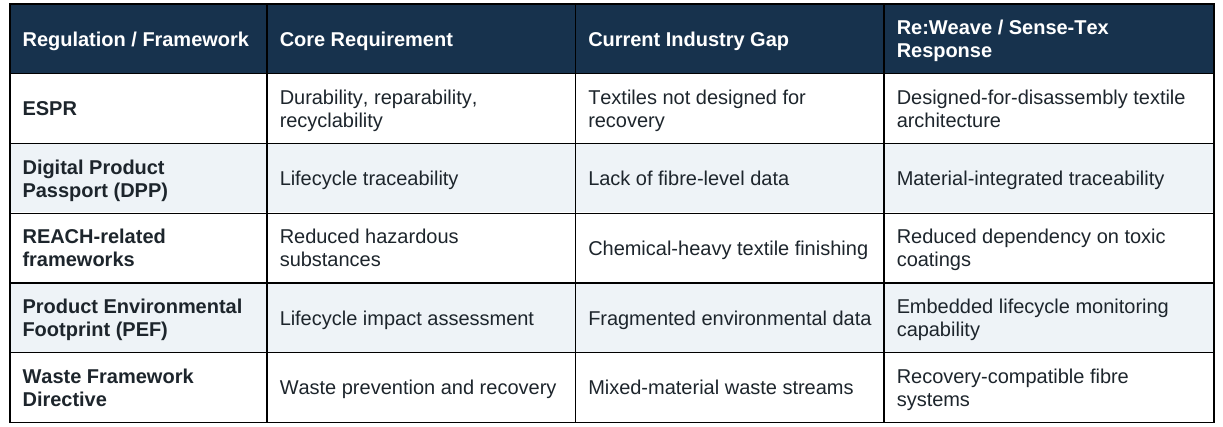
Table A2. Pillar 1 – Hybrid Textiles
Note. Based on circular product design requirements, smart textile integration challenges, and extended producer responsibility frameworks (European Parliament & Council of the European Union, 2024a, Arts. 1–5, 11; Directive 2008/98/EC, Art. 8a; Liu et al., 2023, pp. 123–128; Niinimäki et al., 2020, pp. 189–193).
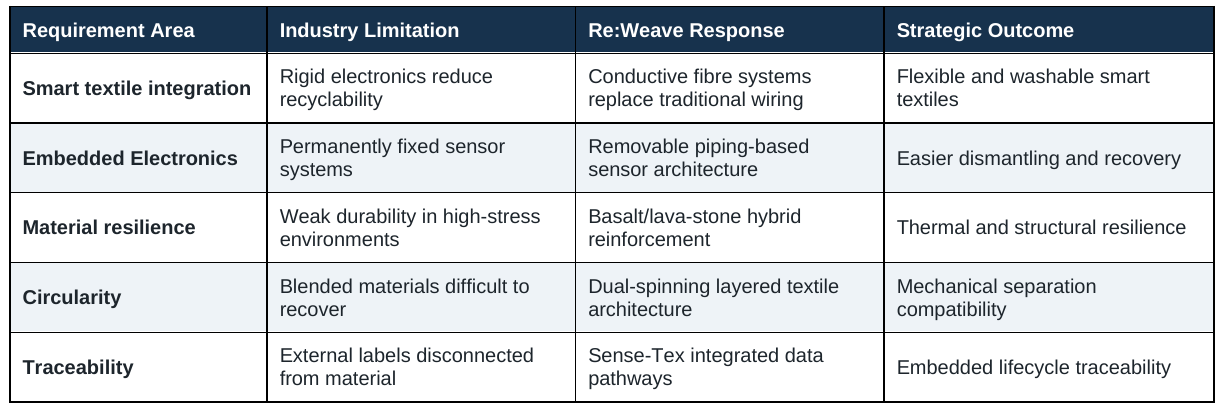
Table A3. Pillar 2 – AI Soil Transformation
Note. Derived from circular economy system integration literature, biological regeneration frameworks, and in-situ resource utilization research (Directive 2008/98/EC, Arts. 4, 10–11; NASA, 2020, pp. 72–77; Geissdoerfer et al., 2017, pp. 759–762; Kirchherr et al., 2017, pp. 224–229).
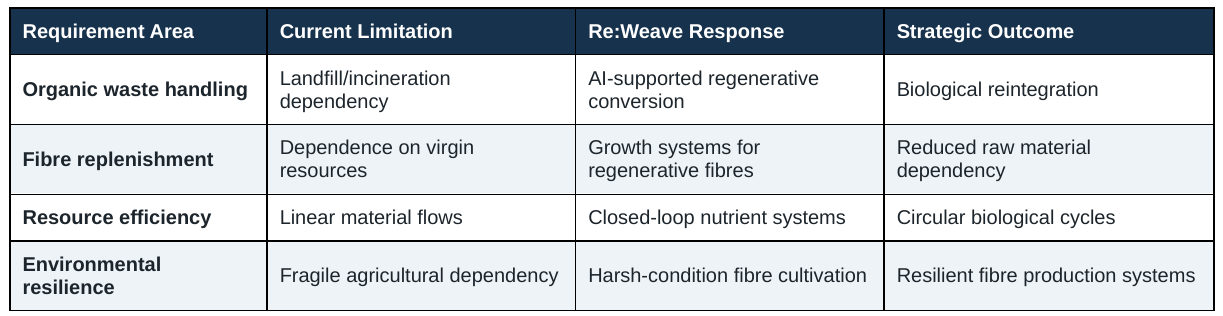
Table A4. Pillar 3 – Modular Systems
Note. Reflects resource efficiency requirements, industrial integration frameworks, and sustainability reporting obligations (Regulation (EU) 2024/1781, Arts. 4–5; Directive (EU) 2022/2464, Art. 19a; Directive (EU) 2024/1785, Arts. 11–15; Geissdoerfer et al., 2017, pp. 760–762).
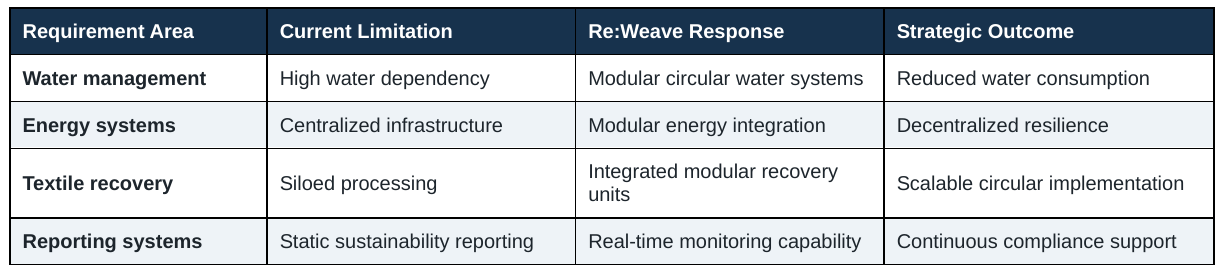
Table A5. Pillar 4 – Autonomous Recycling Clusters (ARC)
Note. Based on textile recycling constraints, fibre degradation research, and extended producer responsibility requirements (Directive 2008/98/EC, Art. 8a; Sandin & Peters, 2018, pp. 357–358; Mao et al., 2021, p. 105).
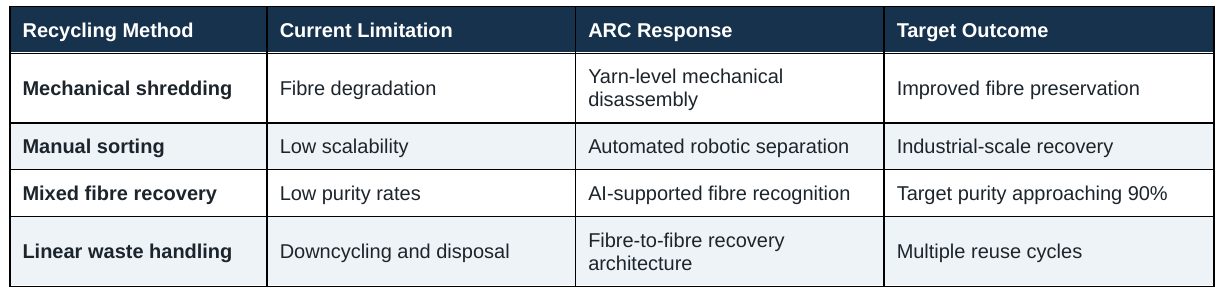
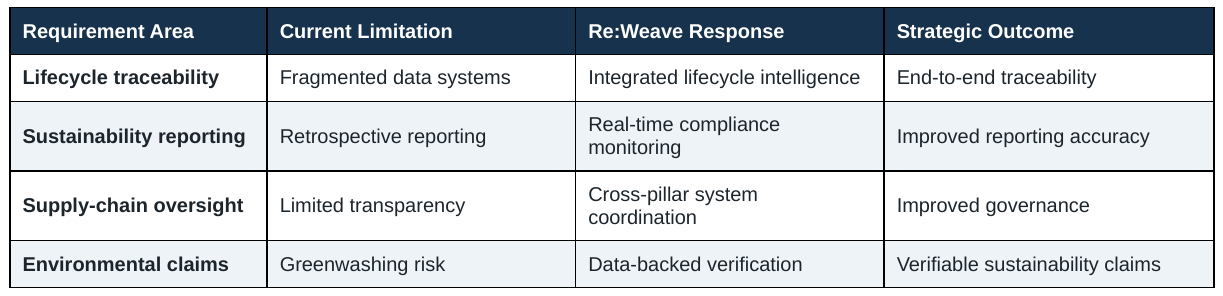
Table A6. Pillar 5 – AI Coordination Layer
Note. Derived from lifecycle traceability, sustainability reporting, and supply-chain accountability frameworks (Regulation (EU) 2024/1781, Art. 11; Directive (EU) 2022/2464, Art. 19a; Directive (EU) 2024/1760, Arts. 5–11; European Commission, 2023, Arts. 3–10).
Appendix B: Environmental and System Comparison
Table B1. Comparative Environmental Performance of Textile Systems
Note. Based on lifecycle environmental impact studies and circular economy analysis (Niinimäki et al., 2020, pp. 189–193; Sandin & Peters, 2018, pp. 357–358; Mao et al., 2021, p. 105; Ellen MacArthur Foundation, 2017, pp. 20, 36).
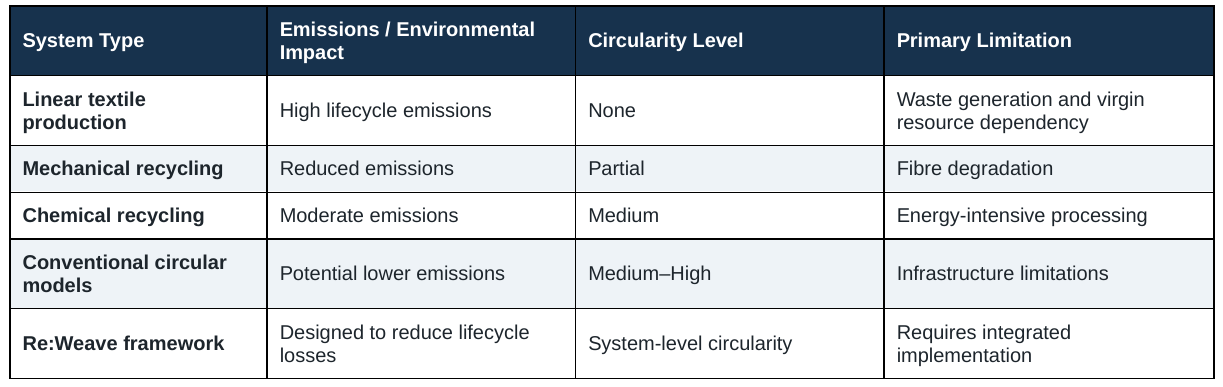
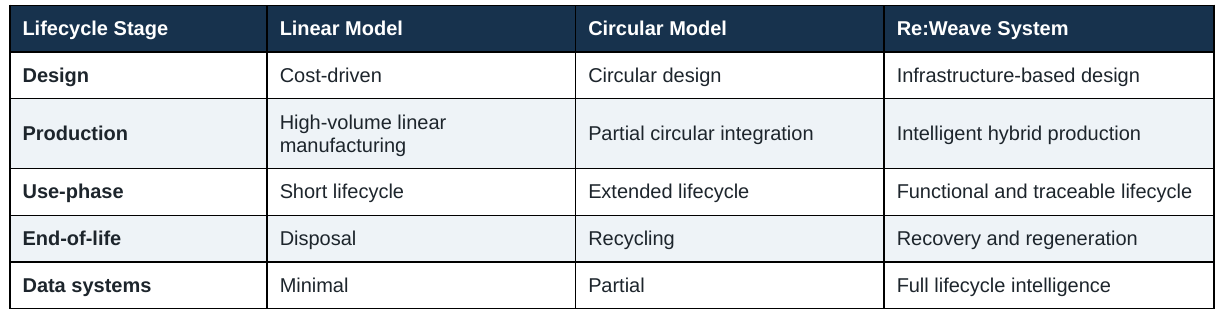
Table B2. Lifecycle System Comparison
Note. Based on circular economy systems literature and lifecycle traceability frameworks (Geissdoerfer et al., 2017, pp. 759–760; Kirchherr et al., 2017, pp. 224–229; Regulation (EU) 2024/1781, Art. 11).
Appendix C: Economic and Industrial Transition
Table C1. Three-Tier Textile Value Transition Model
Note. Synthesised from circular economy transition literature and emerging sustainability compliance frameworks (Geissdoerfer et al., 2017, pp. 759–762; Directive (EU) 2024/1760, Arts. 27–29; European Commission, 2023, Arts. 3–10).
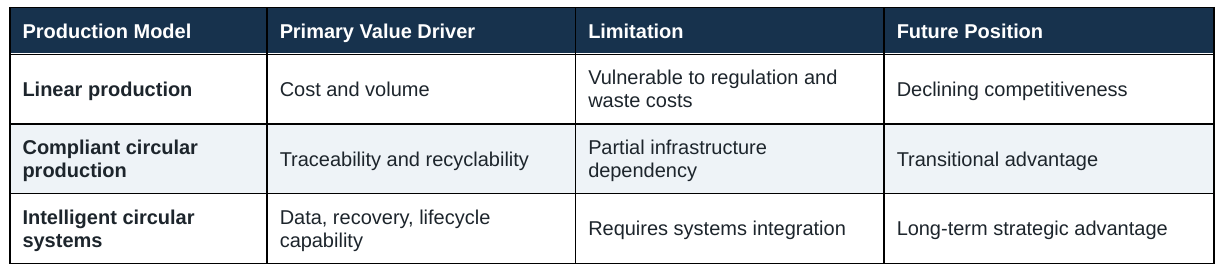
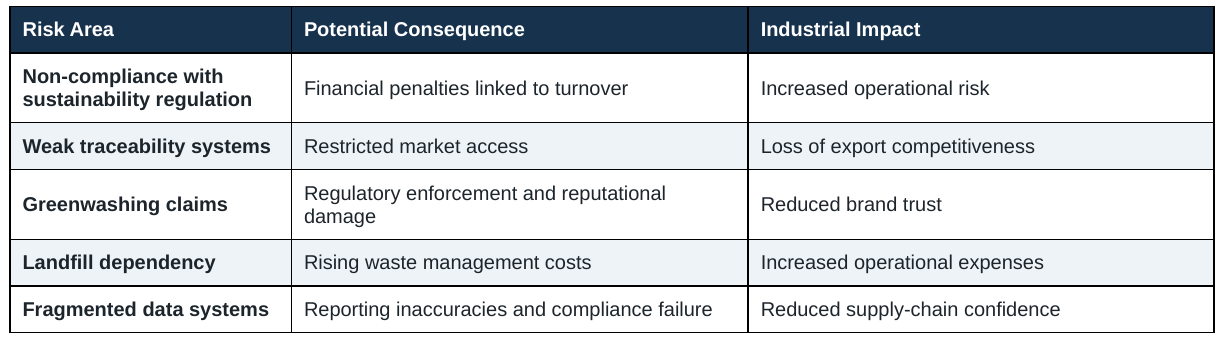
Table C2. Cost of Inaction Matrix
Note. Based on EU sustainability compliance frameworks, environmental reporting obligations, and greenwashing regulations (Directive (EU) 2024/1760, Arts. 27–29; European Commission, 2023, Arts. 3–10; Directive 2008/98/EC, Arts. 4, 8a).
Appendix D: System Gap Analysis
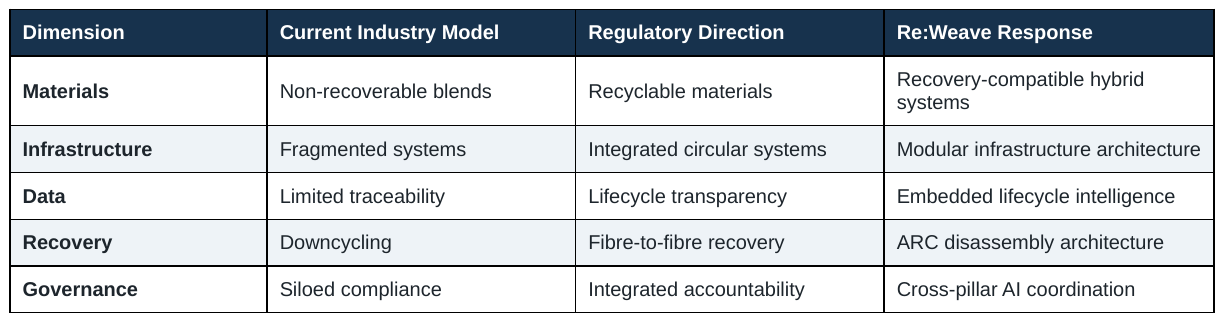
Table D1. Industry vs Regulation vs Re:Weave
Note. Synthesised from environmental impact research, EU regulatory frameworks, and circular economy system analysis (Niinimäki et al., 2020, pp. 191–193; Regulation (EU) 2024/1781, Art. 11; Directive 2008/98/EC, Art. 8a; European Commission, 2023, Arts. 3–10).