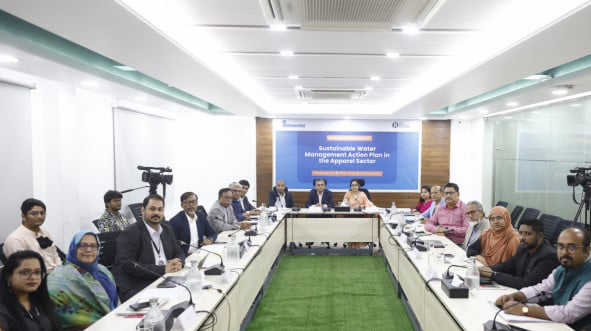
Bangladesh must urgently introduce industrial water pricing to curb excessive extraction and prevent an impending groundwater crisis, experts cautioned at a roundtable session in the city on 29 November.
Specialists revealed an alarming trend in Gazipur, the country’s key manufacturing hub, where groundwater levels are dropping 2–3 metres every year due to unchecked industrial pumping. Factories continue to extract water as though it were an unlimited, cost-free resource—pushing the region toward a point where industries may soon be unable to secure the water needed to operate.
Despite a prolonged monsoon this year, the soil is losing its ability to retain water, causing poor aquifer recharge. As a result, Bangladesh’s industrial zones—dependent almost entirely on groundwater—are being powered by a rapidly shrinking reserve.
“Water is being wasted in many cases. To prevent misuse, pricing for industrial water use must be considered,” said Hasin Jahan, Country Director of WaterAid Bangladesh, during the consultation titled “Strategic Consultation on Sustainable Water Management Action Plan in the RMG Sector.”
She noted that although the government has imposed restrictions in some industrial areas, the deeper crisis is looming. “If groundwater levels fall further in Gazipur, what happens when industries can no longer pump out water?” she asked. She added that water pricing would push industries toward alternative solutions such as rainwater harvesting, stricter ETP usage, and improved water recycling. WARPO has drafted guidelines on industrial water use, including mandatory local permissions, but water tariffs have not yet been introduced.
Experts expressed frustration over the absence of a policy preventing untreated water discharge—a rule common in several neighbouring countries. Because industries access water at no cost, overuse and inefficiency have become rampant. They called for metering systems, stronger monitoring, coordinated action among ministries, and affordable green financing to support sustainable water use.
AKM Masum Ul Alam, adjunct faculty at the Bangladesh University of Health Sciences, emphasised the need for unified water inspection policies and continuous ETP operation. He said many factories only run ETPs when inspectors visit.
Md Yakub Hossain, Executive Director of VERC, described how groundwater depletion in areas like Savar has become so severe that even submersible pumps fail, while surface water pollution makes agriculture impossible.
“Industries are necessary, but people also need to survive,” he warned.
Photo Courtesy by : The Business Standard