Bangladesh Special Economic Zone (BSEZ), widely known as the Japanese economic zone, is steadily transforming from blueprint to reality, with confirmed investments of $353.4 million from 12 companies and dozens more investors lining up for entry.
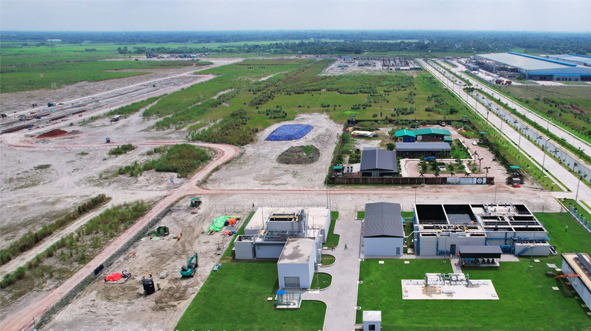
Located in Araihazar, Narayanganj, the 1,000-acre industrial hub—jointly backed by the governments of Bangladesh and Japan—is beginning to show tangible progress. So far, the Bangladesh Economic Zones Authority (BEZA) has handed over around 230 acres of land to developers, with another 220 acres expected to be transferred within the year.
On the ground, development is visibly advancing. Internal roads, drainage systems, and land filling have already been completed in several sections, while factories and administrative buildings are rising across the zone. Three companies have already started production, and around 30 more firms from different countries are currently in the pipeline.
A visit to the site reveals early signs of industrial activity. At Artnature Bangladesh Limited, one of the operational units, around 200 workers—mostly women—are engaged in producing high-quality customized wigs for export markets such as Japan and Singapore. The company has already invested $9 million out of its planned $20 million and is also setting up research and development facilities.
“We are currently operating as a 100% export-oriented company,” said a company official, adding that future plans include expansion into raw fiber processing.
Among the early investors, Singer Bangladesh Limited leads in scale, having secured 33.4 acres with a planned investment of $78 million, of which $56.3 million has already been realized. The company began operations in 2024 in the home appliances segment, marking the largest operational footprint in the zone so far.
Japan-based Lion Kallol Limited has also commenced production in the FMCG sector, investing $7.6 million out of a planned $19.4 million. Its initial products include dishwashing liquid and toothbrushes, with plans to expand its portfolio.
The zone is attracting a diverse mix of industries, including home appliances, textile chemicals, FMCG, food processing, packaging, and accessories—indicating its emergence as a multi-sector industrial hub rather than a single-industry cluster.
Several new investors are preparing to begin operations. Germany’s Rudolf Bangladesh Limited and Japan’s Nicca Bangladesh are entering the textile chemicals segment, while Pladis ACI Bangladesh, a UK-Bangladesh joint venture, is gearing up for a major food processing project.
Chinese investors are also making a strong entry. BSN (Bangladesh) Packaging Company is planning the largest single investment in the zone at $80 million, while Leaders Label Material (Bangladesh) is progressing with a $25 million project.
Officials say the fully prepared industrial land, combined with modern infrastructure and strategic location, is making BSEZ increasingly attractive to foreign investors.
As more land is handed over and additional companies begin construction, the Japanese economic zone is poised to become a key driver of Bangladesh’s industrial diversification, export growth, and foreign direct investment in the coming years.