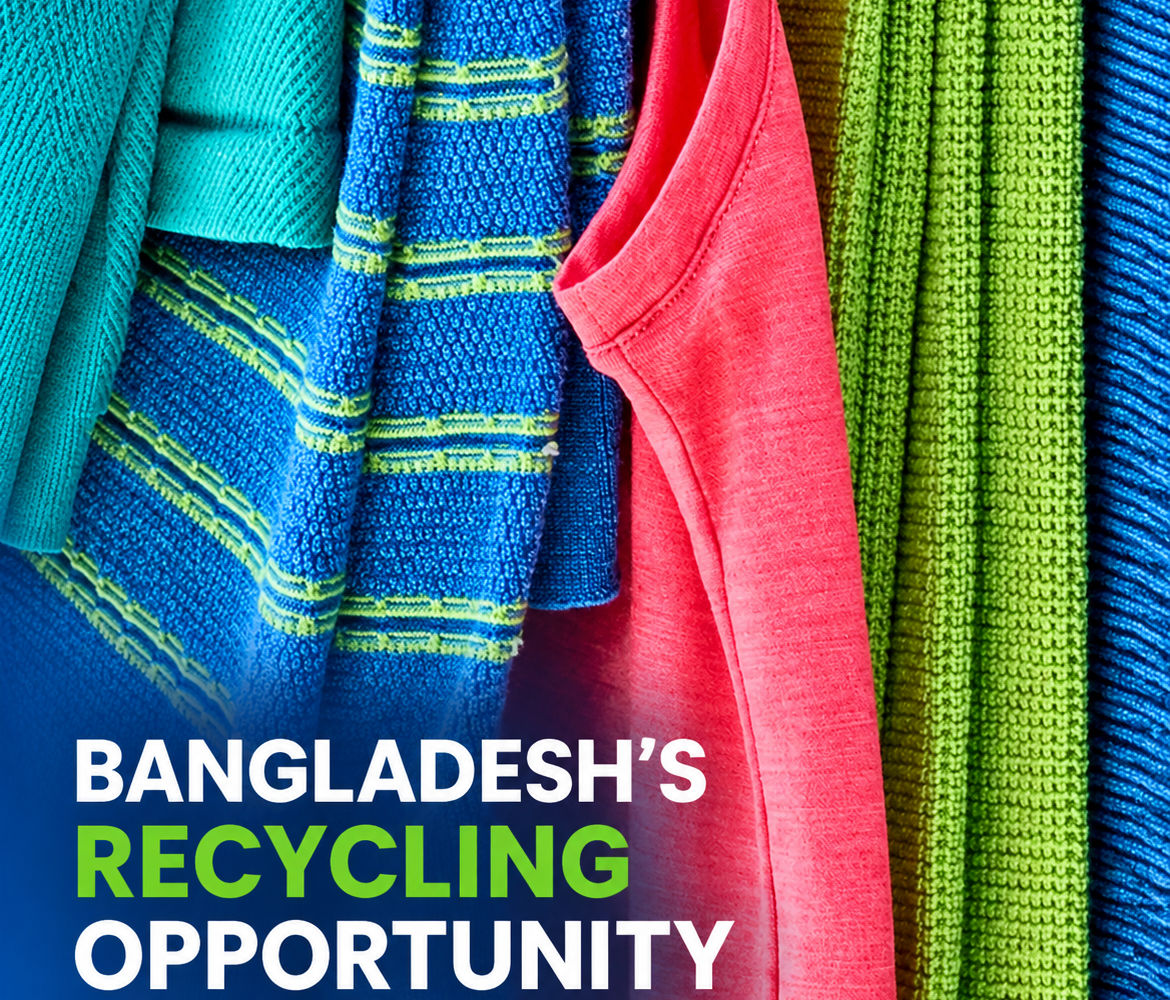
Every year, by BGMEA’s estimate, Bangladesh’s garment factories produce around 400,000 tonnes of pre-consumer cutting waste, known locally as jhut. Only about five percent of it is recycled locally. The rest is exported, downcycled into stuffing, or burned.
And one detail in the pricing stopped me. Sorted white jhut has been valued at around $600 a tonne. Color unsorted jhut, around $235. It is the same cotton. The difference is color.
So color is already setting the price of Bangladesh’s waste. I want to make the case that it also sits at the center of a bigger question: whether that waste can become yarn that buyers actually want.
Why recycled yarn hits a ceiling
I have spent more than 35 years in textiles, starting as a mill intern and working inside many of the major US mills. I understand the instinct to treat recycled fiber as a sourcing problem. But on the mill floor, it is a performance problem.
Mechanical recycling shortens staple length. At 20% recycled content, the virgin fiber carries the yarn. Push toward 30% to 50%, and hairiness goes up, pilling goes up, and somewhere in that range the yarn simply stops behaving.
The industry has workarounds, and each one costs something. Blending in recycled polyester adds strength, but it creates a mixed-fiber garment that is much harder to recycle at end of life. Adding twist adds strength too, but over-twisted yarn is stiff and harsh, which is a real limitation for knitwear worn against the skin, the heart of Bangladesh’s business. Sorting by color avoids dyeing altogether, but it narrows the palette and leaves a mountain of mixed-color waste selling at the lower price.
Then we dye it
Here is the part I think the industry underestimates. Mechanically recycled fiber arrives at the dyehouse already weakened. Conventional dyeing then adds heat, tension, and chemistry. Post-consumer fiber often needs bleaching first, which is another round of chemical stress on fiber with no margin left.
And then there is the water. Conventional dyeing typically uses 50 to 110 liters per kilogram of yarn, and every one of those liters has to be sourced, heated, treated, and discharged. Every mill owner in Bangladesh knows exactly what that costs, and buyers are asking harder questions about it every season.
So in the conventional process, color lands firmly on the wrong side of the ledger. It weakens the yarn, and it adds cost and environmental load at the same time.
A different way to achieve color
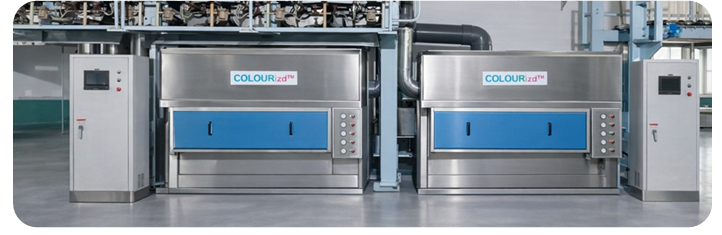
At COLOURizd, we don’t dye. We color yarn. Our QuantumCOLOUR™ system injects visible pigment into the yarn bundle and binds it to the fiber surfaces. It does not depend on a chemical reaction between dye and fiber, so there are no dye sites to clear and no bleaching step required.
The process uses about one liter of water per kilogram of yarn, as a process medium. That water stays with the yarn and evaporates in drying, so there is zero wastewater discharge. An ISO 14067:2018 assessment by Peterson Projects & Solutions found up to 73% lower CO₂ emissions than conventional dyeing.
What surprised us
When we ran QuantumCOLOUR™ on mechanically recycled cotton yarn, we were watching strength closely. If it behaved like conventional dyeing, we would have consistent color and a weaker yarn. That would not have been good enough.
That is not what happened. Tenacity increased at every recycled content level we tested. At 50% recycled content, the gain was more than 20%.
The reason makes sense once you see it. The binder changes how the fibers interact inside the yarn bundle. Short fibers that would normally slide past each other under load hold together a little better, and yarns with more short fibers show the bigger gains. We are continuing to verify these results across more yarn types, but the direction has been consistent.
What this means for a Bangladeshi mill
From a mill owner’s point of view, I see four things.
First, recycled content can go up without leaning on polyester or extra twist, which protects both hand feel and end-of-life recyclability.
Second, color becomes a step that can add value to recycled yarn instead of taking it away.
Third, water and effluent largely drop out of the coloration step, which matters for cost, for compliance, and for the conversations buyers are already having.
Fourth, the demand is coming. Textile EPR legislation in Europe and California is creating obligatory demand for usable recycled fiber, and the brands that buy from Bangladesh will need suppliers who can deliver it at scale, in color, and at quality.
Bangladesh already has the fiber. It has the spinning capacity and the know-how. So the question I would put to the industry is this: if color is where recycled yarn loses its value, could it also be where Bangladesh gets that value back?
Working together in Bangladesh
COLOURizd has recently appointed RHCORP LTD. as our representative in Bangladesh, so mills and brands here now have a local partner for conversations about trials and installation.
We believe that changing how color is achieved changes everything. Bangladesh may be the place that proves it.
About COLOURizd
COLOURizd LLC is a yarn coloration technology company based in North Carolina, USA, with R&D in Hong Kong. Its QuantumCOLOUR™ system applies pigment at the yarn stage using about one liter of water per kilogram of yarn, with zero wastewater discharge and up to 73% lower CO₂ emissions than conventional dyeing (ISO 14067:2018). The technology has been in commercial operation since 2018, is Woolmark validated, and uses OEKO-TEX ECO PASSPORT compatible chemistry. COLOURizd LLC is a yarn coloration technology company based in North Carolina, USA, with R&D in Hong Kong. Its QuantumCOLOUR™ system applies pigment at the yarn stage using about one liter of water per kilogram of yarn, with zero wastewater discharge and up to 73% lower CO₂ emissions than conventional dyeing (ISO 14067:2018). The technology has been in commercial operation since 2018, is Woolmark validated, and uses OEKO-TEX ECO PASSPORT compatible chemistry.

Author Bio
Jennifer Thompson is CEO and Co-Founder of COLOURizd, where she leads business development, partnerships, and investor relations for QuantumCOLOUR™, a yarn coloration system that uses about one liter of water per kilogram of yarn with zero wastewater discharge. She has spent more than 35 years in textiles, starting as a mill intern and going on to work with textile technology companies, run her own design consultancy, and serve as Director of Textile Design at Target. She is wary of any process that exists mainly because it has always been done that way, and dyeing is one of them.