BTJ: Sustainability has evolved considerably from a largely voluntary corporate initiative into a strategic business priority. From your experience, how should companies define “meaningful sustainability” today—and how can they distinguish genuine progress from simply meeting compliance requirements?
If our goal is to ensure fair access to resources—in the broadest sense of the term, with a clear focus on individual and regional needs—and to enable people to achieve lasting well-being based on education and work while respecting shared ethical values; if we aim to maintain a long-term vision that considers the consequences of our current actions on future generations, then we are working toward real progress. Toward tangible sustainable development.
Unfortunately, regulatory compliance requirements vary from region to region, nation to nation, and continent to continent. Given that these standards represent the conditio sine qua non for protecting social rights and the environment, a global baseline should be established based on the highest level of protection—rather than the lowest, which serves only to secure profits for a few while depleting the environment and local communities.
Increasingly challenging regulatory compliance demands very high baselines, pushing companies to achieve meaningful sustainability to consolidate their market position, in line with their size and role within the supply chain.
Being sustainable means being responsible and pursuing “shared value” (Porter & Kramer, 2011): continuing to generate economic value for the company while simultaneously aiming for a positive impact on society and the environment at local level and taking global priorities into account.
When a company manages to pursue, achieve, measure, monitor, and implement environmental and/or social benefits over time, it is laying solid foundations for “meaningful sustainability.”
BTJ: You have extensive experience in sustainability reporting and the application of GRI Standards. What makes a sustainability report genuinely useful for a company and its stakeholders, rather than simply becoming another annual reporting exercise?
A sustainability report ceases to be a mere formal exercise and becomes genuinely useful when it undergoes a paradigm shift: it moves away from being a retrospective, ex-post analysis that solely looks at the past, and transforms into a framework for strategic planning and forward-looking guidance. I would emphasize three key aspects that, in my view, remain valid regardless of the reporting framework applied—whether voluntarily or as a regulatory mandate:
- The identification of so-called “material topics” does not exist merely to decide “which metrics to populate and, consequently, what to write in the document.” Rather, it serves to pinpoint where the organization’s most significant environmental, social, and economic impacts are concentrated, while assessing whether the internal governance mechanisms and risk oversight structures managing these impacts are truly fit for purpose. When conducted with analytical rigor, this assessment clearly indicates the priority vectors along which capital allocation, innovation, and business model evolution should be directed.
- Consequently, a sustainability report is truly valuable to an enterprise only if its data—both quantitative and qualitative—does not remain confined within the realm of mere disclosure, whether for investor relations or external communications. Instead, these metrics must actively feed into management control systems and corporate planning.
- Ultimately, the utility of a sustainability report—as well as the organization’s overall credibility and reputation—demands an honest accounting of current realities and a genuine commitment to accountability. This requires disclosing not only positive performance metrics, but also, with equal transparency, operational gaps, systemic constraints, and unmet objectives.
BTJ: European sustainability regulations are creating new expectations around transparency, due diligence, environmental claims and corporate accountability. How should companies—particularly SMEs and companies outside Europe that supply European markets—prepare for this changing regulatory landscape?
European regulations have effectively become fundamental requirements for accessing the single market (license to operate and license to sell). For SMEs and non-EU economic operators integrated into European supply chains, the challenge requires navigating a dual track: complying directly with specific legal obligations while managing the trickle-down effect. To prepare effectively for this landscape, enterprises must adopt a structured approach built on operational pillars:
- Implementing integrated frameworks and establishing due diligence systems designed to build genuine operational and supply chain risk oversight within their local territories;
- Equipping the organization with data infrastructure based on technical specifications, laboratory testing, recognized scientific methodologies, primary data, and verifiable, reproducible metrics;
- Achieving rigorous positioning within the European market is a supply condition and makes the enterprise more resilient and competitive.
BTJ: The concept of double materiality has become increasingly important in sustainability reporting. In practical terms, how can companies identify what is truly material to their business, their stakeholders and the environment?
As is well known, the concept of Double Materiality—a cornerstone of the European CSRD/ESRS framework—represents a fundamental shift in reporting, requiring organizations to evaluate materiality through two interconnected lenses, the Impact Materiality (Inside-Out) and the Financial Materiality (Outside-In). This represents a fundamental paradigm shift, as it requires evaluating not only how ESG factors bear upon financial performance (Outside-In), but also how corporate operations impact society and the environment (Inside-Out).
In practice, however, identifying what is genuinely material frequently falls trap to theoretical over-engineering or self-referential assumptions. To prevent this, management must navigate several common “traps”. A first trap is considering material what is determined solely by perception surveys or internal consensus. True materiality resides where operational risks and structural impacts concentrate—which rarely occurs strictly within company gates (gate-to-gate), but rather upstream or downstream. This necessitates moving beyond generic proxies toward verifiable, primary value-chain data.
Another trap is treating financial materiality as a theoretical exercise. An impact or sustainability driver achieves financial materiality only when it measurably alters the firm’s risk profile, cost of capital, or long-term operational continuity. If the double materiality assessment fails to reallocate Capex, influence C-suite decision-making, or directly feed into the enterprise risk management (ERM) framework, it remains a tick-the-box reporting exercise rather than a driver of corporate strategy.
BTJ: You have worked extensively on circular economy issues. What needs to change in the traditional linear “take–make–dispose” model before we can say that a company has genuinely moved towards circularity?
As highlighted by measurement frameworks from the Ellen MacArthur Foundation (Circulytics), the WBCSD (CTI – Circular Transition Indicators), and recent international ISO standards on the Circular Economy, circularity cannot be reduced to a simple end-of-life recycling metric. These standards clearly demonstrate that true circularity measures value retention across the entire lifecycle, while integrating key indicators on water stewardship, energy efficiency, and greenhouse gas emission reductions throughout the value chain.
Translating these frameworks into the operational reality of a manufacturing company requires effectively managing material and value flows to decouple corporate growth from negative environmental and social impacts. The core pillars here are ecodesign and prevention, the adoption of Best Available Techniques (BAT) alongside eco-innovation, robust data and flow measurement and monitoring, and comprehensive traceability covering both materials and information.
Looking again at the European regulatory landscape—specifically the Ecodesign for Sustainable Products Regulation (ESPR)—the Digital Product Passport (DPP) aligns squarely with this vision and is set to become a critical enabler for circularity.
BTJ: Recycling is often presented as a central solution to environmental challenges. From your experience, what are the conditions necessary to make recycling systems genuinely effective—including collection, sorting, traceability, technology, markets and consumer participation?
Moving beyond what might be considered self-evident, I am convinced that the environmental, social, and economic efficacy of recycling systems does not begin at sorting or disposal facilities. Rather, it originates in R&D centers, where eco-design and source prevention must serve as the guiding principles for all products and services brought to market. No matter how innovative or high-tech, end-of-pipe recycling solutions implemented post-design cannot be fully effective without a robust upstream awareness of end-of-life outcomes.
Furthermore, the rapid pace of technological innovation is often mismatched by the slow, inadequate adaptation of local collection and sorting infrastructure. Recycling fuels industry; much like primary raw material sourcing, it must guarantee reliable, consistent, and high-quality feedstock streams to ensure security of supply and performance parity.
BTJ: Greenwashing has become a major concern, while companies are also facing increasing scrutiny over environmental claims. What principles should businesses follow when communicating their sustainability achievements to ensure that their claims are credible, transparent and verifiable?
It’s simple. Environmental claims must be engineered to be verifiable before publication, not adjusted retroactively. If a lengthy explanation is required to prevent misunderstanding, the claim should be rewritten before seeking further evidence.
Taking a step back, sustainability has unquestionably become a key competitive driver. Consequently, this has fueled a surge in misleading, unverified, or outright false messaging regarding the alleged environmental benefits of products and services. To safeguard corporate credibility and market positioning, a company’s environmental communications must be backed by a comprehensive and rigorous supporting evidence dossier.
This dossier must be established prior to public release, match the level of detail implied to the “average consumer,” and withstand contextual scrutiny—assessing what can be proven, at what level of granularity, with what supporting evidence, and over what timeframe. Furthermore, the substantiation must be prior, statistically representative, complete, verifiable, reproducible, up-to-date, and conducted using recognized scientific evaluation methodologies.
BTJ: Many companies, especially small and medium-sized enterprises—struggle with the cost, expertise and complexity of sustainability measurement and reporting. What practical first steps would you recommend to an SME beginning its sustainability journey?
I would focus on the steps that are common to both the journey toward circularity—which, as emphasized, goes far beyond recycling—and the journey toward sustainability, which is certainly not mere reporting.
Guided by the core principle of pollution prevention to safeguard human health and the environment, a practical starting point for an SME lies in identifying the shared elements between both pathways, drawing alignment from the principles of the UN 2030 Agenda for Sustainable Development Goals (SDGs).
Addressing the topic of sustainability can be set up by adopting ISO standards.
BTJ: Bangladesh is one of the world’s major textile and apparel manufacturing hubs, with strong pressure to improve environmental performance while remaining globally competitive. From your international experience, what sustainability priorities should Bangladeshi manufacturers focus on most urgently?
If I wanted to limit myself to a “conciliate” answer, I would say that while I lack an in-depth knowledge of Bangladesh’s textile sector, the non-negotiable priorities for the country’s manufacturers are the sustainable management of water resources and the rigorous control of process chemistry. This goes hand-in-hand with the essential oversight of human and labor rights through compliance with health, safety, and decent work standards, which form the ethical and operational prerequisite of any value chain.
But this answer is short-lived.
At the risk of sounding like the “usual environmentalist,” I must remind us that despite contributing a minimal share to global greenhouse gas emissions (around 0.4%, depending on the metrics and databases referenced), Bangladesh is among the countries most exposed to the consequences of global warming: prolonged heatwaves with extreme humidity levels, increasingly frequent severe weather events, rising sea levels, and soil salinization.
Climate change adaptation and safeguarding the operational continuity of manufacturing infrastructure are the key factor for both sustainability and industrial competitiveness—indispensable for ensuring the resilience of the local economic and social fabric.
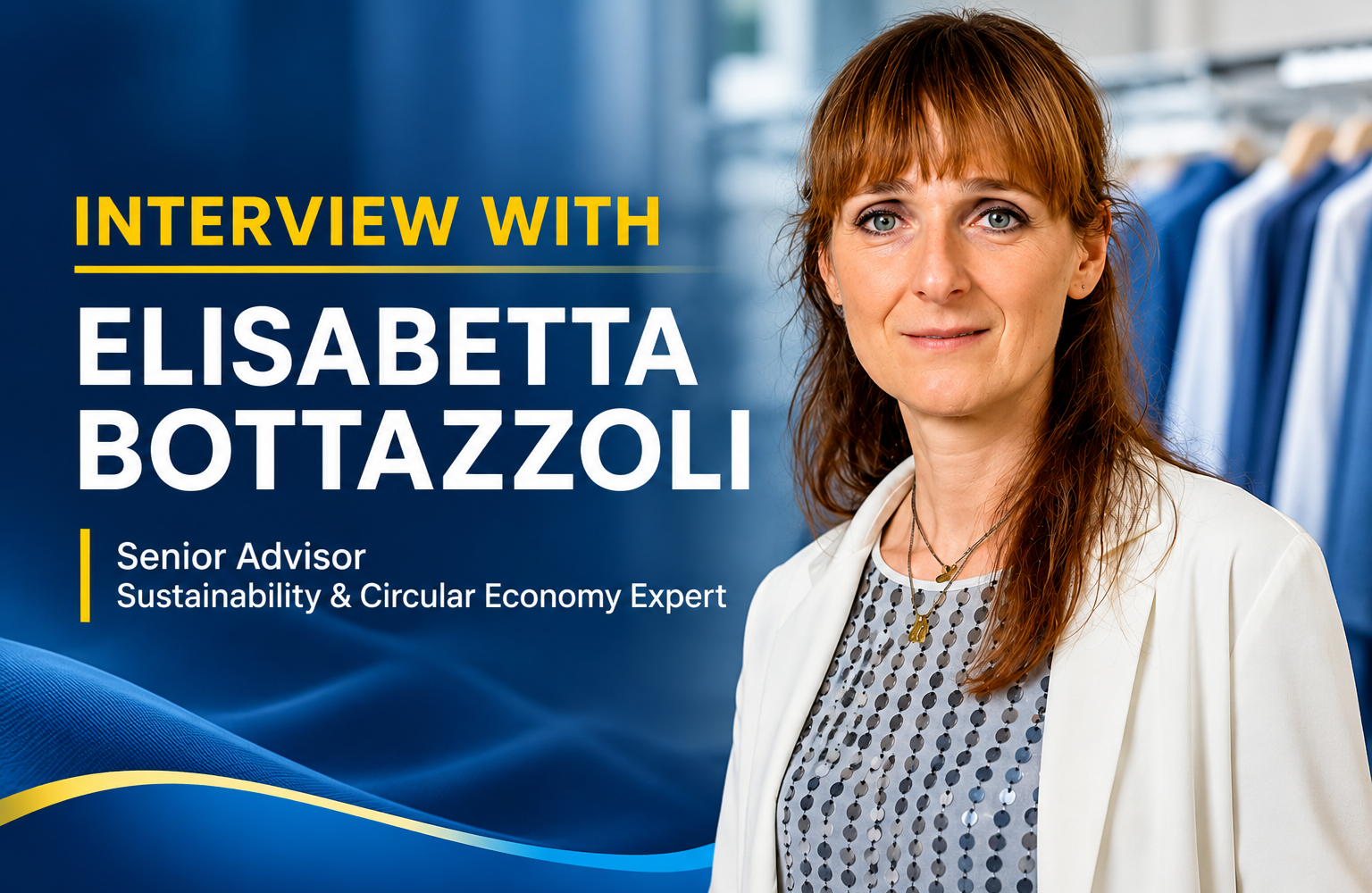
About Elisabetta Bottazzoli
Born in 1971, Elisabetta Bottazzoli has a degree in Political Science from Università Statale of Milan in addition to Master’s Degree in National Law and Community Law on Environment and an Executive Master in Sustainability and Business Innovation at Bologna’s Business School.
Elisabetta Bottazzoli has written extensive publications and continues to give important contribution in important research projects in the field. Throughout her career she has carried out technical-legal support and Environmental Damage Assessments at National Environmental Protection Agency and has ten years of experience at CONAI – National Consortium Packaging. Today she is a freelancer and carries out numerous activities of support, project management and report and evaluation drafting in collaboration with Italian industry associations.