InvestmentTradeBusinessEconomyNews

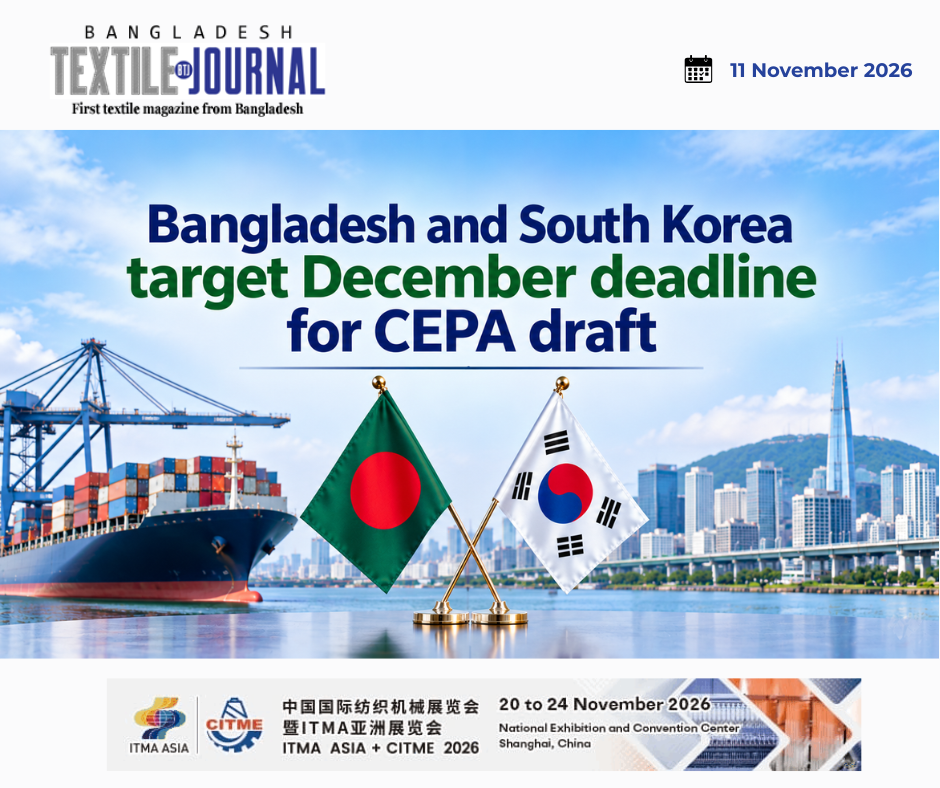
Bangladesh and South Korea target December deadline for CEPA draft

BTJ News Desk
SHARE [addthis tool="addthis_inline_share_toolbox"]
Benninger, a complete system supplier with leading technologies for continuous wet processing and discontinuous dyeing, offers proven solutions that meet the needs of Indian textile manufacturers, who are under growing pressure to process a wider range of fabrics faster while using less water, energy, and chemicals. At ITME 2026, Benninger presents FabricMaster, SynthMaster, and CPB Knit – reliable solutions for demanding woven and knitted articles, from sportswear and heavy jersey to sensitive synthetic blends and high-value underwear fabrics. In every dyehouse, some articles place considerably greater demands on the machinery than others. Fabrics may mark easily, develop uneven shades, or require longer processing times. As fashion cycles shorten and product diversity increases, the ability to process demanding qualities reliably is becoming an important competitive advantage for Indian mills serving both domestic and export markets. Benninger FabricMaster: Versatile Dyeing, from Sportswear to Heavy Jersey Discontinuous dyeing is one area in which fabric quality and machine performance are particularly closely linked. Processors must handle an increasingly diverse range of woven and knitted fabrics while reducing cycle times, water consumption, and energy use. The ability to switch efficiently between fabric qualities without compromising colour consistency is therefore essential. Benninger addresses these requirements with the FabricMaster jet dyeing machine. It processes woven and knitted fabrics marks rope-mark-free, including articles that are difficult or impossible to process on other machines. These include heat-set polyester sportswear, smooth viscose-elastane blends, and heavy 20s cotton jersey. Intelligent liquor circulation, efficient liquor penetration, high rope speeds, and gentle fabric transport enable shorter processing times while reducing water and energy consumption. The result is greater flexibility without compromising productivity or dyeing reliability. Benninger SynthMaster: Gentle Processing of Sensitive Textile Articles The Benninger SynthMaster is designed for fabrics that are sensitive to compression during processing. Nylon-elastane blends, high-value viscose-wool underwear fabrics, and non-heat-set polyester articles, both knitted and woven, may retain compression marks in the finished product. The SynthMaster’s horizontal jet dyeing concept provides smooth, tension-free fabric movement while maintaining consistent process conditions throughout the machine. This allows the goods to leave the machine free of compression marks. Its nozzle technology and optimised chamber design enable operation at low liquor ratios, helping to reduce water and energy consumption. The compact machine footprint also helps mills use existing production space efficiently, an important consideration where increasing capacities within existing facilities is a priority. Because the SynthMaster shares key components with the FabricMaster, customers benefit from simplified maintenance, operational familiarity, and a high degree of compatibility between the two machine platforms. Benninger CPB Knit: Resource-Efficient Dyeing of Knitted Goods The Benninger Cold-Pad-Batch system, CPB Knit, provides salt-free dyeing for knitted goods with water consumption of less than one litre per kilogram. The system offers tension-free, non-curling fabric transport, requires no biopolishing, and achieves high dyestuff yield. At the centre of the system is a padding mangle with two Küsters S-rolls. Their nip profiles are adapted to the fabric and process requirements, supporting level dyeing without listing or tailing. The compact design includes a dyeing trough that swivels downwards and backwards, improving accessibility and operator safety. Expertise Beyond Continuous and Discontinuous Dyeing Benninger’s experience and know-how extend across continuous and discontinuous dyeing and finishing. The company integrates technologies that reduce the consumption of water, energy, and chemicals while improving process stability. These include automated liquid dispensing, powder dissolving and distribution systems, wastewater heat recovery, and caustic soda recovery for mercerising ranges. With more than 165 years of experience in textile machinery, Benninger remains focused on solving the practical challenges faced by dyehouses and finishing plants. By combining Swiss engineering, process expertise, and close collaboration with customers, supported by a strong presence in India, the company helps textile manufacturers transform fabrics into high-value products efficiently, sustainably, and with consistently high quality. Visitors can benefit from Benninger’s experience and expertise and gain first-hand insights into finishing solutions that support competitive business operations at the upcoming India ITME. They are warmly invited to meet the experts at Booth D1F2 in Hall

Bangladesh and South Korea have agreed to finalise the draft Comprehensive Economic Partnership Agreement (CEPA) by December 2026, paving the way for its formal signing at a high-level meeting.

The decision was reached during a meeting between Commerce Minister Khandakar Abdul Muktadir and South Korean Ambassador to Bangladesh Kim Ji-joon at the Secretariat in Dhaka on Tuesday, 10th November.

According to the Export Promotion Bureau (EPB) and Bangladesh Bank, bilateral trade between the two countries reached US$1.65 billion in the 2024–25 fiscal year (FY25). Bangladesh imported goods worth US$1.18 billion from South Korea, while its exports to the country amounted to US$462 million.

During the meeting, the commerce minister assured Korean investors that the government would give priority to resolving their operational and import-related difficulties to facilitate business and encourage further investment.

He also proposed establishing a specialised Design and Development Centre in Bangladesh through joint investment in the shipbuilding sector, utilising the country’s skilled engineers and workforce.

Ambassador Kim expressed South Korea’s interest in finalising the CEPA at the earliest to strengthen bilateral trade and economic cooperation. He said Seoul had already communicated its position on the draft agreement and submitted a detailed questionnaire to Bangladesh.

Both sides discussed the remaining steps towards completing the draft and preparing for its formal signing.

The ambassador also highlighted operational challenges faced by around 200 South Korean companies operating in Bangladesh. Among the concerns were administrative complications in importing research materials and samples for Samsung’s Research and Development (R&D) Centre, delays in issuing import permits (IPs) and difficulties arising from customs regulations.

In response, Muktadir directed the Commerce Ministry to appoint a joint secretary as a focal point to expedite the resolution of import-related issues affecting Samsung and other Korean investors. He also said the government was working to simplify visa procedures and introduce a fully online, real-time system for issuing import permits.

The minister further proposed a joint coordination meeting involving the Commerce Ministry, National Board of Revenue (NBR), Finance Ministry and Korean investors to address policy-related concerns and improve the business environment.

The proposed shipbuilding Design and Development Centre was another key focus of the discussions. Muktadir highlighted opportunities for joint ventures that could combine Korean technology and investment with Bangladesh’s engineering expertise and skilled workforce to meet growing global demand.

The ambassador welcomed the proposal and expressed interest in exploring long-term technology transfer and joint investment opportunities with major South Korean shipbuilding companies, including Hanwha Ocean and Hyundai Heavy Industries.

The two sides also discussed potential cooperation in liquefied natural gas (LNG) supply.

Commerce Secretary Sharf Uddin Ahmed Choudhury, Additional Secretary (WTO) Khadiza Nazneen and other senior ministry officials attended the meeting.

SHARE [addthis tool="addthis_inline_share_toolbox"]