The textile sector increasingly recognises sustainability and reduced carbon emissions as important objectives in its production lines.
Perhaps one of the most meaningful contributions to sustainability in fashion boils down to fibre choice. This means motivating material sourcing specialists to carefully consider the impacts that fibre choice will have on the environment and society, from carbon emissions intensity and recyclability to biodegradability and social welfare.
But in a landscape where materials are compared directly with one another, not only for their performance but also for their sustainability attributes, careful attention must be paid to the details and the many complexities involved.
A familiar tool used to assess the sustainability of materials is life cycle assessment (LCA). To date, LCAs done for wool in accordance with ISO 14040 and 14044 have typically associated wool with high greenhouse gas (GHG) emissions intensities, driven by the enteric methane emissions of sheep as grazing ruminants. However, these standards do not differentiate between biogenic and fossil emissions, and this is problematic.
There is a substantial risk to the environment if we get these comparisons wrong, focusing only on the simplest and most obvious formulas for calculating environmental scores. While linear approaches may work well for pure extraction and factory-based operations, they ignore the multiple complexities and circular nature of natural systems.
This is important when considering natural fibres, since they are grown in natural systems—systems that can be either problematic and extractive or highly beneficial. The primary production context matters.
So How Can Methane-Emitting Sheep Contribute to Net Zero Goals?
It is a well-known fact that ruminants, including sheep, produce methane and that methane is a potent greenhouse gas, much more so than carbon dioxide, albeit only for a short period of time. This is the root of the calls to lower GHGs by reducing the number of ruminants. Alas, nature is far more complex.
When evaluating the true sustainability impact of materials, this complexity matters. The calculations for measuring methane emissions in isolation are not wrong in themselves; the problem is that these emissions are not considered in an ecosystem context. Ruminants, including sheep, are not merely exhaust pipes that emit methane, but rather live within a landscape, an ecosystem that tends to gravitate towards a state of equilibrium. The question, then, is not only how much methane is emitted, but also the context in which it is emitted.
Nature Offers Solutions
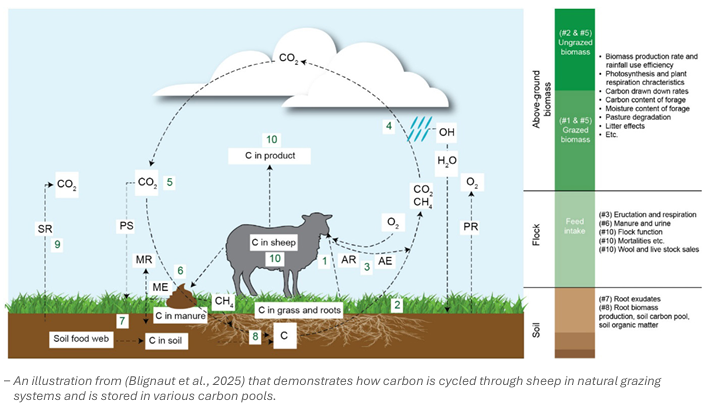
The hydroxyl radical (OH) is the troposphere’s primary oxidant and breaks down methane, carbon monoxide, and volatile organic compounds, and for this reason is central to the GHG emissions conversation.
Due to its extreme reactivity, OH is constantly being created and destroyed, and grazing ruminants on natural pastures play an important role in maintaining the landscapes that generate the precursors of the hydroxyl radical—water vapour, biogenic volatile organic compounds (BVOCs), and soil nitrogen oxides. The more OH is available in the troposphere, the faster methane is broken down, reducing warming.
Well-managed grazing can promote OH formation. In natural grazing systems, soil microbial activity forms nitrogen oxides while plant emissions form volatile organic compounds, which make up the precursors for the formation of OH (Regenetarinism, August 26, 2026); this is one way OH is formed. Other pathways to OH formation exist, all of which rely on water vapour. Here again, responsible grazing management has proven effective in improving the absorption and retention of water in the soil, which could increase the water vapour available to form these efficient, climate-mitigating molecules.
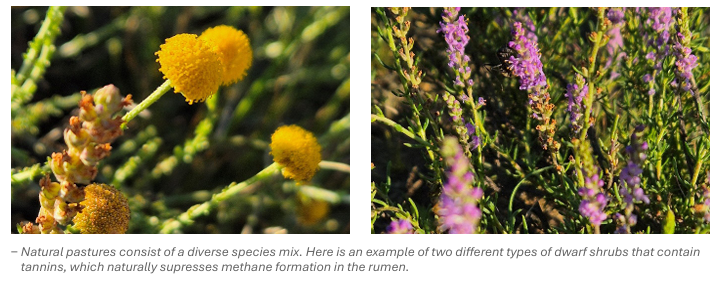
Much research has been done on feed additives to lower methane emissions, but nature has a solution to this too. Diverse plant communities that contain tannins, saponins, legumes, and herbaceous plant species suppress methane production in the rumen.
As a result, animals grazed on diverse natural forage, as is often the case with sheep, will have a very different carbon footprint from those that run on single-species planted pastures or produced under intensive conditions.
Seeking a Balance
The troposphere has a limited capacity to oxidise compounds such as methane and carbon monoxide. This capacity depends on the amount of OH formed relative to the quantity of these compounds present.
The decomposition rate of methane is directly influenced by the global OH concentration and is affected by fossil fuel emissions. These compounds compete for the OH radical, meaning that an increase in thermogenic carbon and carbon monoxide emissions results in fewer OH radicals being available in the atmosphere. Good grazing management offers a solution here, too.
Proper grazing management can substantially reduce the fuel load and, with it, the risk of fire. Intense fires are major emitters of carbon monoxide and methane and consume a large amount of OH radicals. In this way, they exert a double climate penalty: they emit methane directly as well as reduce the atmosphere’s ability to break it down from other sources. (Regenetarinism, August 26, 2026)
Biogenic or Fossil Carbon?
The earth is a closed system with a finite amount of carbon. Biogenic carbon is the same carbon that is being cycled and recycled all the time, but fossil (thermogenic) carbon was sequestered by the biogenic cycle hundreds of millions of years ago and was effectively removed from circulation.
Through the burning of fossil fuels, this stored carbon is now being released back into the atmosphere, representing “new” carbon that must once again be processed by the biogenic cycle. It is not enough to refer to “carbon”; a distinction should be made based on its source.
What the Accounting Says
The ISO 14040 series of standards do not explicitly address the concept of biogenic carbon, and practitioners have therefore tended to ignore it, leading to a carbon bias in which natural fibres are heavily disadvantaged in the carbon accounting system. This has since been addressed by the publication of ISO 14067:2018, which explicitly recognises biogenic carbon to reflect the full or partial carbon footprint of a product by allowing the practitioner to report both emissions and removals.
Until now, LCAs of wool farming enterprises have considered only carbon emissions, never accounting for removals. This grossly overestimates the carbon footprint of wool, and the result is evident in Higg Materials Sustainability Index (MSI) and EU-PEF scores. (IWTO Green Book, 2026).
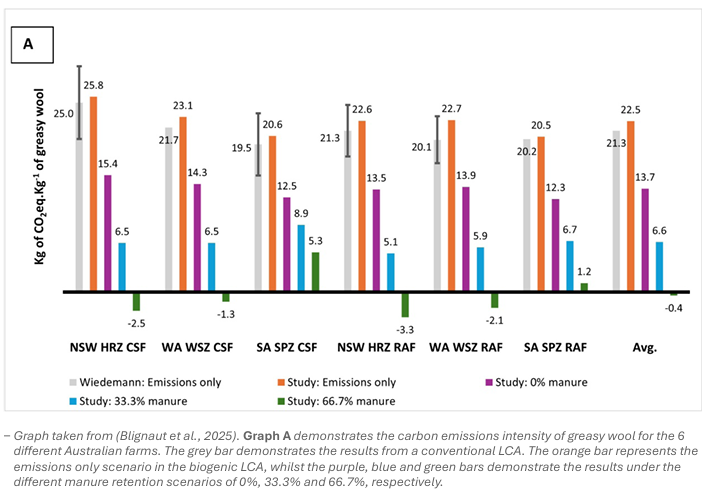
Work undertaken in the International Wool Textile Organisation’s Green Book project, in partnership with CapeWools SA, has led to the publication of Blignaut et al. (2025), the first attempt to conduct a wool LCA according to the ISO 14067 methodology using an existing LCA conducted on 6 Australian farms.
This biogenic LCA analysis, which considered the carbon removals that occur in natural systems, reduced the carbon emissions intensity of greasy wool by between 38.2% and 114.7%. The reduction is broad because it depends on the assumptions used for manure retention, which, according to literature, varies greatly, between 10–90%. The researchers thus used 0%, 33.3%, and 66.7% manure retention scenarios to account for these vast differences. The paper received an additional external review conducted by TÜV SÜD to validate conformance against ISO 14067.
The Full Cycle Must Be Considered
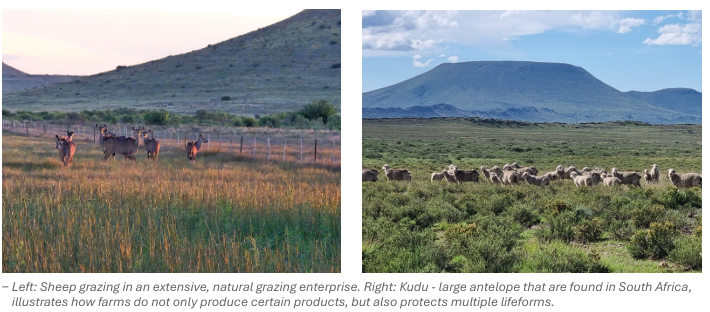
The full context of production must be considered in order to make decisions that can deliver positive environmental impact. In the case of primary wool production, we need to bear in mind that wool growers produce more than wool: they also maintain diverse landscapes that grow millions of tons of biomass, creating and sustaining habitats that support a diverse array of species and provide a host of key ecosystem services.
Many recent studies that seek to understand the relationship between livestock grazing and plant and soil health indicate that well-managed farms can not only deliver valuable impacts for increased soil formation and health but can also act as net carbon sinks over time, thus contributing to Net Zero goals (Meissner et al., 2023), (FAO, Global assessment of soil carbon in grasslands, 2023), (Stanley et al., 2024), (Simmons et al., 2025), (Bråthern et al., 2021), and (Reinecke et al., 2025).
This raises another issue with typical LCAs: natural systems respond over long periods, not just one or two years. This is true for all ecosystem processes, but in the case of the carbon cycle, plant growth—and so the ability to draw carbon down from the atmosphere—is highly dependent on temperature and rainfall, meaning that seasonal and climatic fluctuations will strongly affect the amount of carbon that can be sequestered or potentially even released.
Likewise, measuring methane emissions over the short term does not give an accurate account, since methane degrades over a period of about twelve years. For a more accurate picture, we should therefore model these changes over the long term (Meissner et al., 2023).
What Do We Stand to Lose?
The narrow view that reducing livestock numbers would solve our climate crisis is simplistic to begin with, and ultimately short-sighted. Beyond the carbon emissions debate, there are many other benefits of raising livestock that should be considered. Livestock have been part of human societies for millennia and play a crucial role in many cultures, promoting social and economic wellbeing (Meissner et al., 2023). This is especially true in developing countries where women are often the owners of the livestock.
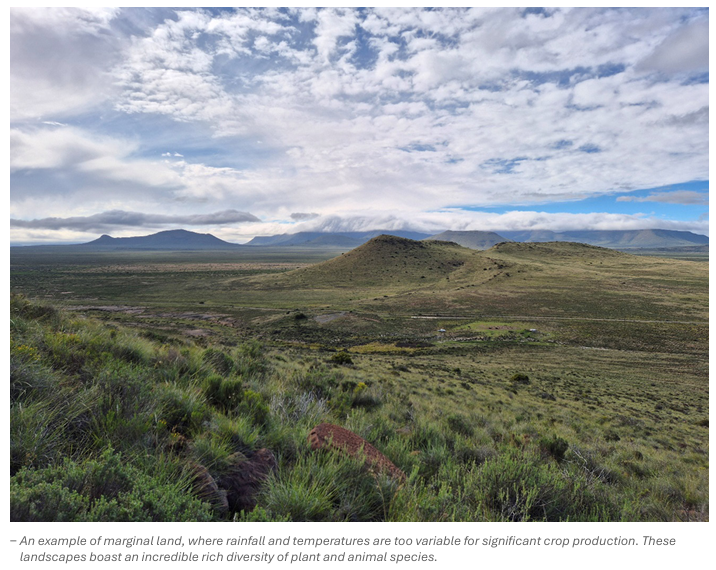
Livestock supports low- and middle-income communities that live on marginal land where crop production is not feasible; livestock creates jobs, keeps schools and hospitals operating in small towns, and promotes thriving communities. The keeping of livestock also provides access to nutrient-dense food—an issue that cannot be overlooked while malnutrition remains such a big problem globally.
Wool Production Can Help Conserve Natural Resources
A plethora of new information points to the many benefits of well-managed grazing for the environment. Whilst we have historically been of the view that grazing animals lead to over-grazing and land degradation, we are now starting to realise that over-grazing is merely a function of time and not an inevitable result of the animals themselves.
If animals are allowed or forced to graze in an area for an extended period, over-grazing will result, but when animals are grazed strategically, they unlock a cascade of beneficial ecosystem reactions.
Grazing for short periods promotes healthy plants by stimulating their regrowth, and over time increases plant density and improves species composition. Healthier plants, combined with the manure and urine excreted by the animals, provide food for soil microbes and aid soil formation, improved soil structure, and increased water absorption and water-holding capacity.
This increases resilience to both droughts and floods, and conserves valuable rainwater by limiting evaporation and runoff. Reduced water erosion conserves soil and maintains soil fertility. Increased soil fertility and improved soil structure ensure healthier and increased plant growth, fully harnessing the sun’s energy and cycling nutrients back into the wider food web, producing healthier animals and humans.
All of this contributes to the formation of habitats that house a vast and complex diversity of life, from microbes, insects, amphibians, and birds to other mammals. At the same time, wool production creates GDP-enhancing products essentially from sunlight and water—resources we are blessed with for free.
Simplicity Is Often Deceptive
These ecosystem, social, and economic benefits cannot be replaced or manufactured. This is the real danger of reducing complex systems to simple metrics when making decisions about sustainability. The context of production and the complexity of natural systems matter, and we should make every effort to include these complexities in our sustainability reporting.
Author Bio
Jo-Anne Bester
Jo-Anne Bester is a South African textile and wool industry professional associated with the International Wool Textile Organisation (IWTO). Having grown up on a Merino sheep farm in the Karoo region of South Africa, she developed a strong personal passion for wool and its role in the textile value chain. Her professional profile reflects her involvement in the international wool industry, while her education includes studies at Milpark Education.
About IWTO
The International Wool Textile Organisation was established in 1930 as the global authority for standards in the wool textile industry. Today, IWTO’s 45 members represent 29 countries across the entire wool pipeline.