Introduction: Ethics Must Reach the Factory Floor
Textile and garment exports are one of the main engines of Bangladesh’s economy, and the industry’s standing with international buyers depends on more than capacity and price. Buyers expect consistent quality and dependable delivery, and they increasingly expect evidence that goods are made responsibly.
Discussions of ethics in this sector usually focus on labour rights, building safety, environmental protection and social compliance audits (Khan et al., 2019; Ethical Trading Initiative [ETI], 2024). These topics matter, but they describe only part of the picture. Ethics also appears in how a sales team prices an order, how a planner reports a delay, how a supervisor responds to a complaint and how a buyer changes an order late in the production cycle.
A factory can hold every required policy and still struggle in these everyday moments. Workers hesitate to report problems because they fear blame. Sales teams accept delivery dates that production cannot meet. Managers delay bad news until the shipment is already at risk. Environmental targets appear in the sustainability report but not in the daily production plan. Compliance systems alone cannot prevent this.
The distinction matters. Compliance asks whether a company meets laws, standards and contractual requirements. Ethical management asks a further question: are our decisions fair, honest and respectful of the people they affect? Take a yarn shortage that disrupts dyeing, weaving, processing and shipment. No manager can make the shortage disappear, but an ethical approach means reporting it honestly, assessing the consequences, coordinating corrective action and refusing to make promises with no realistic operational basis.
Responsibility also does not end at the factory gate. International buyers shape working conditions through their prices, order volumes, forecasts, delivery expectations, payment practices and late changes (Islam et al., 2023). Responsible business conduct therefore has to be considered across the whole supply chain (OECD, 2018).
This paper asks how ethical management can become a working management approach inside Bangladesh’s textile industry. It is a conceptual, practice-oriented review drawing on research on ethical labour management and purchasing practices, international due-diligence guidance, recent regulation and operating patterns commonly seen in textile manufacturing. It reports no primary survey or interview data, and the case in Section 6 is hypothetical. The framework, indicators and roadmap are meant as a practical structure for managers and a starting point for empirical testing.
Industry Context: Scale, Pressure and Opportunity
The scale of the industry makes ethical management an economic concern as well as a social one. According to provisional Export Promotion Bureau data published by the Bangladesh Garment Manufacturers and Exporters Association (BGMEA), ready-made garment exports reached about US$38.70 billion in fiscal year 2025–26. That was around 80.6% of total merchandise exports of roughly US$48.0 billion (BGMEA, 2026; The Business Standard, 2026). An industry this dependent on one export category cannot afford to lose its reputation for reliability.
Buyers want competitive prices, consistent quality, shorter development cycles, traceability and evidence of responsible production, while manufacturers manage uncertain raw-material supply, energy availability, financing costs and shipping schedules.
Textile production is unusually sensitive to coordination. A delay in yarn procurement can hold up yarn dyeing, weaving, wet processing, finishing, inspection and shipment, even if every other department performs well. Under that kind of pressure, rushed decisions, optimistic promises and incomplete reports become tempting, and problems get passed to the next department instead of being solved.
This is where ethical management becomes an operational matter. A company that encourages early reporting has time to arrange alternative materials, reset priorities or negotiate a realistic delivery date. A company that discourages bad news may find out only when the options have run out.
The industry therefore has an opportunity to move past a narrow idea of compliance. A factory should be judged not only by whether it passes an audit or holds a certificate, but by how consistently its managers apply policies, respond to grievances, report risks, treat suppliers fairly and complete corrective actions.
Ethical management is part of commercial success, not separate from it: it is how a business protects its people, serves its customers and keeps the trust that long-term relationships depend on.
Understanding Ethical Management in Textile Manufacturing
Ethical management means making and carrying out business decisions in a way that is fair, honest, transparent, accountable and respectful of the legitimate interests of stakeholders.
In textile manufacturing these include workers, managers and owners, suppliers and subcontractors, international buyers, regulators, surrounding communities and the natural environment. Their interests sometimes conflict, and ethical management helps managers balance them without relying on short-term financial considerations alone.
Consider an urgent order that would bring welcome extra business. If production lacks the capacity, materials or processing time, accepting it without a recovery plan may end in excessive overtime, compromised quality, added cost or a late shipment. The ethical response is not necessarily to refuse. It is to check capacity, consult the departments involved and give the customer a commitment that can actually be kept.
This paper organises ethical management around five connected pillars (Figure 1):
- People and labour ethics: Respect for workers’ rights, safety, dignity and voice.
- Customer and commercial ethics: Honest information, realistic commitments and fair commercial treatment.
- Operational integrity: Accurate reporting, responsible planning, quality discipline and accountability.
- Environmental responsibility: Careful management of resources, chemicals, emissions, wastewater and waste.
- Business integrity and transparency: No corruption, conflicts of interest, falsification or unauthorised subcontracting.
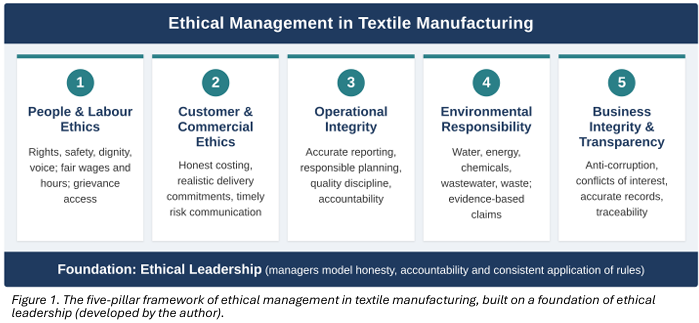
All five rest on ethical leadership. Policies cannot create an ethical workplace if managers reward people for hiding problems, overlook unfair treatment, or push departments to hit targets at all costs. When senior management communicates honestly, accepts accountability and applies rules consistently, those habits spread through the organisation.
The Five Pillars in Practice
1. People and Labour Ethics: Respect Beyond Compliance
Workers are central to textile manufacturing. Their skill, experience and commitment shape efficiency, quality and delivery, so protecting their rights is both an ethical duty and sound management.
Labour ethics covers safe conditions, lawful wages, reasonable working hours, fair treatment, freedom from harassment and discrimination, and access to effective grievance mechanisms (Khan et al., 2019). Workers should be able to raise concerns without fear of retaliation.
A policy on paper does not guarantee any of this. A grievance procedure has little value if workers believe complaining will cost them their jobs, and formal overtime rules mean little when poor planning keeps forcing long hours.
The useful question is how policies work in practice: do workers know their rights, are complaints investigated objectively, and are corrective actions recorded and finished?
Production pressure needs special attention. When a shipment slips, management may need extra hours or revised priorities, but those decisions must stay within labour law, contractual requirements and worker-protection standards. A delivery problem should never become an excuse for unsafe conditions or coercion.
Supervisors matter most here because they turn management decisions into daily practice. One who humiliates workers or discourages defect reporting damages morale and performance; one who explains targets clearly and listens to concerns builds trust.
Equal opportunity, fair recruitment, harassment prevention and maternity protection belong in regular management reviews, not only in audit files.
2. Customer and Commercial Ethics: Honest Costing and Realistic Commitments
Export customers judge a supplier on more than price. They look at consistency, communication, responsiveness, traceability and, above all, whether commitments hold.
Ethical customer management starts with accurate information. A quotation should rest on a sound assessment of material cost, processing requirements and specifications, and any assumption that could materially change the price should be stated.
A low quotation may win the order, but if the cost was never properly assessed it puts pressure on production, tempts people to cut necessary controls and leads to disputes when extra costs surface.
Delivery dates need the same discipline. Before confirming one, the relevant teams should review material availability, capacity, laboratory approvals, processing lead times, and inspection arrangements.
In a textile mill the delivery date is not simply a number entered by sales. It is the result of a chain of linked activities, and a promise that ignores the chain creates pressure all the way down it.
When circumstances change, the customer should hear about it promptly, with a realistic recovery plan. Hiding a known problem avoids an awkward conversation for a while and damages the relationship badly when the buyer finds out.
The same applies to quality: a manufacturer should not conceal defects, substitute materials without approval or report test results that misrepresent the product.
Commercial ethics does not mean agreeing to every buyer demand. It means negotiating professionally, explaining constraints honestly and keeping promises.
3. Operational Integrity: Planning, Reporting and Accountability
Operational integrity is the honesty and discipline with which an organisation plans, runs, monitors and reports its work.
A typical woven-fabric order may pass through yarn procurement or spinning, yarn dyeing where required, weaving, fabric inspection, wet processing, finishing, testing, final inspection and shipment. Routes and durations vary, but the delivery outcome depends on coordination across the whole chain (Figure 2).
Figure 2 (Page 98): Simplified woven-fabric order chain showing how a delay at one stage moves downstream to shipment. Developed by the author; actual routes vary by product.
It begins with reliable information. Production reports should show actual progress, not the progress managers would like to see.
Material shortages, machine downtime, quality concerns and capacity limits must be recorded accurately; if a department reports an order as on schedule despite a substantial delay, management loses the chance to step in early.
The cause is not always dishonesty. People often avoid bad news because they fear blame, and departments may calculate completion dates on different assumptions. Clear reporting definitions, consistent data and a culture that welcomes early escalation are the remedy.
Delivery performance is a shared responsibility. Sales should not commit to dates without production input, planning should set achievable schedules, procurement should watch critical materials, production should report real capacity and quality should flag approval risks.
One practical principle helps: separate a problem from the reporting of that problem. People should answer for negligence, concealment or repeated failure to follow procedures, but not be punished for raising a genuine risk early. Otherwise the organisation teaches silence.
4. Environmental Responsibility: Beyond Green Buildings and Certificates
Textile manufacturing puts real pressure on water resources, energy systems and the surrounding environment, particularly in wet processing, dyeing, washing, printing and finishing.
Many factories have invested in cleaner technology and management systems, which is valuable, but environmental responsibility cannot be judged by buildings, certificates or audit scores alone. It has to show up in daily operating practice.
In practice that means proper chemical storage and handling, wastewater treatment, monitoring of discharge parameters, efficient use of water and energy and responsible waste disposal, all within environmental law, permit conditions and customer requirements.
Claims also need evidence: a product should not be described as sustainable, recycled or low-impact unless the company can support that with verified information on composition, origin, processing and certification.
Water reuse and resource efficiency can reduce environmental pressure and improve resilience (Isaac & Webster, 2026), but they need technical assessment, investment and monitoring, and they are not universal solutions.
Environmental and operational efficiency often point the same way, since less rework and better process control mean less waste and lower cost.
A practical programme starts with measurable baselines, such as water and energy use per unit, wastewater compliance, chemical-management performance and waste generated, and reviews progress over time.
The aim is not to show that a policy exists but that environmental risks are understood, controlled and steadily reduced.
5. Business Integrity and Supply-Chain Transparency
Ethical management also demands integrity in purchasing, recruitment, subcontracting, financial transactions and documentation.
Conflicts of interest arise when employees recommend suppliers, approve purchases or negotiate deals in which they have an undisclosed personal stake, and gifts or commissions can quietly distort decisions. Organisations need clear rules for such situations and a safe way to report suspected misconduct.
Records must match reality. Purchase orders, invoices, production records, inspection reports, test results and shipment documents should be accurate and consistent with the underlying transactions, because falsified records expose a company to legal, financial, contractual and reputational risk.
The same applies to the supply chain. A manufacturer should know which suppliers and subcontractors are involved in an order and obtain approval before production moves elsewhere, since unauthorised subcontracting clouds quality, labour conditions and traceability.
Where customers specify fibre origin, recycled content or restricted substances, claims should rest on records and verification, not verbal assurances.
Transparency does not mean publishing every commercial detail. It means keeping accurate records, giving authorised stakeholders the information they are entitled to and never misrepresenting how a product was made.
These practices work when employees understand the rules and managers apply them without favouritism.
Buyer–Supplier Ethics: Responsibility Must Be Shared
Ethical management cannot be achieved by placing all responsibility on manufacturers. Buyers and suppliers work inside the same commercial relationship, and both sets of decisions affect production conditions, financial stability, quality and delivery.
Buyers legitimately expect competitive prices, reliable quality and on-time delivery; suppliers need accurate forecasts, clear requirements, workable lead times, timely approvals and commercially sustainable terms.
The tension shows up in purchasing practice. A request for a lower price, a shorter lead time, a smaller quantity or a changed order may look reasonable on its own. Repeated, such requests increase material waste, disturb capacity planning and raise the risk of late delivery.
Islam et al. (2023) studied unfair purchasing practices affecting Bangladeshi garment suppliers during the COVID-19 period and documented order cancellations, price reductions and delayed payments. Those findings describe the period studied and should not be read as a measure of current practice across all buyers, but they show why responsible purchasing deserves attention alongside factory-level compliance.
Buyers can act responsibly in several concrete ways:
- Providing clear and reasonably stable forecasts.
- Communicating design, specification and order changes promptly.
- Allowing lead times that match the product and production route.
- Paying on the agreed terms and handling cancellations and claims fairly.
- Avoiding demands that effectively push suppliers to compromise worker welfare, quality or legal requirements.
- Working with suppliers on significant risks instead of relying only on penalties.
Suppliers carry their own duties. They should not accept orders without a realistic assessment of capacity, conceal known production risks, manipulate test results or use unauthorised subcontractors.
When a genuine shortage or interruption occurs, the supplier should give an evidence-based explanation, identify the affected quantities and present a recovery plan, and the buyer should assess the facts and consider reasonable options while keeping its contractual rights.
Shared responsibility does not mean every delay is the buyer’s fault or that poor planning should be excused. It means each party answers for the decisions within its control.
An Illustrative Case: When a Delivery Date Becomes an Ethical Test
The following example is hypothetical. It illustrates a common kind of operational challenge and does not describe a specific company or verified incident.
A woven-fabric manufacturer accepts an order for a buyer’s seasonal collection. The delivery schedule assumes yarn arrives on time, yarn dyeing goes to plan and weaving and later processing run without major interruption.
Then a yarn shortage develops and dyeing falls behind. Weaving cannot complete the planned quantity, and the delay moves on to finishing, final inspection and shipment preparation. The delivery date in the order system has not changed, but the real position has deteriorated. The company now faces an ethical test.
One response is to play down the delay. Sales keeps reporting that delivery is under control while production is told to recover the schedule without a realistic look at capacity. As the deadline nears, the company faces rushed processing, extra cost, pressure on employees, quality risk and possibly air freight or cancellation.
The other response is to acknowledge the risk early. The responsible teams verify the available yarn, identify the affected quantities, review remaining lead times and work out the earliest realistic completion dates.
Management then tells the buyer plainly, without exaggeration, and proposes options:
- Prioritising certain quantities.
- Resequencing production where technically feasible.
- Using alternative materials subject to buyer approval.
- Agreeing a revised delivery arrangement.
Any plan must respect quality requirements, worker protections and contractual obligations.
This approach does not guarantee that the original date will be met. Its value lies in the quality of the decision-making.
Four lessons follow. Accurate information comes first, because nobody can decide responsibly on misreported status. Early escalation is a strength, not a weakness. Commercial commitments must be backed by operational evidence, and sales targets should not override realistic lead times. And accountability should follow the cause, whether it lies in material supply, planning or approvals, not fall automatically on the last department in the chain.
A recovery plan that protects the date by ignoring safety, falsifying records or knowingly compromising quality is not a recovery plan.
International Due Diligence: Preparing for Responsible Business Expectations
Global garment supply chains increasingly expect companies to identify, prevent, mitigate and address the adverse impacts of their activities, and to show how they do it.
The OECD’s due diligence guidance for the garment and footwear sector offers a useful framework: embed responsible conduct in policies and management systems, assess actual and potential impacts on workers, human rights and the environment, prevent and mitigate them, track results, communicate accurately and provide for remediation where appropriate (OECD, 2018, 2026).
For manufacturers this means reviewing labour risks, monitoring subcontractors, keeping accurate material records, strengthening chemical management, investigating grievances and documenting corrective action.
Regulation is moving in the same direction, though more slowly than once expected.
The European Union’s Corporate Sustainability Due Diligence Directive, Directive (EU) 2024/1760, was amended by Directive (EU) 2026/470, published in the Official Journal on 26 February 2026 (European Parliament & Council of the European Union, 2024, 2026).
Member States must transpose it by 26 July 2028, with application from 26 July 2029. The amendment narrowed the scope to very large companies: broadly, EU companies with more than 5,000 employees and over EUR 1.5 billion in net worldwide turnover, and non-EU companies with over EUR 1.5 billion in net turnover generated in the EU.
Exact obligations depend on the legislation, the company’s circumstances and the implementing rules. Bangladeshi manufacturers will generally not be covered directly, but many of their European buyers will be, and they are likely to pass due-diligence expectations down the chain through information requests and contract terms.
The sensible response is to build reliable systems now, with accurate records, a clear view of significant risks, named owners for corrective actions and regular checks that improvements work, rather than wait for a particular audit or deadline.
Due diligence should not become another paperwork exercise; its purpose is to find and fix risks before they cause harm.
Measuring Ethical Management: From Audit Findings to Performance Indicators
A policy that is never reviewed has little influence on daily work, while too many indicators create administration without improving decisions.
Companies should choose a manageable set that reflects their main risks, rests on reliable data and has named owners. Table 1 gives examples that can be adapted to a factory’s size, processes and available information.
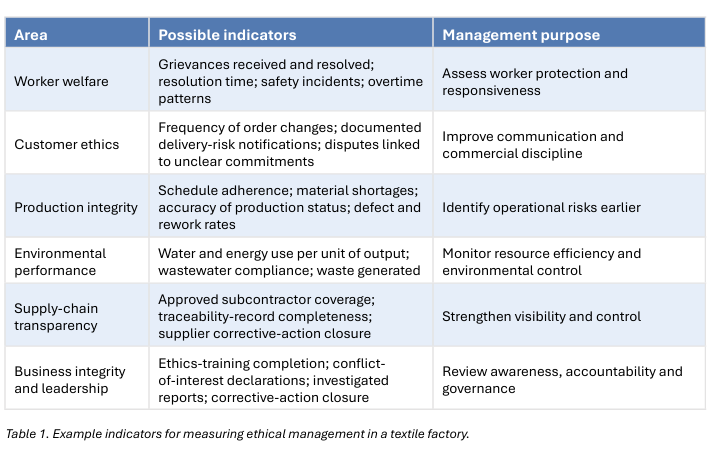
Indicators need careful reading. A rise in reported grievances does not necessarily mean conditions have worsened; it may mean workers trust the reporting system more.
Likewise, a high on-time delivery rate proves little if it is achieved through unsustainable overtime, hidden subcontracting or inaccurate reporting.
Targets should reward responsible performance, not a single outcome at any cost, and repeated delivery failures that stem from unrealistic commitments call for better order acceptance and capacity planning, not just pressure on production staff.
The purpose of measurement is not a perfect ethical score. It is to show where risks exist and whether controls work.
A Six-Step Roadmap for Implementing Ethical Management
Ethical management does not require a complicated new system. Often the more important task is to connect existing policies, responsibilities and procedures so that ethical principles influence everyday decisions.
Figure 3 shows a six-step roadmap as a practical starting point.
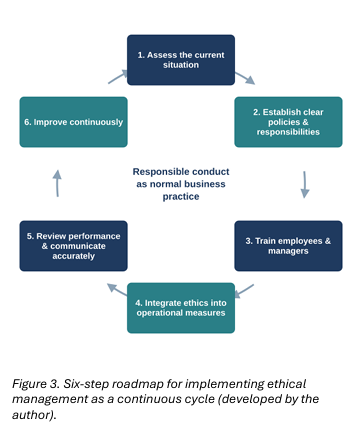
Step 1: Assess the current situation
Review policies, audit findings, grievances, customer complaints, environmental records, production delays and supply-chain risks, and look for gaps between documented procedures and actual practice.
A policy may require delivery risks to be escalated, but are they reported in time to act? Employee input reveals what documents cannot, and the assessment should be used to learn, not to assign blame.
Step 2: Set clear policies and responsibilities
Define expectations for labour rights, respectful behaviour, anti-bribery, conflicts of interest, accurate reporting, environmental duties, customer communication and supply-chain transparency.
Say who is responsible for implementation and escalation, how concerns are reported and what protects people from retaliation. Senior management must apply these rules consistently.
Step 3: Train employees and managers
Training works best when it addresses situations people actually face:
- Realistic costing and delivery commitments for sales and marketing.
- Accurate reporting and risk escalation for production and planning.
- Conflicts of interest and documentation for procurement.
- Respectful communication and grievance handling for supervisors.
Refresh it when procedures change or problems recur.
Step 4: Build ethics into operational routines
An order-review meeting can look at material availability, realistic lead times, capacity and the risk of late changes as well as price and delivery date, and a production review can test whether reported progress matches actual output.
Labour and environmental indicators should sit beside productivity and quality, so that financial and delivery targets are not the only measure of success.
Step 5: Review performance and communicate accurately
Review the indicators from Table 1 regularly, looking at trends, repeated failures, open grievances and the effectiveness of corrective action.
Separate individual misconduct from weak systems, inadequate training and unrealistic expectations, because each needs a different response. Report honestly on what has been done and what remains unresolved.
Step 6: Improve continuously
New customer requirements, regulations, technology and workforce needs create new risks. Learn from complaints, delays, quality failures and supplier assessments, and address root causes.
If the same issue keeps recurring, ask whether the procedure, resources, incentives or leadership behaviour has to change, and recognise people who report risks early or suggest practical improvements.
Challenges and Recommendations
Implementation is rarely straightforward. Manufacturers face financial limits, intense price competition, limited technical resources and short lead times.
Smaller suppliers may struggle to build documentation systems, invest in environmental upgrades or answer many different buyer assessment frameworks, and even larger firms stumble when departments have conflicting targets.
Measurement needs care too: if managers are rewarded only for shipments they may underreport risks, and if grievance numbers are read as failure, workers may stop raising legitimate concerns.
A practical answer is to start with the most significant risks, clear responsibilities and a few reliable indicators, and build more advanced systems as capacity grows.
Each group has a different part to play.
Factory owners and senior management
Factory owners and senior management should treat ethical management as a core responsibility rather than leaving it to the compliance team:
- Set clear standards and apply them consistently.
- Review production commitments before accepting orders.
- Encourage timely risk reporting.
- Protect workers’ rights.
- Link environmental goals to measurable practice.
- Avoid incentives that reward output at the expense of safety, quality or honest reporting.
Leaders should also examine their own behaviour. If employees are told to be honest but every reported problem is met with punishment, the organisation sends conflicting messages.
Sales, marketing, planning and production teams
These teams meet where commercial promises collide with production reality.
Sales should consult the relevant departments before confirming demanding orders, planners should use realistic assumptions, production should keep progress data accurate and quality teams should report non-conformities objectively even under commercial pressure.
Cross-functional meetings should focus on evidence and solutions, not blame.
International buyers and brands
International buyers and brands should assess suppliers on whether their own purchasing practices support responsible production, not only on price, quality, delivery and audit results.
Better forecast visibility, early notice of changes, feasible lead times, payment on agreed terms and fair handling of claims all help.
Joint industry recommendations for Bangladesh make a similar point about the role of brands (ETI, 2024). Responsible purchasing does not remove suppliers’ obligations; it recognises that outcomes are shaped by decisions on both sides.
Industry associations and policymakers
Industry associations and policymakers can offer practical guidance, management training and shared learning, particularly for smaller manufacturers that need accessible help with grievance systems, traceability, environmental measurement and due-diligence requests.
They can also bring manufacturers, buyers, workers’ representatives and public institutions together on recurring problems no single factory can solve, and clear regulation with transparent enforcement helps responsible businesses compete on a level footing.
Conclusion: Ethical Management as an Operating Advantage
Ethical management is becoming central to the long-term success of Bangladesh’s textile industry. As international supply chains put more weight on responsible conduct, manufacturers must show not only that they meet formal requirements but that their daily decisions reflect honesty, fairness, accountability and respect for people and the environment.
This paper has examined five connected areas: worker welfare, customer relationships, operational integrity, environmental responsibility and business transparency. They reinforce one another.
Unreliable production reporting threatens customer commitments, unrealistic delivery expectations increase pressure on workers, weak supplier controls undermine traceability, and poor environmental management creates operational, regulatory and reputational risk.
Responsibility is also shared: manufacturers answer for production, quality, labour conditions and honest communication, while buyers shape outcomes through forecasts, lead times, order changes and payment practices.
Ethical management will not remove every delay, disagreement or environmental challenge, and it does not promise immediate financial gain. Its value lies in a more reliable basis for decisions, earlier warning of risk and stronger credibility.
For Bangladesh’s textile industry the way forward is not simply better audit preparation. It is to build organisations where responsible conduct is part of normal management: in how orders are accepted, workers treated, risks reported, resources used and relationships maintained.
That is how ethics becomes a foundation for long-term competitiveness.
References
1. Bangladesh Garment Manufacturers and Exporters Association. (2026). Export performance [Data based on Export Promotion Bureau statistics]. BGMEA.
https://www.bgmea.com.bd/page/Export_Performance
2. Ethical Trading Initiative. (2024). Joint recommendations for responsible business conduct in Bangladesh.
https://www.ethicaltrade.org/resources/guidance-and-reports/joint-recommendations-responsible-business-conduct-bangladesh
3. European Parliament & Council of the European Union. (2024). Directive (EU) 2024/1760 of 13 June 2024 on corporate sustainability due diligence. Official Journal of the European Union.
https://eur-lex.europa.eu/eli/dir/2024/1760/oj
4. European Parliament & Council of the European Union. (2026). Directive (EU) 2026/470 amending Directives 2006/43/EC, 2013/34/EU, (EU) 2022/2464 and (EU) 2024/1760 as regards certain corporate sustainability reporting and due diligence requirements. Official Journal of the European Union.
https://eur-lex.europa.eu/eli/dir/2026/470/oj
5. Isaac, L., & Webster, M. (2026, March 26). The economics of reuse: Bangladesh’s shift toward industrial water reuse. The Water Blog, World Bank.
https://blogs.worldbank.org/en/water/the-economics-of-reuse–bangladesh-s-shift-toward-industrial-wat
6. Islam, M. A., Abbott, P., Haque, S., & Gooch, F. (2023). Impact of global clothing retailers’ unfair practices on Bangladeshi suppliers during COVID-19. University of Aberdeen.
https://doi.org/10.57064/2164/19814
7. Khan, S. I., Bartram, T., Cavanagh, J., Hossain, M. S., & Akter, S. (2019). “Decent work” in the ready-made garment sector in Bangladesh: The role for ethical human resource management, trade unions and situated moral agency. Personnel Review, 48(1), 40–55.
https://doi.org/10.1108/PR-01-2018-0001
8. OECD. (2018). OECD due diligence guidance for responsible supply chains in the garment and footwear sector. OECD Publishing.
https://doi.org/10.1787/9789264290587-en
9. OECD. (2026). Due diligence essentials for responsible garment and footwear (Responsible Business Conduct Spotlights). OECD Publishing.
https://www.oecd.org/en/publications/responsible-business-conduct-spotlights_03a75bf9-en/due-diligence-essentials-for-responsible-garment-and-footwear_c7ae4e4a-en.html
10. The Business Standard. (2026, July 2). June exports rebound, but FY26 earnings edge down to $48b. The Business Standard.
https://www.tbsnews.net/economy/exports-slip-058-48b-fy26-despite-june-rebound-1478001
Author Bio
K. M. Ziauddin Mahamud
Manager, Sales and Marketing (Fashion)
Zaber and Zubair Fabrics Ltd.
K. M. Ziauddin Mahamud is a textile professional with extensive experience spanning textile engineering, product development, marketing, sales, and business management. He currently serves as Manager, Sales and Marketing (Fashion) at Zaber and Zubair Fabrics Ltd., where he is responsible for global business development and works closely with international buyers to drive innovation in value-added and sustainable woven fabric solutions.
Before moving into industry, he worked as a full-time faculty member in the Department of Textile Engineering at the University of South Asia, teaching courses related to textile processing, industrial practices, and manufacturing systems. This academic experience has strengthened his ability to bridge theoretical knowledge with real-world industrial applications.
Mr. Mahamud is currently pursuing an M.Sc. in Textile Engineering (Textile Engineering Management) and holds a Postgraduate Diploma in Textile Industry Management from the Bangladesh University of Textiles (BUTEX).
In addition, he earned a Master of Professional Marketing (MPM) from the University of Dhaka and a B.Sc. in Textile Engineering from the University of South Asia.
His professional and research interests focus on product diversification, sustainable fabric innovation, textile value-chain upgrading, industry management, and global market strategy.