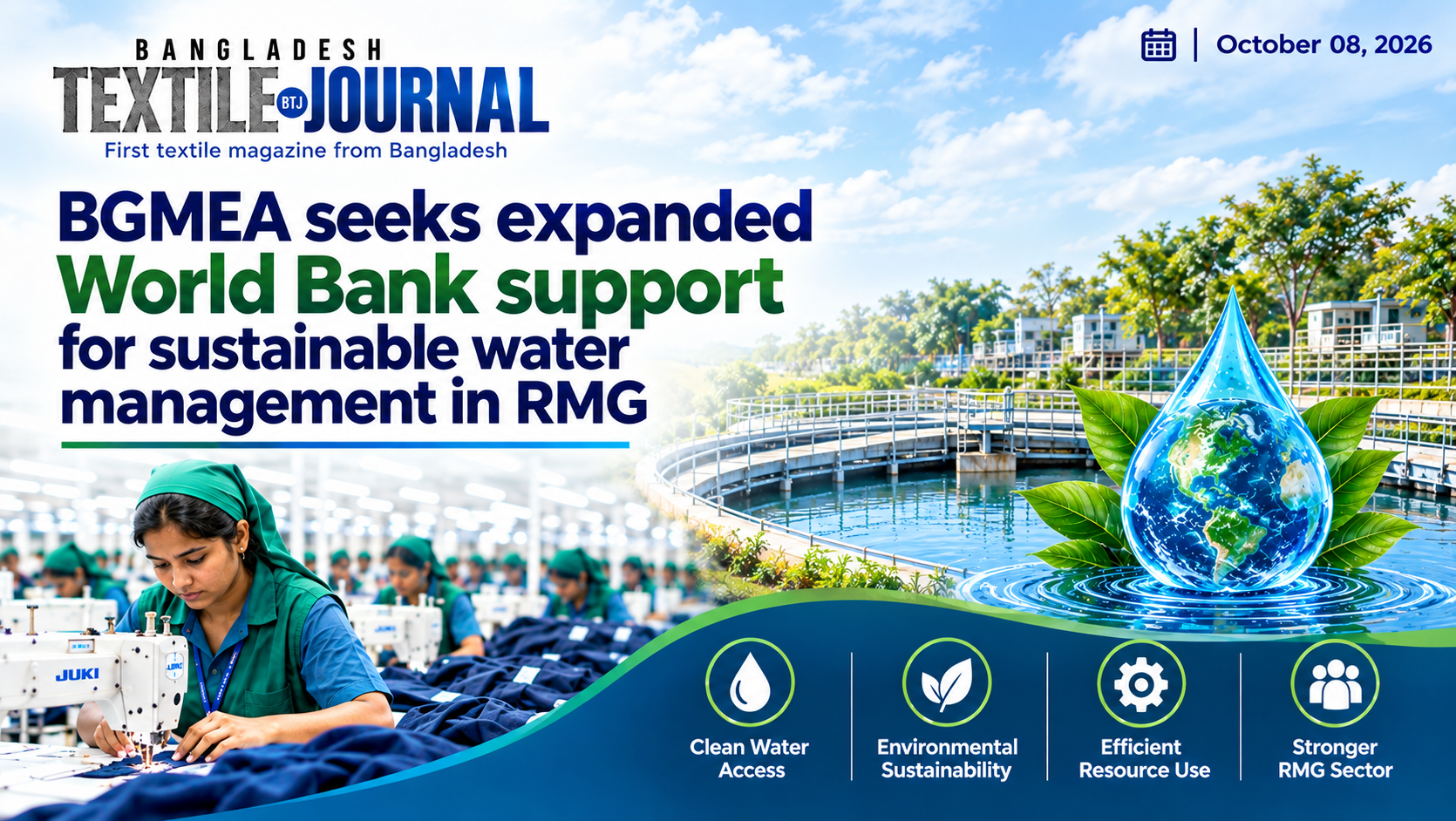
Bangladesh Garment Manufacturers and Exporters Association (BGMEA) has urged the World Bank to significantly increase funding and expand the coverage of its sustainable water management programme to support the green transformation of Bangladesh’s ready-made garment industry.
The call came during a high-level meeting between BGMEA President Mahmud Hasan Khan and a World Bank delegation led by Mara K. Warwick, Regional Director for Sustainable Development for the South Asia Region, at the BGMEA Complex in Uttara, Dhaka, on 7 October.
The meeting reviewed progress under the Dhaka Water Security and Resilience Programme (D-Water) and its $5 million Viability Gap Funding (VGF) pilot initiative, aimed at supporting sustainable water management in the garment sector.
BGMEA had initially submitted a list of 31 factories for participation, but the World Bank selected eight factories for the programme’s initial rollout. Citing strong interest from garment manufacturers, BGMEA called for both the funding envelope and the number of participating factories to be increased.
Mahmud Hasan Khan stressed that efficient water management is increasingly linked to the international competitiveness of Bangladesh’s apparel industry. According to BGMEA, international buyers, particularly European brands, are placing greater emphasis on data related to water consumption, wastewater treatment and water recycling throughout the apparel production process.
“Adopting water-efficient modern technology is indispensable not only to protect Dhaka’s rivers and groundwater levels, but also to retain our competitive edge in global export markets,” Mahmud Hasan said.
BGMEA leaders also highlighted the high upfront investment required for water-efficient technologies and environmental infrastructure. They noted that factory owners are facing financial constraints amid global economic uncertainty and pressure on apparel prices, making it difficult to secure financing for green projects.
The association therefore called on international development partners, including the World Bank, to consider grants, long-term concessional loans and zero-interest financing to help manufacturers undertake water and environmental improvement projects.
The meeting also discussed challenges faced by small and medium-sized enterprises (SMEs), particularly factories that lack sufficient space or access to suitable drainage infrastructure for individual Effluent Treatment Plants (ETPs).