1. Abstract
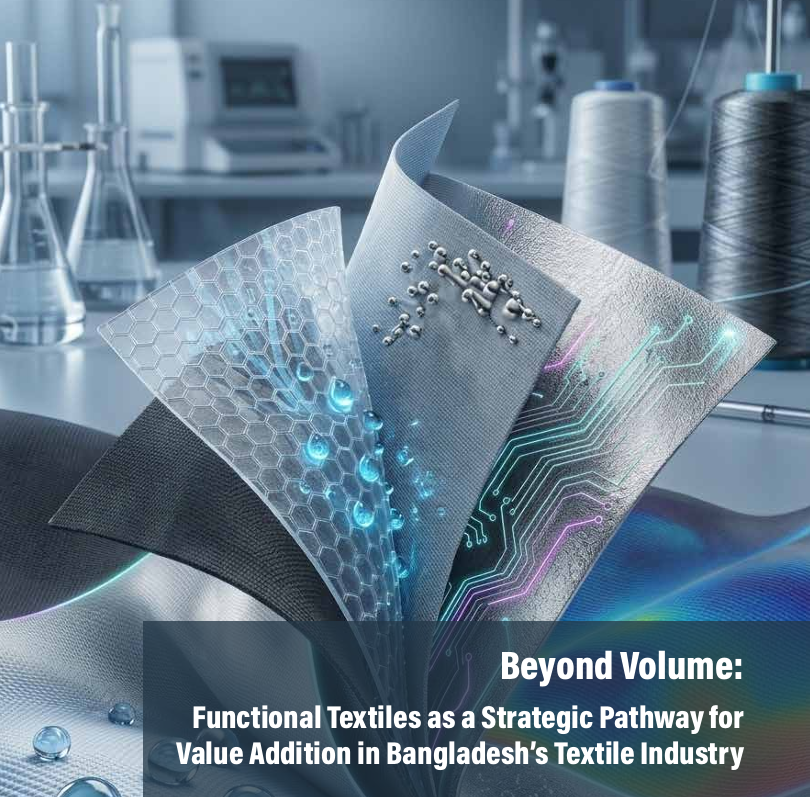
Bangladesh’s textile and ready-made garment industry has become the country’s most important export sector, but its growth has relied overwhelmingly on high-volume production of basic apparel. That model is increasingly exposed to margin pressure, buyer concentration, rising compliance costs, and competition from other sourcing countries. Functional textiles create an alternative pathway because they raise product value through performance features rather than volume alone.
Incorporating functions such as moisture management, antibacterial performance, water repellency, UV protection, thermal regulation, and flame resistance allows manufacturers to differentiate fabrics for sportswear, workwear, outdoor apparel, medical textiles, and selected home-textile applications. The opportunity is particularly relevant for Bangladesh because a large portion of these functions can be introduced through dyeing and finishing, where the country already has a meaningful industrial base.
This report argues that functional textiles can serve as a practical value-addition strategy for Bangladesh if the transition is pursued in a phased way. The sector has useful strengths in wet processing, compliance, and export-oriented manufacturing, yet it also faces clear constraints: limited R&D, dependence on imported specialty inputs, insufficient testing infrastructure, and a product-development culture that is still largely buyer driven. A realistic roadmap should therefore begin with process upgrades, move into targeted product diversification, and then expand into more specialized performance and technical textile solutions.
2. Introduction
Over the last four decades, Bangladesh has emerged as one of the world’s leading apparel exporters. The industry contributes the majority of national export earnings and sustains millions of jobs across spinning, weaving, knitting, dyeing, finishing, and garment manufacturing. This achievement has been built on reliability, low cost, and scale. However, dependence on a narrow basket of basic items such as T-shirts, trousers, shirts, and sweaters has limited value capture.
The problem is not that volume-based production has failed; rather, it has reached a strategic ceiling. Basic apparel categories are highly price sensitive, buyer bargaining power is strong, and the room for meaningful margin growth is limited. At the same time, Bangladesh is preparing for a future in which preferential trade advantages may weaken and international competition may intensify further.
Meanwhile, global apparel and textile demand is changing. Buyers and consumers increasingly seek products that provide comfort, durability, safety, hygiene, and weather protection alongside style. Growth in activewear, workplace uniforms, medical products, and outdoor garments indicates that value is moving toward performance. Bangladesh therefore needs an upgrading path that does not depend solely on becoming cheaper or larger. Functional textiles offer such a path because they connect existing manufacturing capability with higher-value market demand.
3. Concept of Functional Textiles
Functional textiles are materials designed to perform specific tasks in addition to basic aesthetic and comfort functions. In conventional apparel, a fabric may only need acceptable hand feel, appearance, and durability. In functional textiles, the fabric must also deliver measurable performance. Examples include transporting sweat away from the body, resisting bacterial growth, repelling water, protecting the wearer from heat or flame, or maintaining body temperature under changing conditions.
These properties can be introduced at several stages of production. Fiber selection is important when performance depends on material composition, such as synthetic or blended fibers used in sportswear. Fabric engineering matters when knit or woven structure affects breathability, elasticity, or insulation. Finishing and coating become critical when the desired function is applied after fabric formation, as in water repellency, wrinkle resistance, or antimicrobial treatment.
For Bangladesh, the most realistic immediate opportunity lies in the finishing stage because the country already has substantial wet-processing capacity. This makes functional textiles a practical extension of current capability rather than an entirely new industrial direction. It also means the transition can start with commercially proven technologies rather than waiting for advanced smart-textile development.
4. Global Market Trends of Functional Textiles
The international textile market is increasingly shaped by performance requirements. Active lifestyles have raised demand for moisture-wicking, breathable, and quick-drying garments. Industrial and workplace applications require abrasion resistance, flame retardancy, and weather protection. Healthcare-related demand has highlighted hygiene, antimicrobial treatment, and barrier protection. Outdoor and travel segments continue to value water repellency, UV protection, and thermal comfort.
Sustainability is also reshaping the functional textile landscape. Global brands are no longer interested in performance at any cost; they increasingly demand safer chemistry, reduced environmental impact, and compliance with stricter chemical restrictions. This has accelerated interest in PFAS-free repellents, low-toxicity antimicrobial systems, and durable finishes that reduce the need for repeated treatment or replacement.
From a competitive perspective, functional textiles help move suppliers away from direct commodity-style price competition. Products are evaluated more on technical performance, reliability, and consistency, which can improve margins and deepen buyer relationships. That is why countries such as China, Vietnam, and India have invested in functional and technical textile capabilities as part of broader industrial upgrading.
5. Bangladesh Industry Capability Analysis
Bangladesh enters this discussion with several advantages. The country has a large manufacturing base, long experience in export production, and a sizable labor force familiar with international quality and compliance requirements. In addition, the textile sector has built significant wet-processing capacity, including dyeing and finishing operations capable of applying a range of basic value-added treatments.
This foundation matters because many mills already perform wrinkle-free finishing, easy-care treatment, softening, anti-pilling improvement, durability enhancement, and selected water-repellent applications. These are not the most advanced functions, but they demonstrate that local firms already possess part of the process knowledge required for a functional textile strategy.
Bangladesh also has a growing reputation in environmental compliance, with many internationally recognized green factories. This can become a strategic advantage if functional products are developed alongside safer chemistry and responsible processing. At the same time, current capability remains uneven, and many producers still depend on imported chemicals, buyer-led specifications, and limited internal technical development.
6. Gap Analysis: Bangladesh vs. Global Competitors
Despite its production scale, Bangladesh lags behind major competitors in several areas relevant to functional textiles. China has achieved broad leadership through integrated supply chains, strong R&D, advanced materials capability, and high machinery intensity. Vietnam has strengthened its role in sportswear and synthetic performance apparel by aligning closely with global brands and investing in product-development capability. India has diversified into technical textiles, specialty fabrics, and engineered applications with support from domestic raw materials and targeted policy attention.
Bangladesh remains more concentrated in basic cotton-based apparel and a limited number of product categories. Its export strength is substantial, but its international image is still tied mainly to low-cost, large-volume manufacturing. This affects not only product mix but also market perception, since buyers may not immediately associate the country with performance-driven sourcing.
The most important capability gaps are weak R&D culture, limited in-house product engineering, underdeveloped testing and certification infrastructure, dependence on imported functional inputs, and insufficient collaboration between industry and academic institutions. Closing these gaps will be essential if Bangladesh wants to compete in higher-value textile segments rather than merely defend its current position in basics.
Comparative Summary
| Country | Current Strength | Functional Advantage | Relevance for Bangladesh |
|---|---|---|---|
| China | Scale plus advanced integration | R&D, smart and technical textiles, rapid commercialization | Shows the value of deep supply-chain capability and innovation investment |
| Vietnam | Brand-linked apparel sourcing | Sportswear, synthetic and blended performance products | Demonstrates how buyer alignment can accelerate movement into functional apparel |
| India | Diversified textile base | Technical textiles, specialty fabrics, domestic raw-material support | Highlights the role of policy support and diversified inputs |
| Bangladesh | Large-scale apparel production | Early-stage finishing capability and compliance strengths | Needs to convert process strength into product and innovation strength |
7. Functional Textiles as a Value-Addition Strategy
Functional textiles create value in ways that conventional mass production cannot. First, they allow existing fabrics to be upgraded through finishing and process control, increasing selling price without requiring a complete transformation of the production base. Second, they reduce direct price pressure because buyers evaluate function, durability, and compliance in addition to cost. Third, they enable entry into product segments that are less exposed to fast-changing fashion cycles and therefore often more stable.
For Bangladesh, one of the strongest strategic arguments is that value addition can begin with finishing-led improvements. A mill producing standard knit or woven fabrics can often improve its market position by adding moisture management, easy-care treatment, repellency, or hygiene features to products that already fit existing demand. That makes functional textiles a scalable strategy for firms that cannot invest immediately in advanced machinery or specialty raw materials.
There is also a relationship benefit. When suppliers contribute to product performance and end-use optimization, they become more than low-cost producers. They begin to participate in technical problem solving, which can deepen partnerships with buyers and improve long-term competitiveness. In an era of supply-chain consolidation, this type of capability matters.
8. Application Areas for Bangladesh
The most realistic near-term opportunity lies in sportswear and activewear. Bangladesh already has strong knitwear capacity, and performance enhancements such as moisture wicking, anti-odor treatment, quick drying, and stretch comfort can be integrated relatively efficiently. This segment also benefits from long-term global growth trends linked to health, fitness, and lifestyle change.
Workwear and protective clothing represent another promising field. Unlike fashion apparel, workwear often prioritizes durability, safety, and consistency over seasonal design. Water repellency, abrasion resistance, flame-resistant treatments, and easy-care properties can increase unit value and support more stable demand. Selected medical and hygiene textiles also deserve attention, especially in basic applications where antibacterial treatment, barrier performance, and cleanability are important.
Bangladesh can also target outdoor apparel, functional home textiles, and sustainable functional products such as PFAS-free repellent fabrics or lower-impact antimicrobial solutions. The key is not to attempt all segments at once, but to identify applications where existing production capabilities can be upgraded with manageable technical and financial risk.
9. Strategic Roadmap for Integration
A phased transformation model offers the most practical route. In the short term, every company should focus on process-based value addition within current finishing systems. This stage includes wrinkle resistance, water repellency, basic antibacterial and odor-control treatment, and durability enhancement. The goal is immediate differentiation with relatively low investment.
In the medium term, the emphasis should shift to product development and diversification. Firms need dedicated technical teams, stronger sampling capability, deeper collaboration with chemical suppliers, and closer engagement with buyers in product design. At this stage, performance knitwear, functional woven workwear fabrics, and upgraded home-textile products become realistic targets.
In the longer term, leading firms can move toward innovation-led and solution-based production in selected technical textile segments. This includes higher-specification protective products, specialized medical textiles, and sustainable performance solutions. Government support, stronger testing capacity, and applied research partnerships will be necessary to sustain this stage.
Functional Transformation Model
| Stage | Primary Focus | Typical Actions | Expected Outcome |
|---|---|---|---|
| Short term | Process-based value addition | Upgrade finishing for repellency, easy care, hygiene, durability | Higher unit price and faster product differentiation |
| Medium term | Product diversification | Build technical teams, sampling, supplier collaboration, segment targeting | Entry into sportswear, workwear, home textiles, and selected medical uses |
| Long term | Innovation-led solutions | Expand testing, applied R&D, specialized technical products, sustainable performance systems | Stronger global positioning and reduced dependence on commodity competition |
10. Challenges and Constraints
The shift toward functional textiles faces cost barriers. Specialty chemicals, coatings, modified processes, and validation testing all raise production costs. For firms operating on thin margins, especially SMEs, this can discourage experimentation. Buyers may also resist higher prices unless the value proposition is clearly demonstrated and performance is consistent.
Dependence on imported specialty inputs remains another major challenge. Functional chemistry, synthetic fibers, and engineered auxiliaries often need to be sourced from abroad, which increases lead time, cost volatility, and supply risk. The absence of strong local testing and certification infrastructure compounds the problem because firms may need external validation to prove product performance.
Skills and market perception also matter. Functional textiles require knowledge of chemistry, standards, and end-use engineering that is still limited in many factories. At the same time, Bangladesh must overcome the perception that it only supplies low-cost basics. Consistent quality, technical credibility, and environmentally compliant solutions will be necessary to build confidence in higher-value offerings.
11. Conclusion
Bangladesh’s textile industry has reached a point where future competitiveness will depend less on producing more of the same and more on producing higher-value products with stronger differentiation. Functional textiles offer a realistic and scalable path because they align with existing strengths in manufacturing and wet processing while opening access to faster-growing and better-margin market segments.
The transition will require more than isolated factory upgrades. It will demand a coordinated effort involving firms, government agencies, chemical and machinery suppliers, universities, and testing institutions. The most effective approach is phased: start with commercially viable finishes, move into targeted product diversification, and gradually build innovation capacity in selected technical and sustainable textile areas.
If Bangladesh can combine process capability, product development, testing support, and sustainability-oriented compliance, functional textiles can become a central instrument for moving the industry from volume dependence toward a more resilient value-added growth model.
12. Priority Actions for Stakeholders
- Manufacturers should allocate part of their capacity to pilot functional products rather than waiting for complete transformation.
- Large mills should establish small cross-functional R&D and product-development teams focused on performance finishes and end-use applications.
- Chemical and machinery suppliers should be engaged as capability partners, not only as vendors, to support trials, process tuning, and training.
- Government should expand accredited testing and certification facilities and provide incentives for value-added and sustainable textile production.
- Universities and institutes should align coursework and applied research with functional finishing, textile chemistry, and performance evaluation.
- Industry associations should promote Bangladesh internationally as a growing source of compliant and value-added textile solutions.
References
- Export Promotion Bureau (EPB). Export statistics of Bangladesh 2024-2025.
- Bangladesh Garment Manufacturers and Exporters Association (BGMEA). Annual report on RMG export performance.
- International Trade Administration. Bangladesh: Textiles and Apparel Sector Overview.
- Bangladesh Investment Development Authority (BIDA). Textiles and apparel sector overview.
- Observatory of Economic Complexity (OEC). Bangladesh textile export profile.
- UNCTAD. Trade and development report.
- International Trade Centre (ITC). Global apparel value chain and competitiveness report.
- Horrocks, A. R., and Anand, S. C. Handbook of Technical Textiles.
- Scott, R. A. (Ed.). Textiles for Protection.
- Karthik, T., and Gopalakrishnan, D. Sustainable Fibres and Textiles.
- Fletcher, K. Sustainable Fashion and Textiles: Design Journeys.
- Centre for Policy Dialogue (CPD). Export competitiveness and structural challenges in Bangladesh textile industry.
- Textile Today. Value addition and product diversification in Bangladesh apparel sector.
Author Profile
K. M. Ziauddin Mahamud is a textile professional with extensive experience spanning textile engineering, product development, marketing, sales and business management. He currently serves as Manager, Sales and Marketing (Fashion) at Zaber and Zubair Fabrics Ltd., where he is responsible for global business development and works closely with international buyers to drive innovation in value-added and sustainable woven fabric solutions.