Introduction
Yarn costing in spinning mills has traditionally been managed through a combination of practical experience and post-production analysis. Over time, systems and ERP solutions have been introduced; however, achieving accurate and timely cost visibility continues to remain a challenge.
Based on long-term industry experience—from manual costing practices to system-driven implementations—it is observed that the issue is not the absence of data, but the lack of structured alignment between mill operations and costing.
This paper highlights key gaps in current practices and presents a practical approach to improve yarn cost estimation and cost visibility.
Nature of Yarn Costing in Spinning Mills
Yarn costing is dynamic and influenced by multiple operational factors:
- Raw material selection and mixing
- Waste generation across processes
- Production efficiency
- Machine utilization
- Conversion costs
Even small variations in these parameters can significantly impact the final yarn cost. Therefore, costing cannot be treated as a static or isolated calculation.
Impact of Raw Material Mixing
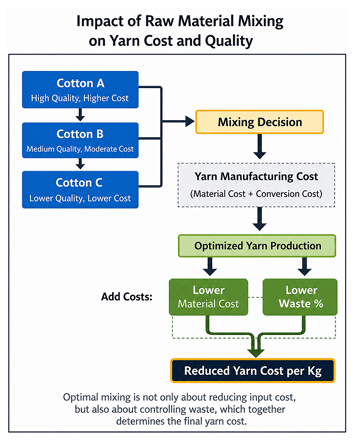
In most spinning mills, yarn is produced by blending multiple cotton varieties to achieve the desired quality and count.
The proportion of mixing plays a critical role:
- Higher quality inputs increase cost but may reduce waste.
- Lower quality inputs reduce cost but may increase waste.
Thus, mixing decisions influence both material cost and waste generation, which together determine the final yarn cost.
In practice, these decisions are often experience-driven. However, without system-based evaluation, exploring alternative mixing options and identifying the most cost-effective combination becomes limited.
Waste and Its Cost Impact
Waste is one of the most sensitive components in yarn costing.
A small increase in waste percentage can:
- Increase raw material consumption
- Reduce output quantity
- Increase cost per unit of yarn
Although waste is monitored in most mills, its direct linkage to costing at each process level is not always clearly established. This limits the ability to control cost variations effectively.
Production Efficiency and Cost Variation
Production performance directly influences conversion cost.
Factors such as:
- Machine efficiency
- Downtime
- Production volume
affect cost per kg of yarn. Variations in production levels lead to changes in cost, which may not be clearly visible without proper integration between production data and costing.
Cost Estimation Before Production
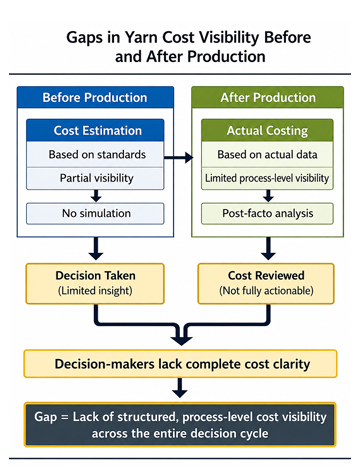
Cost estimation before production is a well-established and essential practice in spinning mills. It supports planning and decision-making related to raw material selection, mixing ratios, and production strategy.
However, in many cases, its practical effectiveness is constrained by:
- Dependence on individual mill standards
- Partial visibility of cost components
- Lack of structured simulation capabilities
As a result, decisions are often taken with limited insight into the full cost impact.
Actual Costing After Production
While actual costing is performed after production based on real data, it also has practical limitations in many mills.
In several cases:
- Costing is not carried out at process level.
- Data is not structured for decision-making.
- Cost information is not presented in a clear, actionable format.
As a result, even though data is available, it does not always provide complete cost visibility to decision-makers.
Core Gap in Yarn Costing
The key issue in yarn costing is not limited to estimation or actual costing alone.
In most mills:
- Data exists across different functional areas.
- However, it remains fragmented.
- And is not structured to support process-level cost visibility.
Therefore:
The challenge is not the absence of data, but the absence of structured integration.
This leads to a situation where:
- Decisions are taken with partial visibility.
- Cost analysis after production is not fully actionable.
Importance of Process-Level Data Integration
To improve yarn costing, it is essential to align data at each process stage.
Each stage of production should provide:
- Input details
- Output and waste
- Associated cost
When this data is structured and integrated:
- Cost can be tracked process-wise.
- Deviations can be identified early.
- Decision-making becomes more effective.
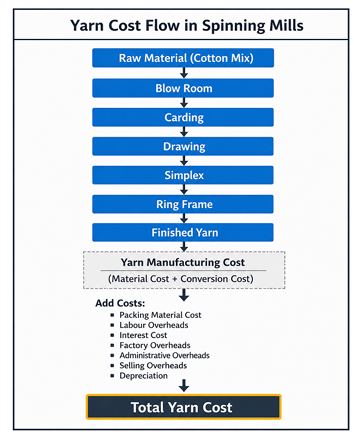
Yarn Cost Build-up from Raw Material to Total Yarn Cost
Role of Industry-Specific ERP Systems
What is required is not just system implementation, but a properly designed, industry-specific ERP framework.
Such a system should:
- Integrate process-level data with costing logic.
- Support simulation of mixing and production scenarios.
- Capture and align operational data for costing.
- Provide clear visibility of cost before and after production.
This enables:
- Informed decision-making
- Improved cost control
- Better alignment between operations and costing
The objective is not to replace experience, but to enhance it with structured data and system support.
Conclusion
Yarn costing continues to be a critical yet challenging function in spinning mills.
The primary issue lies not in the availability of data, but in how that data is structured and used.
By focusing on:
- Process-level data integration
- Improved cost visibility
- System-supported decision-making
mills can significantly enhance their ability to estimate, monitor, and control yarn cost.
The future of yarn costing lies in combining industry experience with structured system design to enable more accurate and proactive decision-making.
Author Bio
Lakshmanan Thirunavukkarasu, M.Sc., P.G.Dip.O.R (Operations Research), Managing Director of Sudarshan Software Exports Limited, has over three decades of experience in textile spinning mills, specializing in yarn costing, process analysis and ERP implementation. His work includes cost estimation, process mapping and integrating mill operations with structured costing systems, with ERP projects also implemented in Bangladesh. He authored Standard Cost Estimation of Yarn Manufacturing – A Scientific Approach, focusing on process-level accuracy and cost visibility, and is associated with cloud-based ERP platforms such as p4pops.com for standard costing, budgeting, production planning and process-wise machine balancing.