Enhancing Durability of Knitting Components Under Abrasive Yarn Conditions
Technical Insights and Industry Perspective
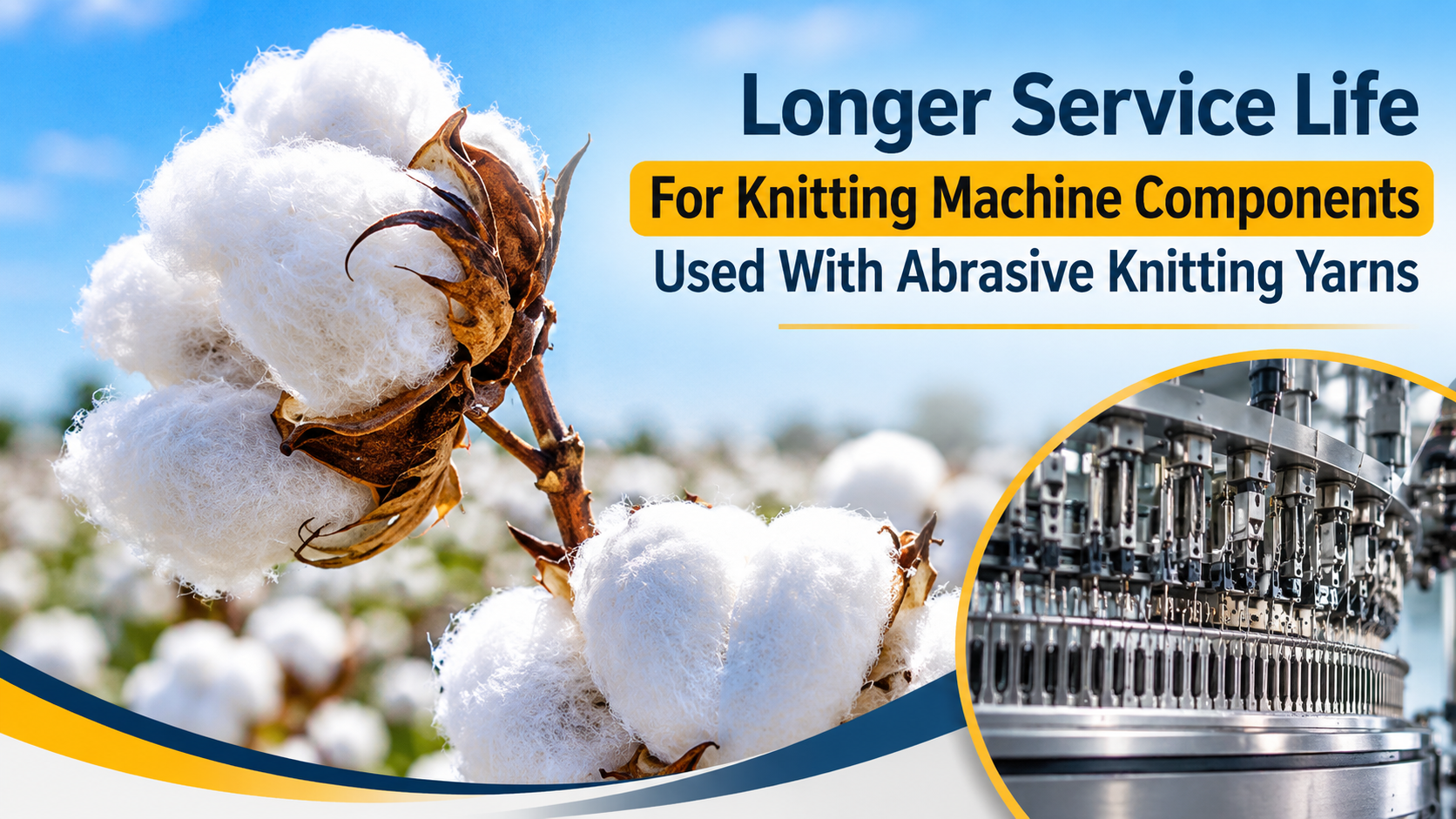
In modern knitting operations, the increasing use of abrasive yarns—both natural and synthetic—has emerged as a critical factor influencing the service life of key machine components such as needles and sinkers. While these yarns enable diversified product development and cost efficiency, they simultaneously accelerate wear and compromise machine performance if not managed properly.
In situations where knitting yarns that cause heavy wear are used, the service life of needles and sinkers can be considerably shortened. In order to increase the service life of these parts, while maintaining high levels of knitting quality, Groz-Beckert offers the following solutions:
- Absolute precision in every product detail
- Specially developed product features and adapted knitting machine components
- Customer-oriented product and application consulting
Use of Abrasive Natural Fiber Yarns in Knitting
Natural Fiber Yarns
Natural fibers, particularly cotton, often contain foreign particles such as sand and silicates, which are inherently harder than steel. These impurities originate from cultivation conditions, harvesting methods, and post-harvest processing (ginning).
From a structural perspective, differences between ring-spun and open-end (rotor) yarns are significant. Rotor-spun yarns, while cost-effective, tend to incorporate shorter fibers and higher contamination levels, increasing their abrasive potential.
During knitting, these particles accumulate in critical zones such as needle hooks and latch openings. Repeated mechanical action—especially latch movement—combined with friction leads to:
- Progressive material wear
- Surface deformation
- Eventual component failure (e.g., latch or hook breakage)
These photographs taken with a scanning electron microscope show the possible differences between ring-spun yarn and OE rotor yarn in their surface as well as the impurity levels in the yarn. The rotor spinning method permits a reduction of process in the preparation for spinning. It consequently allows cotton fibers to be processed, which are shorter or more contaminated. The resulting risk is that these yarns cause greater wear on knitting machine components.
Natural Fiber Yarns in the Knitting Process
Typical Wear Characteristics in Knitting Machine Components Used with Abrasive Natural Fiber Yarns
Example: Latch Needle
The impurities, marked in red, accumulate in the openings. These impurities, combined with the resulting impact force and friction applied, cause wear on the needle every time the latch opens and closes. This can even result in needle breakage (in this case breakage of the latch).
Use of Abrasive Artificial Fiber Yarn
Artificial Fiber Yarns
Artificial fiber yarns can also cause wear. Titanium dioxide is used as a matting agent for fibers such as polyester filaments. Sometimes titanium dioxide micro crystals protrude from the surface of the filaments and act like a saw on the surface of the needle or sinker during the loop-forming process.
This causes premature wear with a ‘sawing’ effect, and consequently severe local abrasion of the needle material.
The abrasiveness of matted artificial fibers can vary between batches and colors or differences in the spinning process.
Artificial Fibers in the Knitting Process
Typical Wear Characteristics on Knitting Machine Components Used with Abrasive Artificial Fiber Yarns
The sawing effect of these yarns can cause sawn grooves in the surface of needles or sinkers. With needles it is usually the inside radius of the hook. Sometimes the latch shank or needle cheek can be affected as well. In a knocking-over/holding-down sinker, usually the knocking-over edge is mostly worn out.
EFFECTS OF ABRASIVE KNITTING YARNS
| On needles | On sinkers |
|---|---|
| Premature wear at the needle hook, needle latch seat, at the latch shank and in the latch, bearing have the following effects:• Sharp rim of latch spoon• Latch breakage (latch spoon breakage or latch head breakage)• Hook breakage• Extreme latch play (radial and axial)• Loss of latch | Premature wear (sawing effect) is usually visible on the knocking-over edge….on the knitted fabricAs a result of the wear on needles or sinkers described here, the quality of the knitted fabric can be severely impaired:• Formation of vertical lines or uneven loop structure• A hairy surface on the knitted fabric caused by damaged/cut filaments• Faults caused by damaged yarn or damaged fibers or filaments• Holes or dropped stitches |
OPTIMIZATION OF PRODUCTION PROCESSES WITH GROZ-BECKERT TECHNOLOGY
| Maintenance and product care | Recommendations |
|---|---|
| The use of abrasive knitting yarns requires not only highly-developed knitting machine components by Groz-Beckert, but also greater attention to the maintenance and care of knitting machines. This applies in particular to the knitting head and to suitable machine adjustment. In cases where abrasive natural fibre yarns are used, the cleaning recommendations must be followed particularly closely. | • Shorter cleaning intervals that are suitable for the operating conditions• Regular and punctual cleaning of needles and sinkers in the machine• Regular and comprehensive cleaning of needles and sinkers in a cleaning bath• Use of a suitable cleaning oil with the ability to dissolve contamination• Correct machine adjustments to minimize friction and tensile strain• Correct machine adjustments (for example yarn carries position) to prevent damage to the knitting machine components |
Groz-Beckert Technology
Groz-Beckert has developed specialized technical features and products in order to guarantee the service life and functional reliability on knitting machine components, in daily use and under a very wider range of applications. In combination with correct maintenance and care, they can be used to reduce machine downtime and consequently production costs.
Conclusion
Abrasive yarns are no longer an exception but a growing norm in knitting. Extending the service life of machine components under such conditions requires a holistic approach—integrating material science, engineering innovation, and disciplined operational practices.
The future of competitive knitting lies not just in faster machines, but in smarter, more resilient production ecosystems.